Virginia SOL USI.7.a
The Standard
- USI.7
- The student will apply history and social science skills to describe the challenges faced by the new nation by
explaining the strengths, weaknesses, and outcomes of the government established by the Articles of Confederation
Virginia Standards of Learning for History and Social Science
Teacher's field guide
What This Standard Means
What Students Need to Do
- Students identify what the national government could and could not do under the Articles. They connect those limits to national debt, trade disputes, Shays’ Rebellion, and the Constitutional Convention.
What Mastery Looks Like
- A student can explain how Congress handled diplomacy and western settlement but lacked money and enforcement power. The student can link those limits to specific problems and the push for a new Constitution.
Common Misconceptions
- Students may picture a president and federal courts, but neither existed. They may think Congress could tax states or enforce its decisions. They may also overlook successes such as the land ordinances and Treaty of Paris.
How to Assess It
- Give students three headings: strength, weakness, and outcome. Have them place one accurate example under each heading, then explain one cause-and-effect link.
Lesson moves
Ways to Teach It
Give students cards for taxation, trade, war, treaties, and western lands, then have groups place each under Congress or the states.
Ask students to write: Which weakness most threatened the new nation, and what evidence supports your choice?
Run a cause-and-effect matching race using cards for unpaid debt, trade disputes, Shays’ Rebellion, and calls for a stronger government.
Compare Congress under the Articles with a student council that can make rules but cannot collect dues or enforce decisions.
Free download
Printable USI.7.a Worksheet
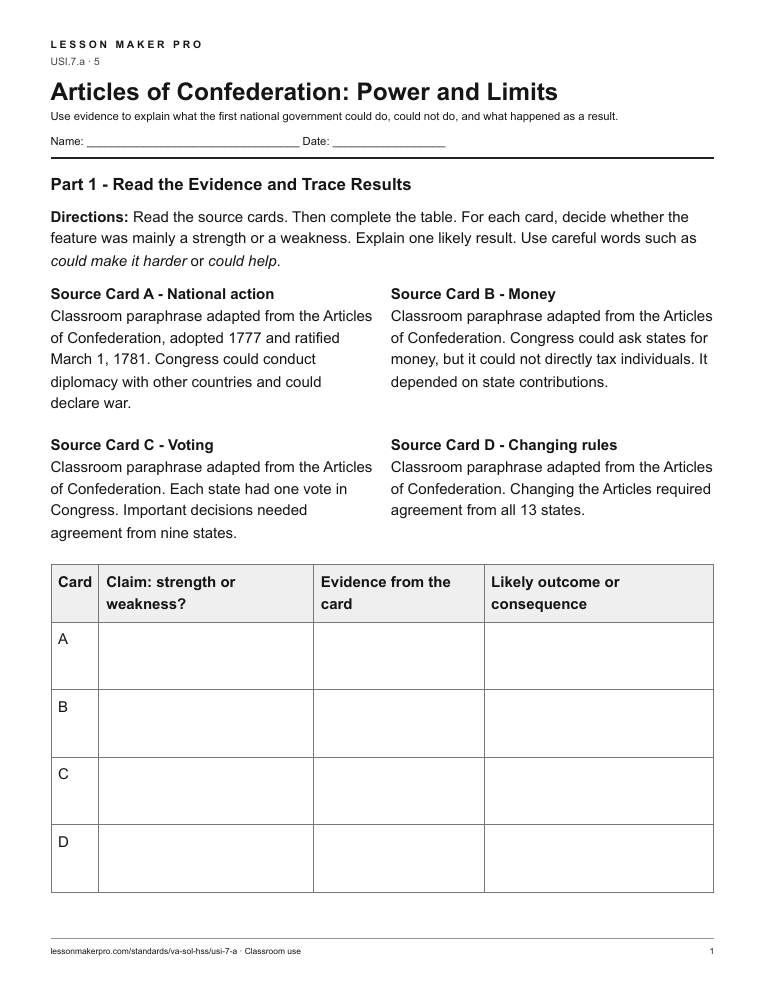
A ready-to-print activity worksheet aligned to USI.7.a, with an answer key for the teacher on its own page. No account needed.
PDF, US Letter, prints cleanly in black and white.
Download the worksheetKeep exploring
Related Standards
- 3.9.b
explaining how the Constitution supports the structure of the United States government
- CE.1.a
explaining the fundamental principles of limited government, republicanism, federalism, checks and balances, separation of powers, and popular sovereignty
- CE.1.c
comparing and contrasting debates, compromises, and plans surrounding the drafting and ratification of the Constitution of the United States and the Bill of Rig...
- CE.1.e
explaining the fundamental concepts of the U.S. government including, but not limited to due process, equal justice under the law, equal protection, elections a...
Turn this exact standard into a lesson
Grade, subject, topic, and the complete standard are prefilled. Create one free, no account needed.
Also for this standard:Make a WorksheetMake a QuizMake a Sub Lesson