Virginia SOL USI.7
SOL Standard (Skills Cluster)
The student will apply history and social science skills to describe the challenges faced by the new nation by explaining the strengths, weaknesses, and outcomes of the government established by the Articles of Confederation; describing the Constitutional Convention and the development of the Constitution of the United States, with an emphasis on the role of James Madison; examining constitutional issues debated, including the role of the national government and the debate over ratifying the Constitution, the influence of the Federalist Papers, and the reasons for the addition of the Bill of Rights; explaining the Three-Fifths Compromise; and examining the three branches of government.
Virginia Standards of Learning for History and Social Science
Cluster contents
Skills in This Standard
USI.7 is a Standards of Learning history and social science standard. These are the skills expectations under it.
- USI.7.a
explaining the strengths, weaknesses, and outcomes of the government established by the Articles of Confederation
- USI.7.b
describing the Constitutional Convention and the development of the Constitution of the United States, with an emphasis on the role of James Madison
- USI.7.c
examining constitutional issues debated, including the role of the national government and the debate over ratifying the Constitution, the influence of the Fede...
- USI.7.d
explaining the Three-Fifths Compromise
- USI.7.e
examining the three branches of government
Teacher's field guide
What This Cluster Means
What Students Need to Do
- Students compare the first national government with the Constitution and explain why leaders sought change. They trace convention and ratification debates, including Madison's work, the Federalist Papers, the Bill of Rights, and the Three-Fifths Compromise. They identify each branch and explain its main job.
What Mastery Looks Like
- A student can name a strength and weaknesses of the government under the Articles, then connect those weaknesses to changes in the Constitution. The student can explain both sides of ratification and why a bill of rights helped win support. The student can describe the branches and explain how the Three-Fifths Compromise affected representation and taxation.
Common Misconceptions
- Students often think the Articles were the same as the Constitution, or that a president led the nation under the Articles. Some think Federalists opposed ratification, or that the Federalist Papers were laws. They may say the Three-Fifths Compromise made each enslaved person three-fifths human, rather than recognizing it as a counting rule that increased slaveholding states' power.
How to Assess It
- Exit ticket: Name one weakness under the Articles, identify the constitutional change that addressed it, and explain which branch uses that power.
Lesson moves
Ways to Teach It
Give groups branch cards, power cards, and scenario cards, then have them build and defend a three-column government chart.
Ask students to write as a Federalist or Anti-Federalist: Should your state ratify before a bill of rights is added?
Run a matching game where teams pair problems, compromises, people, documents, and outcomes, then explain each match for a point.
Use a school rule dispute to compare weak central authority with shared powers and separate decision-making roles.
Free download
Printable USI.7 Worksheet
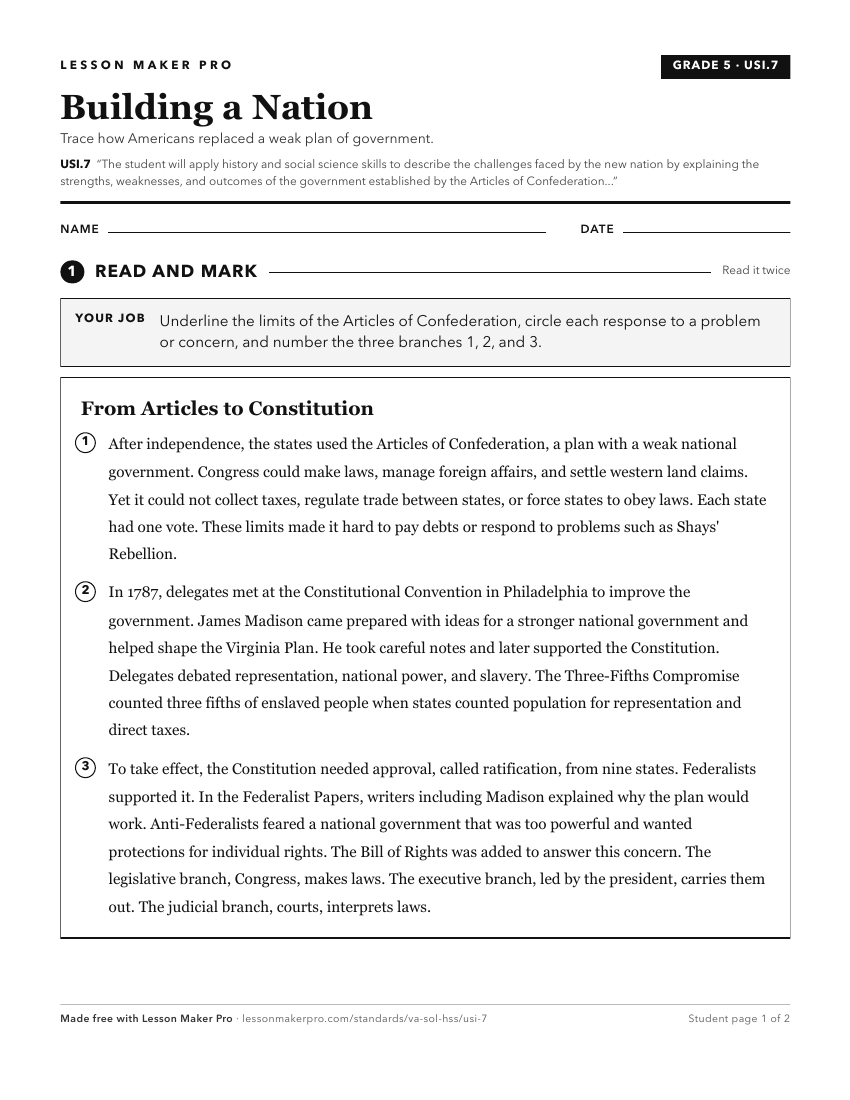
A ready-to-print activity worksheet aligned to USI.7, with an answer key for the teacher on its own page. No account needed.
PDF, US Letter, prints cleanly in black and white.
Download the worksheetKeep exploring
Related Standards
- USI.5
The student will apply history and social science skills to explain the social, political, religious, economic, and geographic factors that shaped colonial Amer...
- USII.4
The student will apply history and social science skills to explain the changing role of the United States from the late 19th century through World War I by
- 2.8
The student will apply history and social science skills to understand the principles of American democracy and relate them to the founding of the nation by
- VS.6
The student will apply history and social science skills to explain the establishment and growth of the new American nation with emphasis on the role of Virgini...
Turn this cluster into a lesson
Grade, subject, topic, and the complete cluster are prefilled. Create one free, no account needed.
Also for this cluster:Make a WorksheetMake a QuizMake a Sub Lesson