Virginia SOL USI.7.d
The Standard
- USI.7
- The student will apply history and social science skills to describe the challenges faced by the new nation by
explaining the Three-Fifths Compromise
Virginia Standards of Learning for History and Social Science
Teacher's field guide
What This Standard Means
What Students Need to Do
- Students explain why delegates argued over whether enslaved people should count toward state population totals. They describe the agreement to count three out of every five enslaved people for representation and direct taxes. They explain that it increased the political power of states where slavery was legal.
What Mastery Looks Like
- A student can connect population counts to seats in Congress and direct taxes. The student can explain who gained power and state that enslaved people received no vote, rights, or freedom from the agreement.
Common Misconceptions
- Students may think each enslaved person was literally declared three-fifths of a human. The fraction was used in a population formula, but the policy still treated enslaved people unjustly. It did not grant voting rights or weaken slavery.
How to Assess It
- Exit ticket: In three sentences, explain the disagreement, describe how enslaved people were counted for representation and taxes, and name who gained political power.
Lesson moves
Ways to Teach It
Give groups state cards with free and enslaved population totals; calculate representation populations using no count and the three-fifths rule.
Prompt: Did the compromise settle the delegates’ dispute fairly? Use representation, taxes, and the rights of enslaved people in your answer.
Play a card sort matching Northern and Southern delegate positions, the final counting rule, and its effect on political power.
Read a child-friendly census infographic and compare today’s whole-person count with the unequal counting rule used at the Constitutional Convention.
Free download
Printable USI.7.d Worksheet
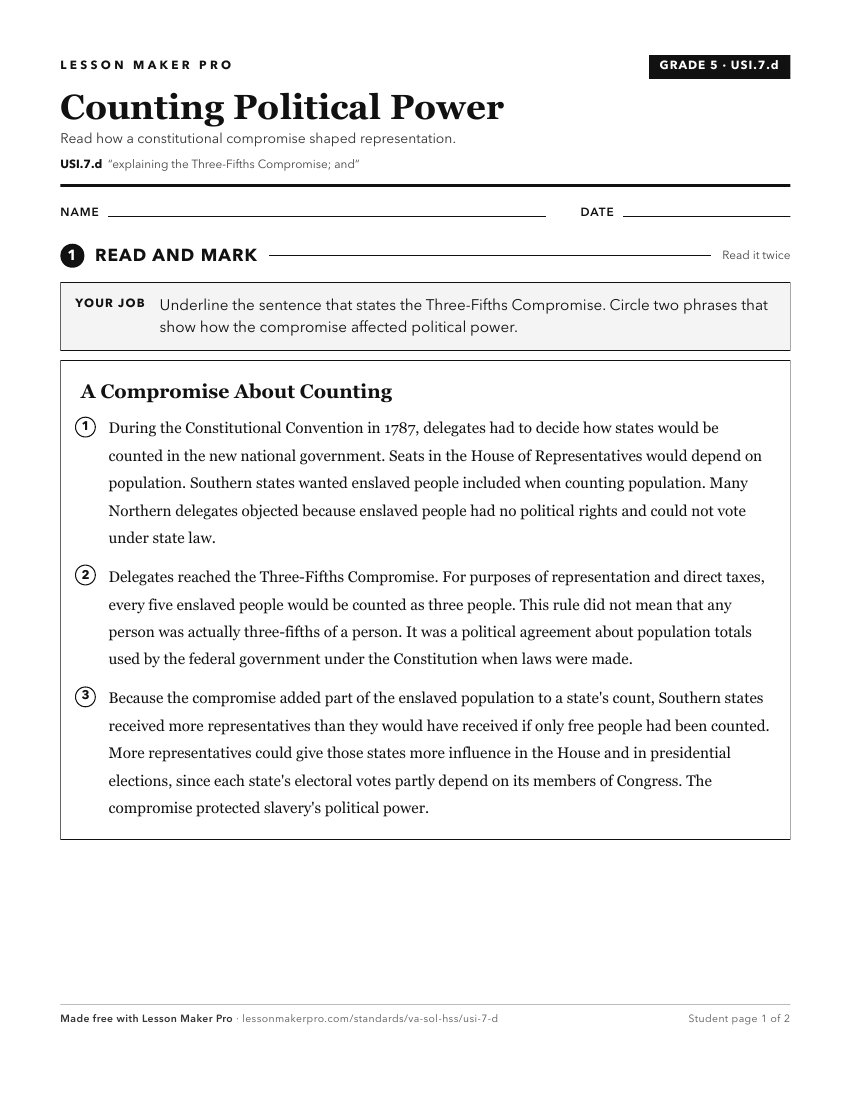
A ready-to-print activity worksheet aligned to USI.7.d, with an answer key for the teacher on its own page. No account needed.
PDF, US Letter, prints cleanly in black and white.
Download the worksheetKeep exploring
Related Standards
- 2.8.b
explaining the relationships between the colonies and Great Britain
- CE.3.d
explaining the relationship between state governments and the national government in the federal system, referencing Federalist No.10 and Federalist No. 51
- USII.2.d
describing the role of Congress and the Supreme Court in specific plans and policies including, but not limited to Lincoln’s Ten Percent Plan
- CE.3.b
explaining the state lawmaking process
Turn this exact standard into a lesson
Grade, subject, topic, and the complete standard are prefilled. Create one free, no account needed.
Also for this standard:Make a WorksheetMake a QuizMake a Sub Lesson