Virginia SOL USI.6.d
The Standard
- USI.6
- The student will apply history and social science skills to explain the American Revolution by
describing the leadership roles of individuals including, but not limited to George Washington, Benjamin Franklin, Thomas Jefferson, Patrick Henry, Thomas Paine, John Adams, and the Marquis de Lafayette
Virginia Standards of Learning for History and Social Science
Teacher's field guide
What This Standard Means
What Students Need to Do
- Students identify each leader and describe the action that made his leadership significant. They sort the leaders into military, political, diplomatic, and persuasive roles, then explain how those roles supported independence.
What Mastery Looks Like
- A student can match each leader to a specific contribution without mixing up writers, diplomats, and commanders. The student can explain how at least two contributions helped the colonies gain independence.
Common Misconceptions
- Students often say Washington wrote the Declaration of Independence or that every leader signed it. They may remember Franklin only as an inventor and miss his diplomacy in France. They may also assume Lafayette was American or confuse Adams's support for independence with Jefferson's writing role.
How to Assess It
- Exit ticket: Match all seven leaders to their actions, then choose two and explain how each action helped the colonies gain independence.
Lesson moves
Ways to Teach It
Give pairs leader cards and action cards to match, then have them sort the matches into military, political, diplomatic, and persuasive leadership.
Ask students to write: Which leader made the greatest contribution to independence, and what specific evidence supports your choice?
Play Who Am I by reading three action clues while teams identify the leader and record the evidence that confirmed their answer.
Have students compare the leaders' different jobs with roles on a school committee, such as speaker, writer, negotiator, organizer, and team captain.
Free download
Printable USI.6.d Worksheet
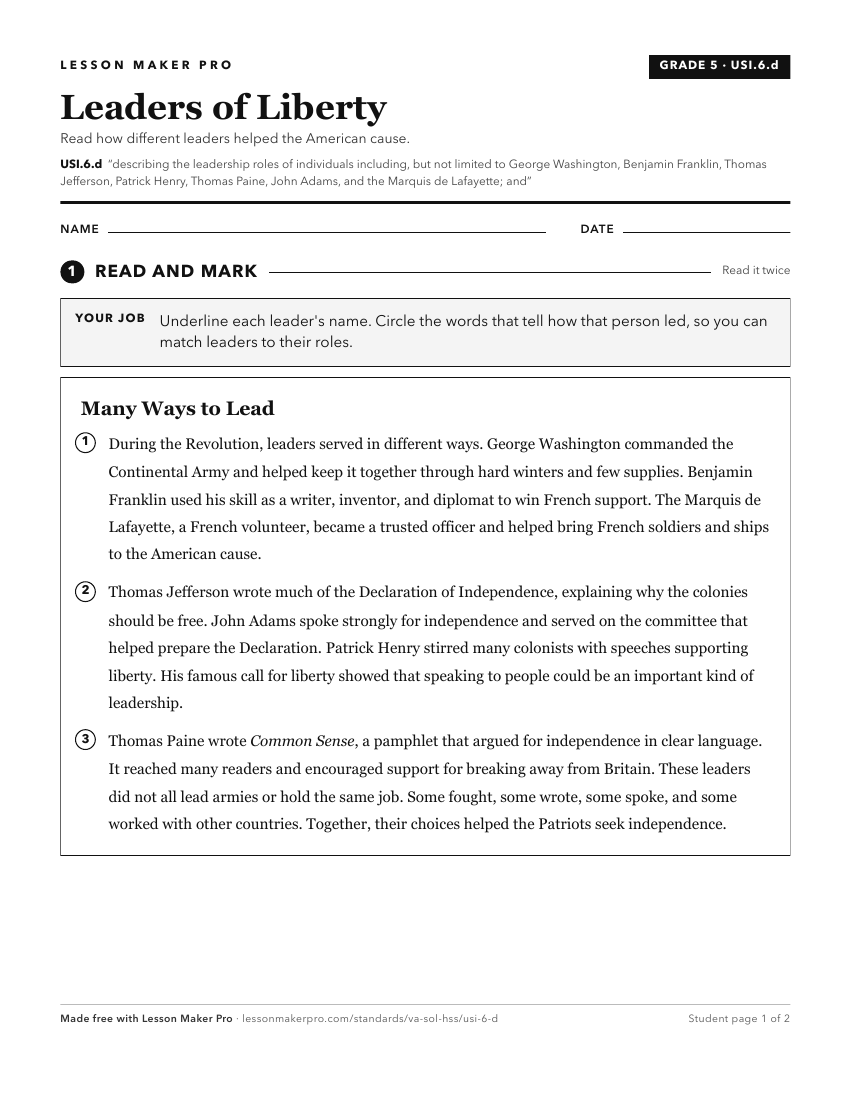
A ready-to-print activity worksheet aligned to USI.6.d, with an answer key for the teacher on its own page. No account needed.
PDF, US Letter, prints cleanly in black and white.
Download the worksheetKeep exploring
Related Standards
- 1.5.c
Presidents: George Washington, Thomas Jefferson, James Madison, and James Monroe
- VS.6.a
explaining the roles of George Washington (known as the “Father of Our Country”), James Madison (known as the “Father of the Constitution”), and Patrick Henry (...
- 2.7
The student will apply history and social science skills to describe the revolutionaries who fought for America’s freedom (1764–1781) including, but not limited...
- VS.7.f
identifying and explaining the leadership roles of Virginians including, but not limited to Thomas “Stonewall” Jackson, Robert E. Lee, William Harvey Carney, Wi...
Turn this exact standard into a lesson
Grade, subject, topic, and the complete standard are prefilled. Create one free, no account needed.
Also for this standard:Make a WorksheetMake a QuizMake a Sub Lesson