Virginia SOL USI.2.a
The Standard
- USI.2
- The student will apply history and social science skills to describe how early cultures developed throughout North America by
describing how archaeologists have recovered artifacts from ancient settlements including, but not limited to Cactus Hill in Virginia
Virginia Standards of Learning for History and Social Science
Teacher's field guide
What This Standard Means
What Students Need to Do
- Students explain how archaeologists locate, excavate, record, and study evidence left by early people. They use soil layers, stone tools, and hearth remains from Cactus Hill to make claims about the past.
What Mastery Looks Like
- Students can describe excavation steps in the correct order and explain why artifacts are mapped before removal. They can connect an artifact or soil layer to a reasonable conclusion about early settlement.
Common Misconceptions
- Students may think archaeologists search for dinosaur fossils or dig quickly to find treasure. They may assume deeper artifacts are always older, or that one artifact proves exactly when and how people lived.
How to Assess It
- Give students a diagram showing stone points and charcoal in two soil layers. Ask them to describe two archaeologist actions and one conclusion supported by the evidence.
Lesson moves
Ways to Teach It
Build a layered shoebox dig with sand, soil, charcoal, and replica tools, then have teams excavate, map, and bag each find.
Ask students to write: What can a stone point and an old hearth tell us, and what can they not prove?
Give teams excavation-step cards to arrange, then award a point when they justify why recording must happen before artifacts are removed.
Compare an archaeologist’s site map with a classroom lost-item map, showing how location helps explain who used an object and where.
Free download
Printable USI.2.a Worksheet
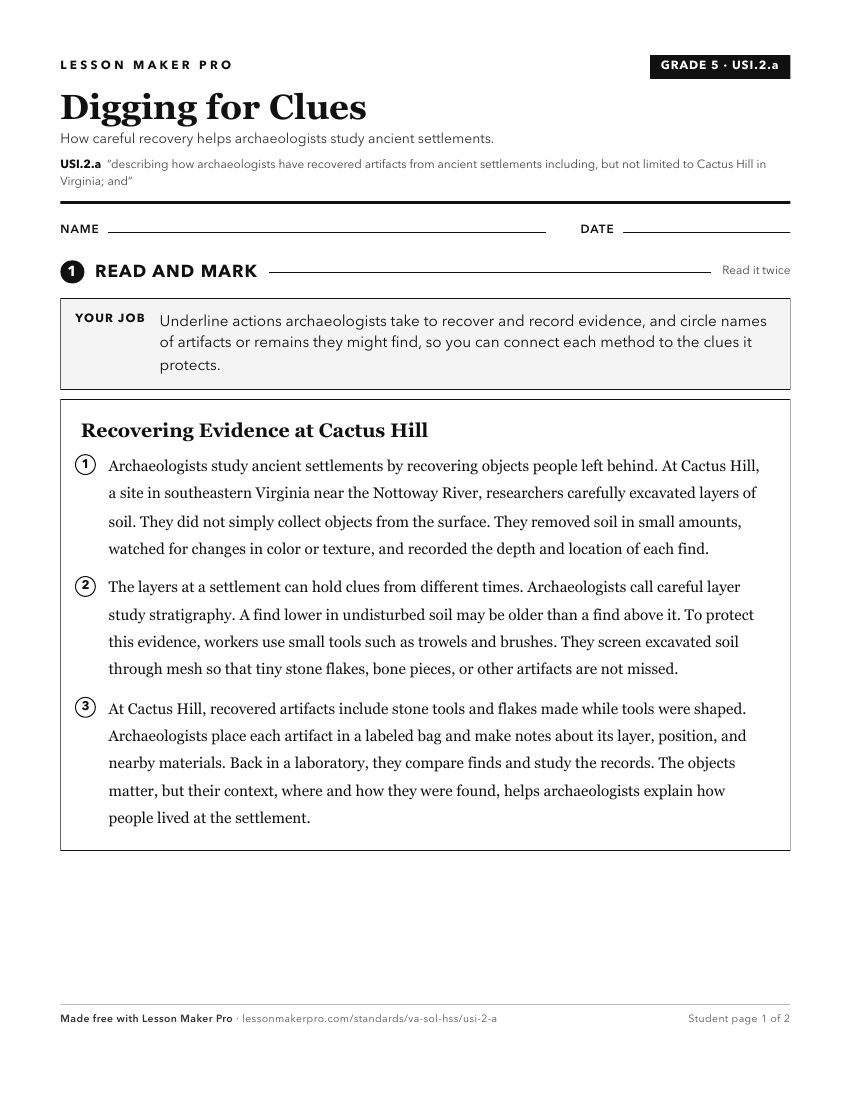
A ready-to-print activity worksheet aligned to USI.2.a, with an answer key for the teacher on its own page. No account needed.
PDF, US Letter, prints cleanly in black and white.
Download the worksheetKeep exploring
Related Standards
- VS.2.a
describing how archaeologists have recovered artifacts from important places in the history of Indigenous people including, but not limited to Werowocomoco
- 1.4.b
describing how life in various Virginia communities has changed over time
- VS.2.e
describing the lives and cultures of Virginia’s Indigenous People leading to the present day.
- VS.2.d
describing the relationships and interactions of Virginia’s Indigenous People and their environment, circa 1600
Turn this exact standard into a lesson
Grade, subject, topic, and the complete standard are prefilled. Create one free, no account needed.
Also for this standard:Make a WorksheetMake a QuizMake a Sub Lesson