Virginia SOL CE.9.d
The Standard
- CE.9
- The student will apply history and social science skills to explain the role of the media and social media as well as its influence on local, state, and national levels of government by
evaluating the effect of social media on political campaigns, politics, and civic discourse
Virginia Standards of Learning for History and Social Science · The student will apply history and social science skills to explain the role of the media and social media and the influence on local, state, and national levels of government by
Teacher's field guide
What This Standard Means
What Students Need to Do
- Students examine who created a political post, who is meant to see it, and how its message might spread. They judge how posts can increase participation, shape campaign messages, or weaken discussion through false claims and personal attacks. They support each judgment with details from the post or source.
What Mastery Looks Like
- Given several posts, a student can identify the creator, audience, purpose, claim, and supporting evidence. The student can compare likely effects on campaigns and public discussion at local, state, and national levels.
Common Misconceptions
- Students often treat likes and shares as proof that a claim is accurate. They may think their feed shows the full public debate, overlooking algorithms, paid targeting, and repeated sharing. They may also label social media as entirely helpful or harmful instead of judging each effect.
How to Assess It
- Show one teacher-created campaign post that makes a claim and displays a high share count. Ask students to identify the audience, judge one likely effect, and support that judgment with two details.
Lesson moves
Ways to Teach It
Give groups six printed mock posts to sort into informs, persuades, mobilizes, misleads, or inflames, then require one evidence note per card.
Ask students to write: Does social media improve political participation, harm civic discussion, or do both, and what evidence supports your view?
Play Source Check Relay with mock posts, awarding points for identifying the creator, claim, evidence, target audience, and missing context.
Compare printed official posts from a mayor, governor, and president, then note how each office uses social media to address constituents.
Free download
Printable CE.9.d Worksheet
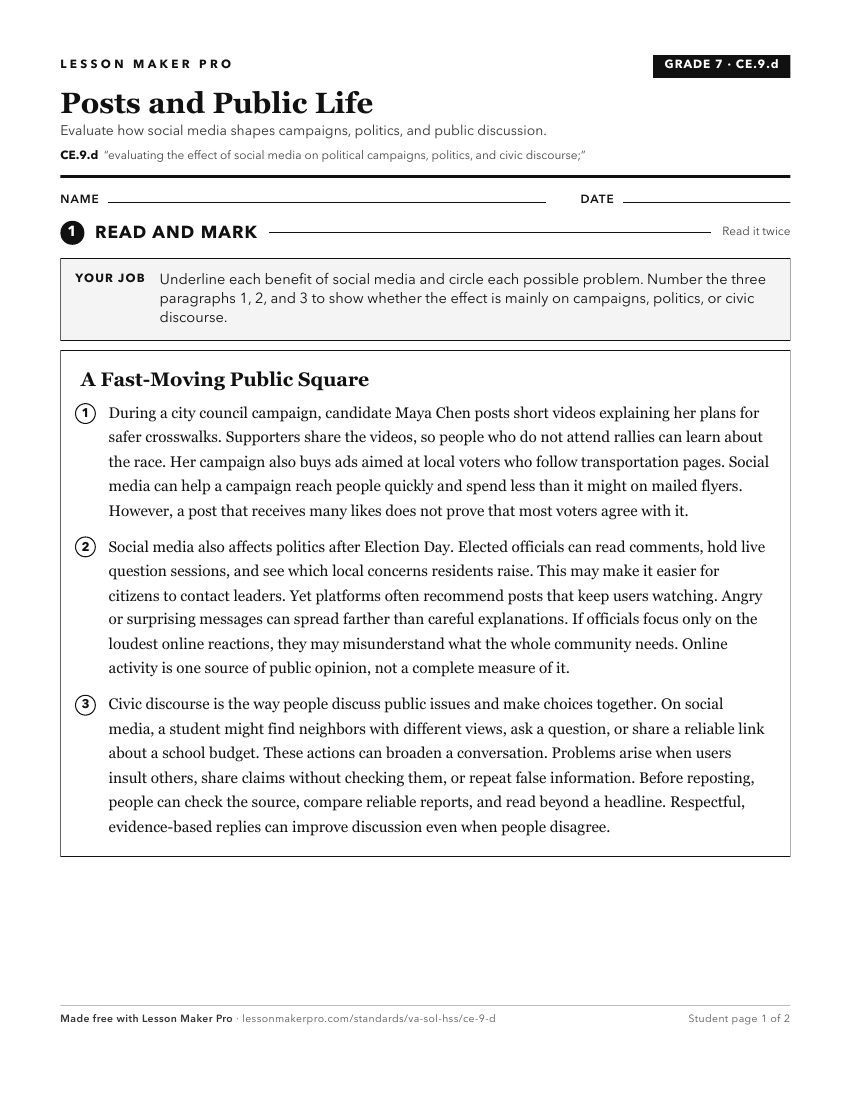
A ready-to-print activity worksheet aligned to CE.9.d, with an answer key for the teacher on its own page. No account needed.
PDF, US Letter, prints cleanly in black and white.
Download the worksheetKeep exploring
Related Standards
- CE.10
The student will apply history and social science skills to analyze the role of public participation in American civic life by
- CE.9
The student will apply history and social science skills to explain the role of the media and social media as well as its influence on local, state, and nationa...
- CE.8.b
analyzing campaigns for elective office, with emphasis on the roles of candidates, volunteers, the media, voters, and poll watchers
- CE.6.d
examining how civic participation can address community needs and serve the public good, including the importance of volunteering, staying informed about curren...
Turn this exact standard into a lesson
Grade, subject, topic, and the complete standard are prefilled. Create one free, no account needed.
Also for this standard:Make a WorksheetMake a QuizMake a Sub Lesson