Virginia SOL CE.9
SOL Standard (Skills Cluster)
The student will apply history and social science skills to explain the role of the media and social media as well as its influence on local, state, and national levels of government by explaining the role and rights of the press in reporting events; describing the effect biased reporting can have on public opinion; explaining the role that individuals play in the political policy-making process by expressing their opinions formally or informally via print media, electronic media, or in-person; evaluating the effect of social media on political campaigns, politics, and civic discourse; identifying the source of information and considering possible motivations or biases of its creator; and evaluating multiple sources describing the same event or idea and reflecting on the reasons for any discrepancies.
Virginia Standards of Learning for History and Social Science
Cluster contents
Skills in This Standard
CE.9 is a Standards of Learning history and social science standard. These are the skills expectations under it.
- CE.9.a
explaining the role and rights of the press in reporting events
- CE.9.b
describing the effect biased reporting can have on public opinion
- CE.9.c
explaining the role that individuals play in the political policy-making process by expressing their opinions formally or informally via print media, electronic...
- CE.9.d
evaluating the effect of social media on political campaigns, politics, and civic discourse
- CE.9.e
identifying the source of information and considering possible motivations or biases of its creator
- CE.9.f
evaluating multiple sources describing the same event or idea and reflecting on the reasons for any discrepancies.
Teacher's field guide
What This Cluster Means
What Students Need to Do
- Students explain how news outlets and online platforms shape what people know and believe about government. They identify sources, motives, evidence, loaded language, and missing context. They compare accounts and choose effective ways to share views with officials or the public.
What Mastery Looks Like
- Students can compare two reports of one event and explain why their details, tone, or conclusions differ. They can judge a political post's credibility and explain how it might affect voters, campaigns, debate, or policy decisions.
Common Misconceptions
- Students may think freedom of the press means reporters can publish anything without legal limits or consequences. They may treat bias as an outright lie rather than selective wording, evidence, or omission. They may also assume popular posts are reliable or represent most citizens.
How to Assess It
- Exit ticket: Give students two brief reports on the same school board vote. Ask them to identify each source, mark one biased choice, explain one discrepancy, and predict how each report could shape opinion.
Lesson moves
Ways to Teach It
Give groups two printed reports of one school board decision, then have them highlight facts, opinions, loaded words, and missing details in different colors.
Students answer the prompt, "When does a political post inform people, and when does it manipulate them?" using details from two sample posts.
Run a source detective game where teams earn points for identifying an author, audience, purpose, evidence, bias, and missing context.
Follow one current city council issue for a week, compare local coverage and public posts, then draft a respectful message to an official.
Free download
Printable CE.9 Worksheet
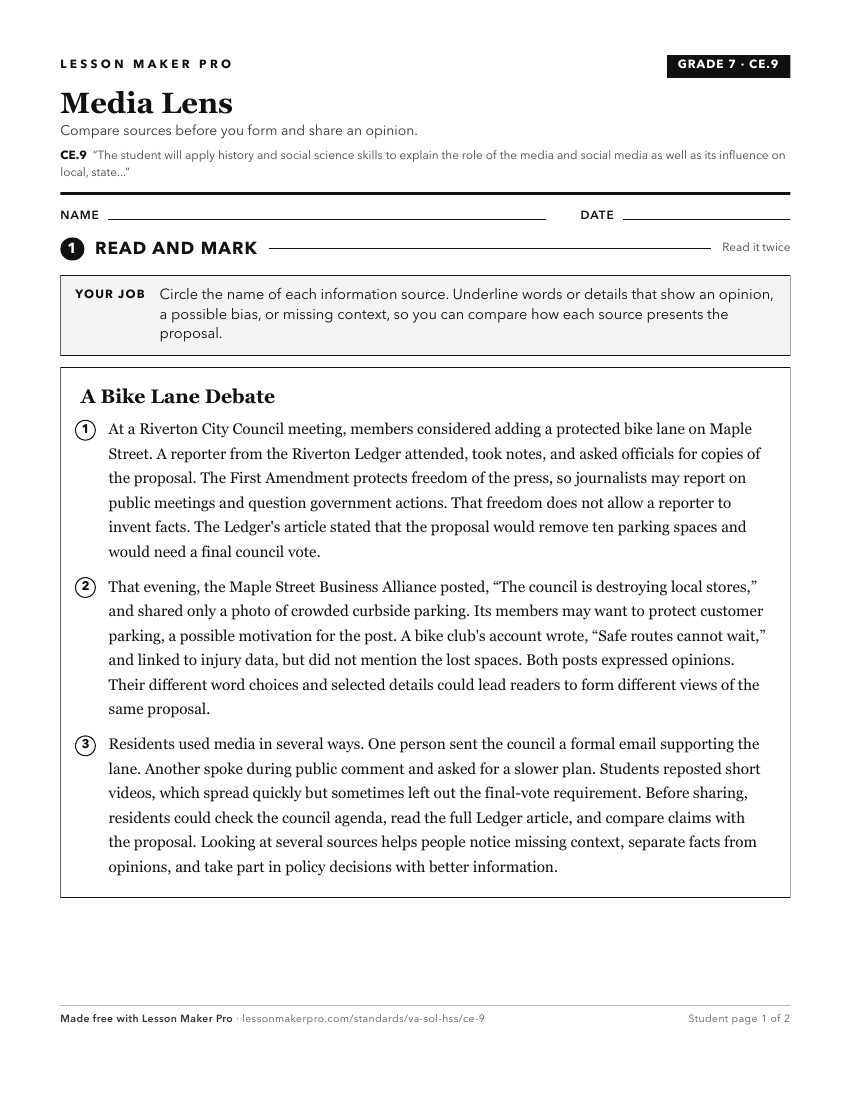
A ready-to-print activity worksheet aligned to CE.9, with an answer key for the teacher on its own page. No account needed.
PDF, US Letter, prints cleanly in black and white.
Download the worksheetKeep exploring
Related Standards
- CE.8
The student will apply history and social science skills to examine the political process at the local, state, and national levels of government by
- USII.9
The student will apply history and social science skills by
- CE.4
The student will apply history and social science skills to analyze American constitutional government at the local level by
- CE.3
The student will apply history and social science skills to analyze how constitutional government functions at the state level by
Turn this cluster into a lesson
Grade, subject, topic, and the complete cluster are prefilled. Create one free, no account needed.
Also for this cluster:Make a WorksheetMake a QuizMake a Sub Lesson