Virginia SOL CE.8.a
The Standard
- CE.8
- The student will apply history and social science skills to examine the political process at the local, state, and national levels of government by
describing the origins, history, and functions of political parties
Virginia Standards of Learning for History and Social Science · The student will apply history and social science skills to examine the political process at the local, state, and national levels of government by
Teacher's field guide
What This Standard Means
What Students Need to Do
- Students explain how disagreements over the power of the federal government led to early political parties. They trace major changes in the party system and explain what parties do during elections and governing.
What Mastery Looks Like
- Students connect the Federalists and Democratic-Republicans to early debates, then identify Democrats and Republicans as the current major parties. They explain functions such as nominating candidates, informing voters, supporting campaigns, and monitoring officeholders.
Common Misconceptions
- Students may think political parties were created by the Constitution or are official parts of government. They may confuse Democratic-Republicans with the modern Republican Party or think parties only operate during elections.
How to Assess It
- Exit ticket: Name one cause of early political parties, one change in the party system, and two functions parties perform today.
Lesson moves
Ways to Teach It
Give groups event and party cards to arrange on a timeline from the Federalists to the modern two-party system.
Ask students to write: Why did political parties form even though some early leaders opposed them?
Play a function-matching game using cards for nominating, campaigning, informing voters, governing, and monitoring officeholders.
Compare two current party websites and record how each informs voters, supports candidates, and states policy goals.
Free download
Printable CE.8.a Worksheet
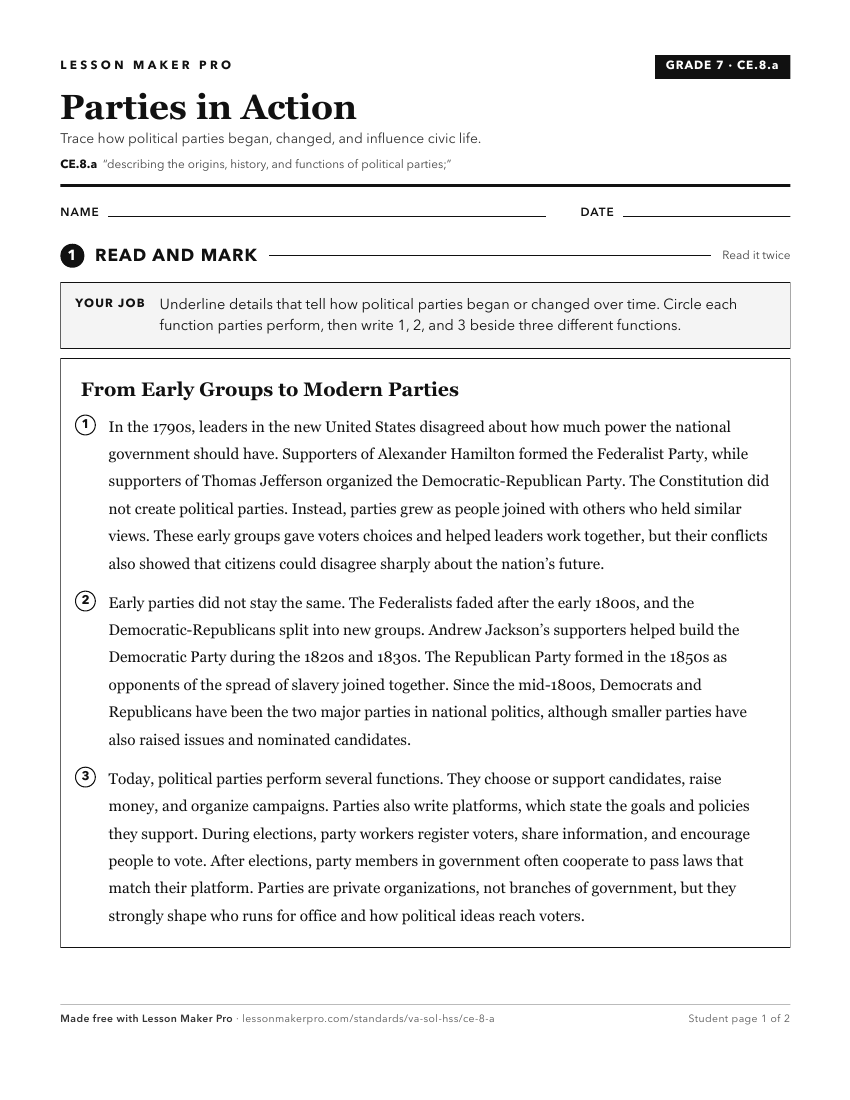
A ready-to-print activity worksheet aligned to CE.8.a, with an answer key for the teacher on its own page. No account needed.
PDF, US Letter, prints cleanly in black and white.
Download the worksheetKeep exploring
Related Standards
- CE.1.a
explaining the fundamental principles of limited government, republicanism, federalism, checks and balances, separation of powers, and popular sovereignty
- CE.2.a
describing the structure and powers of the government (the three branches of government)
- CE.4.a
describing the structure and powers of the local government and explaining the local lawmaking process
- CE.3.a
describing the structure and powers of the state government (the three branches of government)
Turn this exact standard into a lesson
Grade, subject, topic, and the complete standard are prefilled. Create one free, no account needed.
Also for this standard:Make a WorksheetMake a QuizMake a Sub Lesson