Virginia SOL CE.5.b
The Standard
- CE.5
- The student will apply history and social science skills to explain the judicial systems established by the Constitution of Virginia and the Constitution of the United States by
describing how due-process protections seek to ensure justice
Virginia Standards of Learning for History and Social Science · The student will apply history and social science skills to explain the judicial systems established by the Constitution of Virginia and the Constitution of the United States by
Teacher's field guide
What This Standard Means
What Students Need to Do
- Students explain how fair procedures protect life, liberty, and property from government action. They connect the Fifth Amendment to federal action and the Fourteenth Amendment to state action.
What Mastery Looks Like
- Students can analyze a government action and identify whether notice, a fair hearing, and an impartial decision are provided. They can explain how each protection reduces unfair treatment.
Common Misconceptions
- Students may think due process guarantees a favorable result rather than a fair procedure. They may believe it applies only to criminal trials or only to citizens. Some confuse the roles of the Fifth and Fourteenth Amendments.
How to Assess It
- Give this exit prompt: “A state suspends a student without explaining why or allowing a response. Name the missing protections and explain why they matter.”
Lesson moves
Ways to Teach It
Run a mock hearing with role cards for the accused person, government official, judge, witness, and attorney.
Ask students to write whether fair procedures or a fair outcome matter more, then defend their answer with one example.
Play a card-sort game matching scenarios to notice, hearing, legal counsel, impartial judge, or no due-process issue.
Give students a school suspension policy and have them mark where the student receives notice and a chance to respond.
Free download
Printable CE.5.b Worksheet
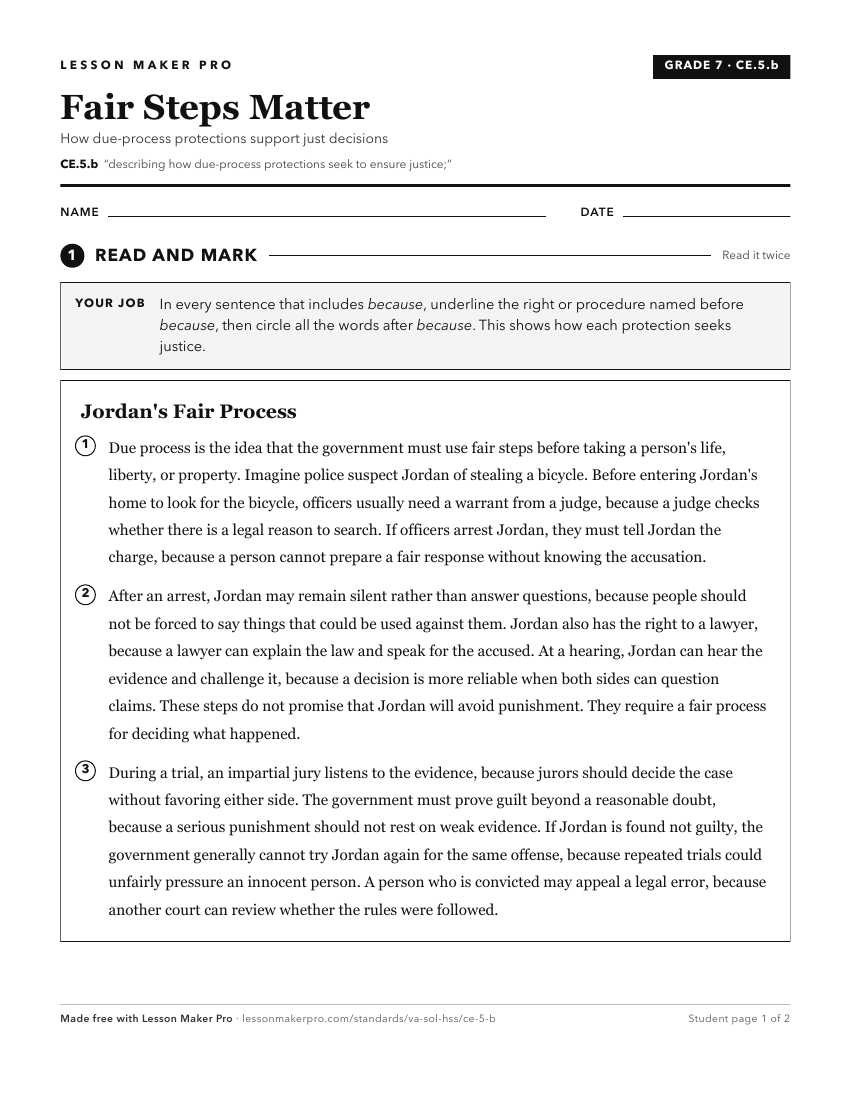
A ready-to-print activity worksheet aligned to CE.5.b, with an answer key for the teacher on its own page. No account needed.
PDF, US Letter, prints cleanly in black and white.
Download the worksheetKeep exploring
Related Standards
- CE.6.b
describing the rights and privileges guaranteed by the First Amendment, including freedoms of religion, speech, press, assembly, and petition, the rights guaran...
- 2.1.c
understanding equal protection
- CE.1.e
explaining the fundamental concepts of the U.S. government including, but not limited to due process, equal justice under the law, equal protection, elections a...
- CE.13.f
describing how governments regulate commerce to protect consumers, the environment, competition in the marketplace, and property rights
Turn this exact standard into a lesson
Grade, subject, topic, and the complete standard are prefilled. Create one free, no account needed.
Also for this standard:Make a WorksheetMake a QuizMake a Sub Lesson