Virginia SOL 2.1.c
The Standard
- 2.1
- The student will apply history and social science skills to distinguish between the rights and responsibilities that individuals have in the United States including, but not limited to
understanding equal protection
Virginia Standards of Learning for History and Social Science
Teacher's field guide
What This Standard Means
What Students Need to Do
- Students explain that laws and public rules must protect every person fairly. They identify situations where people receive the same legal rights and protections.
What Mastery Looks Like
- A student can sort examples into fair and unfair treatment. The student can explain why a rule cannot protect one group while excluding another.
Common Misconceptions
- Students may think fairness always means giving everyone the exact same thing. They may believe laws protect only adults or people in charge. Some confuse equal treatment with ignoring individual needs or accommodations.
How to Assess It
- Exit ticket: Circle the fair situation from two examples, then write one sentence explaining how the law protects everyone in that example.
Lesson moves
Ways to Teach It
Give groups student figures and rule cards, then ask them to show how one playground safety rule protects every child.
Ask, “Should a librarian enforce the same borrowing rule for every child? Why?” and have students write two sentences.
Play Fair or Unfair: read short rule scenarios, and students hold up a green or red card and explain their choice.
Examine a crosswalk sign near school and discuss how the traffic law protects every person who uses the crossing.
Free download
Printable 2.1.c Worksheet
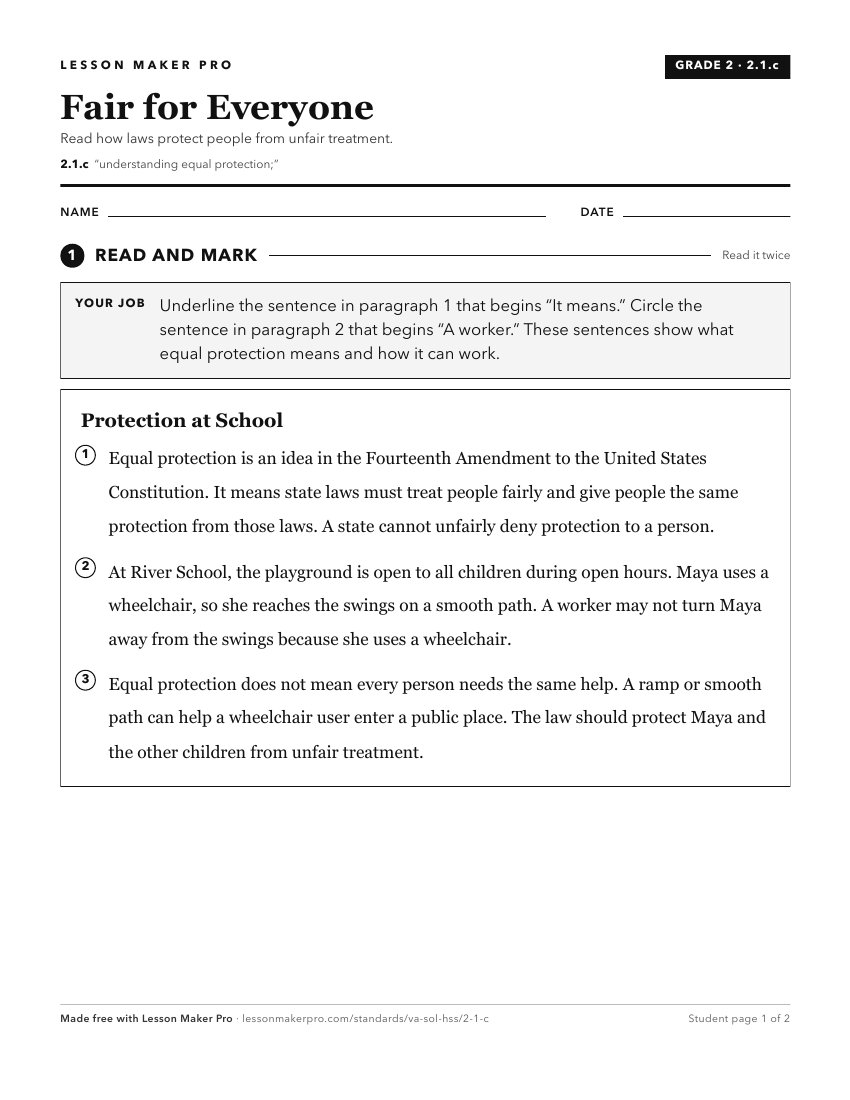
A ready-to-print activity worksheet aligned to 2.1.c, with an answer key for the teacher on its own page. No account needed.
PDF, US Letter, prints cleanly in black and white.
Download the worksheetKeep exploring
Related Standards
- CE.3.e
explaining the principle of separation of powers and the operation of checks and balances at the state level.
- CE.5.b
describing how due-process protections seek to ensure justice
- CE.1.e
explaining the fundamental concepts of the U.S. government including, but not limited to due process, equal justice under the law, equal protection, elections a...
- 3.1.c
understanding the importance of supporting and defending the Constitution of the United States and the Bill of Rights
Turn this exact standard into a lesson
Grade, subject, topic, and the complete standard are prefilled. Create one free, no account needed.
Also for this standard:Make a WorksheetMake a QuizMake a Sub Lesson