Virginia SOL K.FFR.3
SOL Standard (Knowledge and Skills Cluster)
Phonics and Word Analysis: The student will apply phonetic principles to read and spell words
Virginia Standards of Learning for English
Cluster contents
Knowledge and Skills in This Standard
K.FFR.3 is a Standards of Learning standard. These are the knowledge and skills expectations under it.
- K.FFR.3.A
Identify capital and lowercase letters of the alphabet
- K.FFR.3.B
Identify common letter-sound correspondences
- K.FFR.3.C
Discriminate between long and short sounds with common spellings for the five major vowels with open and closed syllables (e.g., short /e/ as in “pet”, long /e/...
- K.FFR.3.D
Demonstrate knowledge that every word has a vowel sound
- K.FFR.3.E
Identify the letter-sound correspondences for consonant digraphs (e.g., ch, sh, th, wh)
- K.FFR.3.F
Demonstrate knowledge of letter-sound correspondences to blend CV, CVC, VC words
- K.FFR.3.G
Decode (read) and encode (spell) words with short vowels, including words beginning or ending in a digraph (e.g., ch, sh, th, wh)
- K.FFR.3.H
Use letter-sound correspondences to read grade-level high frequency words, including decodable and irregular words, with automaticity and accuracy
Teacher's field guide
What This Cluster Means
What Students Need to Do
- Students match uppercase and lowercase letters and connect letters or digraphs to their sounds. They hear short and long vowel sounds, notice that every word has a vowel sound, and blend simple words. They read and spell short-vowel words and recognize common high-frequency words accurately.
What Mastery Looks Like
- Students quickly match letter forms and produce their usual sounds. They blend and spell simple words such as at, sun, chip, and wish. They recognize common high-frequency words, including words with unexpected spellings.
Common Misconceptions
- Students may give a letter name instead of its sound or confuse uppercase and lowercase forms. They may treat both letters in a digraph as separate sounds. They may also expect every high-frequency word to follow regular sound patterns.
How to Assess It
- Show the letters M, m, e, and sh, then ask students to name each sound, read me and shed, and spell shop with letter tiles.
Lesson moves
Ways to Teach It
Have students use magnetic letters to build am, cat, he, and shop, then touch each letter or digraph while blending.
Ask students to compare he and hen, then explain what happens to the vowel sound when the final consonant is added.
Play sound bingo using letter cards, digraph cards, short vowel words, and familiar high-frequency words.
Search classroom labels for words with vowel sounds, then sort them by short vowels, long vowels, or irregular spellings.
Free download
Printable K.FFR.3 Worksheet
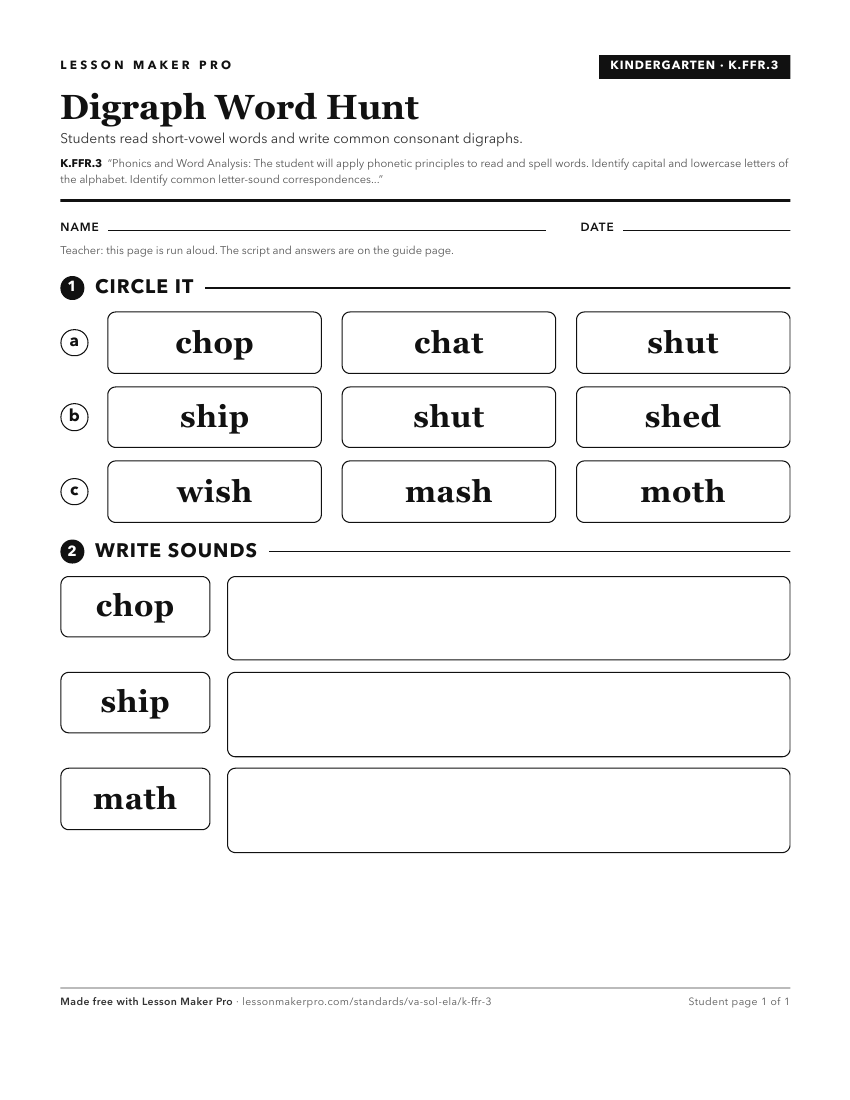
A ready-to-print activity worksheet aligned to K.FFR.3, with an answer key for the teacher on its own page. No account needed.
PDF, US Letter, prints cleanly in black and white.
Download the worksheetKeep exploring
Related Standards
- 5.FFR.3
Phonics and Word Analysis: The student will apply grade level phonics and word analysis skills to decode (read) unfamiliar words in grade level text.
- 2.FFR.3
Phonics and Word Analysis: The student will apply phonetic principles to read and spell words.
- 4.FFR.3
Phonics and Word Analysis: The student will apply grade level phonics and word analysis skills to decode (read) unfamiliar words in grade level text.
- 1.FFR.3
The 1st Grade version of this standard.
Turn this cluster into a lesson
Grade, subject, topic, and the complete cluster are prefilled. Create one free, no account needed.
Also for this cluster:Make a WorksheetMake a QuizMake a Sub Lesson