Virginia SOL 2.RV.1
SOL Standard (Knowledge and Skills Cluster)
Vocabulary Development and Word Analysis
Virginia Standards of Learning for English
Cluster contents
Knowledge and Skills in This Standard
2.RV.1 is a Standards of Learning standard. These are the knowledge and skills expectations under it.
- 2.RV.1.A
Discuss meanings of new words or phrases acquired through conversations and literature.
- 2.RV.1.B
Use vocabulary across content areas.
- 2.RV.1.C
Determine the meaning of an unknown word using frequently occurring root words and inflectional affixes (e.g. -s, -ing, - ed).
- 2.RV.1.D
Use the context of a sentence to apply knowledge of homophones.
- 2.RV.1.E
Apply knowledge of morphology (e.g., common grade appropriate suffixes, prefixes), synonyms, and antonyms to determine the meaning of new words.
- 2.RV.1.F
Distinguish shades of meaning among verbs and adjectives.
- 2.RV.1.G
Develop breadth of vocabulary knowledge by listening to and reading high quality, complex text.
- 2.RV.1.H
Use newly learned words and phrases in discussions and speaking activities.
Teacher's field guide
What This Cluster Means
What Students Need to Do
- Students figure out unfamiliar words by using sentence clues, word parts, related words, opposite words, and homophones. They compare verbs and adjectives to notice small differences in meaning. They use newly learned words when discussing stories and other subjects.
What Mastery Looks Like
- Students infer a new word’s meaning and point to a sentence clue, root, prefix, or suffix that helped. They choose the correct homophone, compare similar words by strength, and use new vocabulary accurately when speaking or writing.
Common Misconceptions
- Students may think every word ending in s means more than one, or that ed always sounds the same. They may choose a homophone because it sounds right without checking the sentence. They may also treat synonyms as exact matches and miss differences such as warm, hot, and scorching.
How to Assess It
- Exit ticket: Read, “The careless puppy raced past the slow dog, and its leash dragged.” Explain careless, replace raced with a weaker verb, give slow’s antonym, and explain why its fits.
Lesson moves
Ways to Teach It
Give pairs base-word and affix cards to build words such as helpful, jumped, and replay, then explain each new meaning.
After a read-aloud, ask, “Which new word best describes the character, and what words or actions helped you understand it?”
Play a word-strength ladder game by ordering verb or adjective cards, such as walk, march, hurry, and sprint.
Use a weather report to collect unfamiliar science words, identify helpful word parts or clues, and use each word in a forecast.
Free download
Printable 2.RV.1 Worksheet
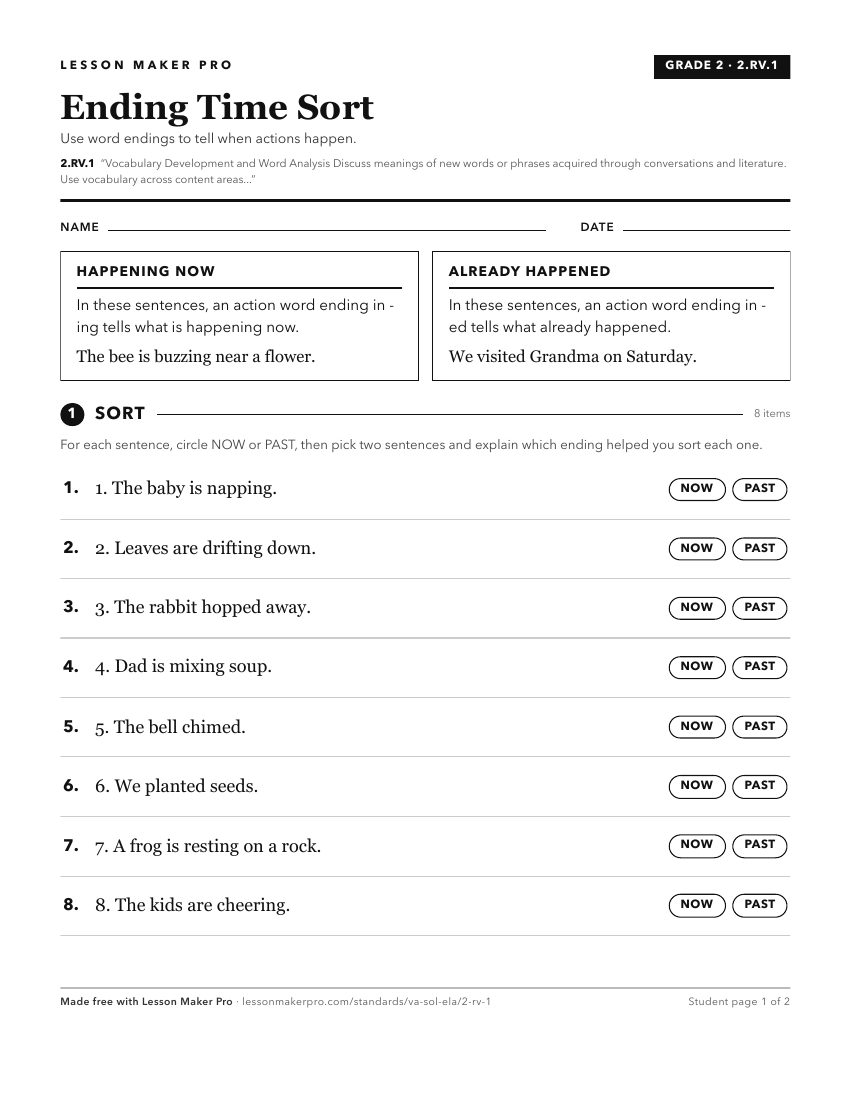
A ready-to-print activity worksheet aligned to 2.RV.1, with an answer key for the teacher on its own page. No account needed.
PDF, US Letter, prints cleanly in black and white.
Download the worksheetKeep exploring
Related Standards
Turn this cluster into a lesson
Grade, subject, and topic are prefilled; the lesson picks the standards under this heading. Create one free, no account needed.
Also for this cluster:Make a WorksheetMake a QuizMake a Sub Lesson