Virginia SOL 2.RV.1.C
The Standard
Determine the meaning of an unknown word using frequently occurring root words and inflectional affixes (e.g. -s, -ing, - ed).
Virginia Standards of Learning for English · Vocabulary Development and Word Analysis
Teacher's field guide
What This Standard Means
What Students Need to Do
- Students break an unfamiliar word into a familiar base word and an ending such as s, ed, or ing. They use both parts to work out the word’s meaning.
What Mastery Looks Like
- Students can separate words such as cats, jumping, and played into a base word and an ending. They explain how the ending changes number, time, or action.
Common Misconceptions
- Students may treat the whole word as new instead of spotting a known base word. They may think every word ending in s means more than one, or confuse ed and ing.
How to Assess It
- Give students this sentence: “The puppy jumped over the logs.” Ask them to circle each base word and explain what the endings show.
Lesson moves
Ways to Teach It
Give pairs base-word cards and ending tiles for s, ed, and ing, then have them build and explain six words.
Ask students to write how walk, walks, walked, and walking are different, then compare answers with a partner.
Play Ending Sort: students draw a word card, name its base word, and place it under s, ed, or ing.
Use a lunch menu or class notice to find words with s, ed, and ing, then discuss each word’s meaning.
Free download
Printable 2.RV.1.C Worksheet
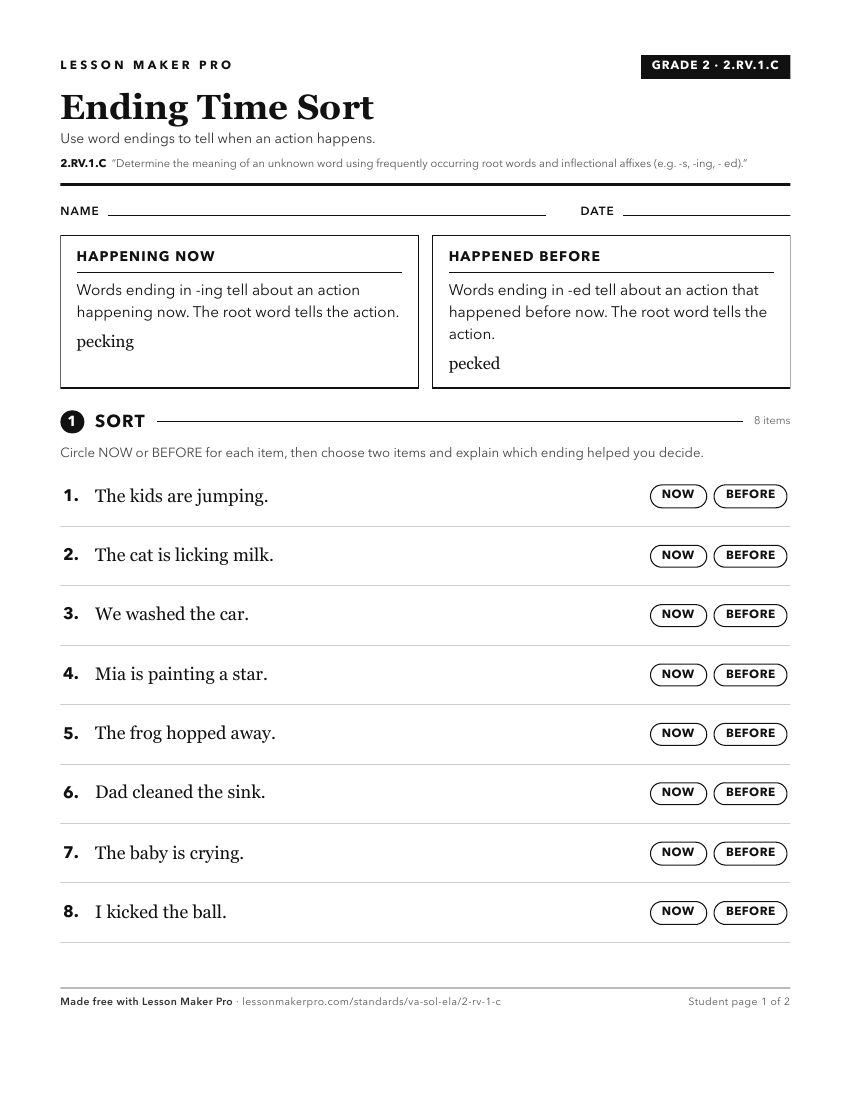
A ready-to-print activity worksheet aligned to 2.RV.1.C, with an answer key for the teacher on its own page. No account needed.
PDF, US Letter, prints cleanly in black and white.
Download the worksheetKeep exploring
Related Standards
- 1.RV.1.E
Determine the meaning of an unknown word using frequently occurring root words and inflectional affixes (e.g. -s, -ing, -ed).
- 4.RV.1.C
Determine the meaning of complex words using frequently occurring root words and inflectional affixes (e.g. -s, -ing, -ed).
- 5.RV.1.C
Determine the meaning of complex words using frequently occurring root words and inflectional affixes (e.g., -s, -ing,-ed).
- 3.RV.1.C
Determine the meaning of complex words using frequently occurring root words and inflectional affixes (e.g. -s, -ing, -ed).
Turn this exact standard into a lesson
Grade, subject, topic, and the complete standard are prefilled. Create one free, no account needed.
Also for this standard:Make a WorksheetMake a QuizMake a Sub Lesson