Virginia SOL 11.RV
SOL Standard (Knowledge and Skills Cluster)
The student will systematically build vocabulary and word knowledge based on grade eleven content and texts.
Virginia Standards of Learning for English
Cluster contents
Knowledge and Skills in This Standard
11.RV is a Standards of Learning standard. These are the knowledge and skills expectations under it.
- 11.RV.1
Vocabulary Development and Word Analysis
- 11.RV.1.A
Develop and accurately use general academic and content-specific vocabulary through reading, discussing, and writing about grade-level texts and topics.
- 11.RV.1.B
Use context and sentence structure to clarify the meanings of words and phrases.
- 11.RV.1.C
Use structural analysis of roots, affixes, and etymology to understand the meanings of unfamiliar and complex words.
- 11.RV.1.D
Analyze the nuances in the meaning of words with similar denotations (e.g., clever, cunning, brainy).
- 11.RV.1.E
Explain and analyze idiomatic language in context.
- 11.RV.1.F
Explain the meaning of figurative language and literary and classical allusions and analyze their role in texts.
- 11.RV.1.G
Use newly learned words and phrases in multiple contexts, including in students’ discussions and speaking and writing activities.
Teacher's field guide
What This Cluster Means
What Students Need to Do
- Students determine word and phrase meanings by using context, sentence structure, word parts, and word history. They compare shades of meaning and interpret idioms, figurative language, and allusions. They apply new vocabulary accurately across discussion, speaking, and writing.
What Mastery Looks Like
- Students can infer an unfamiliar word’s meaning and point to context, syntax, roots, or affixes that support the inference. They explain how similar words differ in tone or effect. They interpret idioms, figurative phrases, and allusions, then use new vocabulary accurately in speech and writing.
Common Misconceptions
- Students often treat context as a nearby synonym instead of using the whole sentence. They may assume a familiar root or affix gives the complete meaning. They also treat near-synonyms as interchangeable and read idioms or allusions literally.
How to Assess It
- Use this exit ticket: “Although Mara was frugal, her brother called her stingy. When the bill arrived, he said, ‘Time to face the music.’” Ask students to compare frugal and stingy, explain the idiom, and use frugal in a new sentence.
Lesson moves
Ways to Teach It
Give pairs word-part cards to assemble complex words, predict meanings, and verify each prediction with a dictionary.
Ask students to choose between two near-synonyms for a character, then defend the choice with evidence from the text.
Run a context-clue relay where teams infer highlighted words, label the clues used, and earn points for accurate explanations.
Have students collect loaded words from headlines or advertisements, replace each with a near-synonym, and discuss how the message changes.
Free download
Printable 11.RV Worksheet
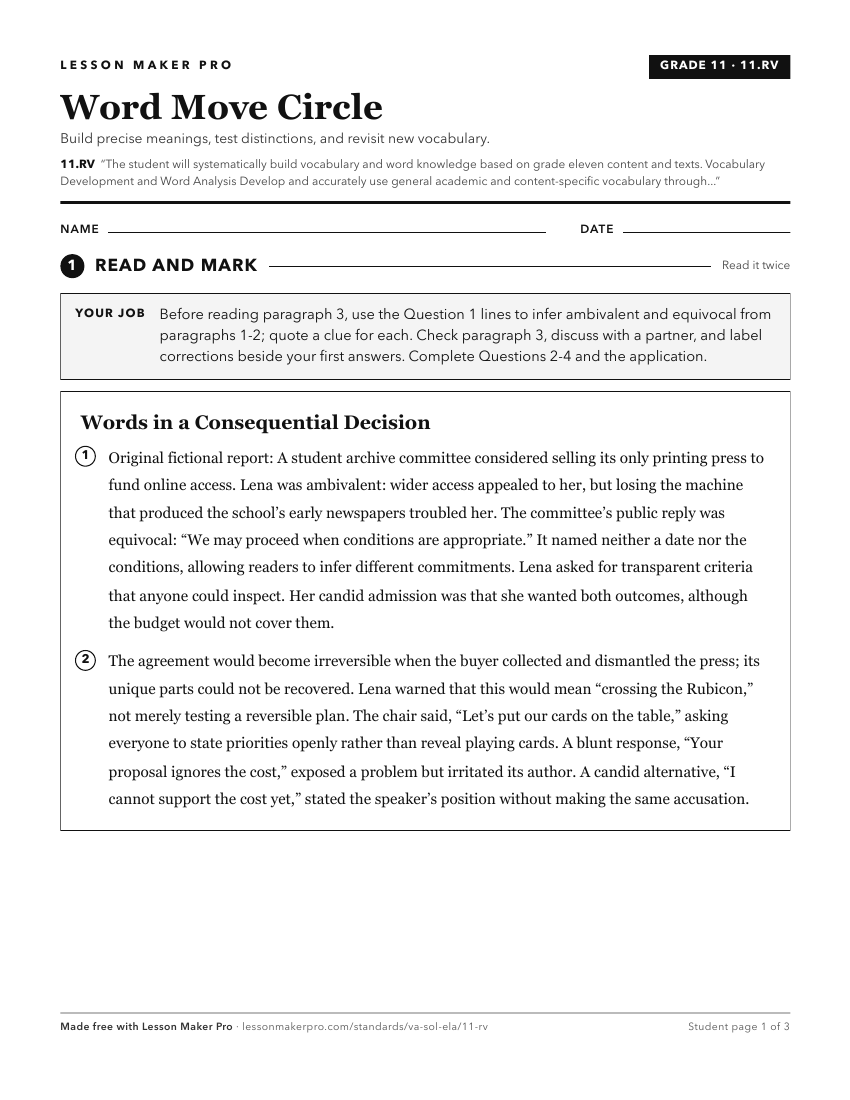
A ready-to-print activity worksheet aligned to 11.RV, with an answer key for the teacher on its own page. No account needed.
PDF, US Letter, prints cleanly in black and white.
Download the worksheetKeep exploring
Related Standards
- 9.RV
The student will systematically build vocabulary and word knowledge based on grade nine content and texts.
- 10.RV
The student will systematically build vocabulary and word knowledge based on grade ten content and text.
- 8.RV
The student will systematically build vocabulary and word knowledge based on grade eight content and texts.
- 12.RV
The student will systematically build vocabulary and word knowledge based on grade twelve content and texts.
Turn this cluster into a lesson
Grade, subject, topic, and the complete cluster are prefilled. Create one free, no account needed.
Also for this cluster:Make a WorksheetMake a QuizMake a Sub Lesson