Virginia SOL 10.RV
SOL Standard (Knowledge and Skills Cluster)
The student will systematically build vocabulary and word knowledge based on grade ten content and text.
Virginia Standards of Learning for English
Cluster contents
Knowledge and Skills in This Standard
10.RV is a Standards of Learning standard. These are the knowledge and skills expectations under it.
- 10.RV.1
Vocabulary Development and Word Analysis
- 10.RV.1.A
Develop and accurately use general academic and content-specific vocabulary through reading, discussing, and writing about grade-level texts and topics.
- 10.RV.1.B
Use context and sentence structure to clarify the literal and figurative meanings of words and phrases.
- 10.RV.1.C
Use structural analysis of roots, affixes, and etymology to clarify the meanings of unfamiliar and complex words.
- 10.RV.1.D
Discriminate between the connotative and denotative meanings and interpret the connotation(s).
- 10.RV.1.E
Identify and explain idiomatic language in context.
- 10.RV.1.F
Explain the meaning of literary and classical allusions and figurative language in context and analyze their roles in texts.
- 10.RV.1.G
Use newly learned words and phrases in multiple contexts, including in students’ discussions and speaking and writing activities.
Teacher's field guide
What This Cluster Means
What Students Need to Do
- Students determine meanings of unfamiliar words and phrases by using context, sentence structure, roots, affixes, and word origins. They distinguish literal meaning from connotation and explain idioms, allusions, and figurative language in context. They use new academic and subject-specific terms accurately in speech and writing.
What Mastery Looks Like
- A student can infer a complex word’s meaning and identify the context clue, sentence pattern, or word part that supports the inference. The student explains how connotation, idiom, allusion, or figurative language shapes a passage. New terms appear correctly in more than one spoken or written context.
Common Misconceptions
- Students often grab the nearest context clue, even when sentence structure contradicts it. They may treat a root as the whole definition or assume synonyms carry the same tone. They may read idioms literally or identify figurative language without explaining its effect.
How to Assess It
- Give students a short passage with one unfamiliar word and one idiom or allusion. Ask them to infer each meaning, cite supporting clues, explain the effect, and use the new word in a different sentence.
Lesson moves
Ways to Teach It
Build complex words with root and affix cards, then annotate how each part changes meaning and check each word in a dictionary.
Compare “slim” and “skinny” in two character descriptions, then write which fits each speaker’s attitude and why.
Run a Context Clue Relay: teams infer highlighted words, label the clue type, and defend each answer with sentence evidence.
Collect a headline or advertisement with loaded language, an idiom, or an allusion, then rewrite it in neutral wording.
Free download
Printable 10.RV Worksheet
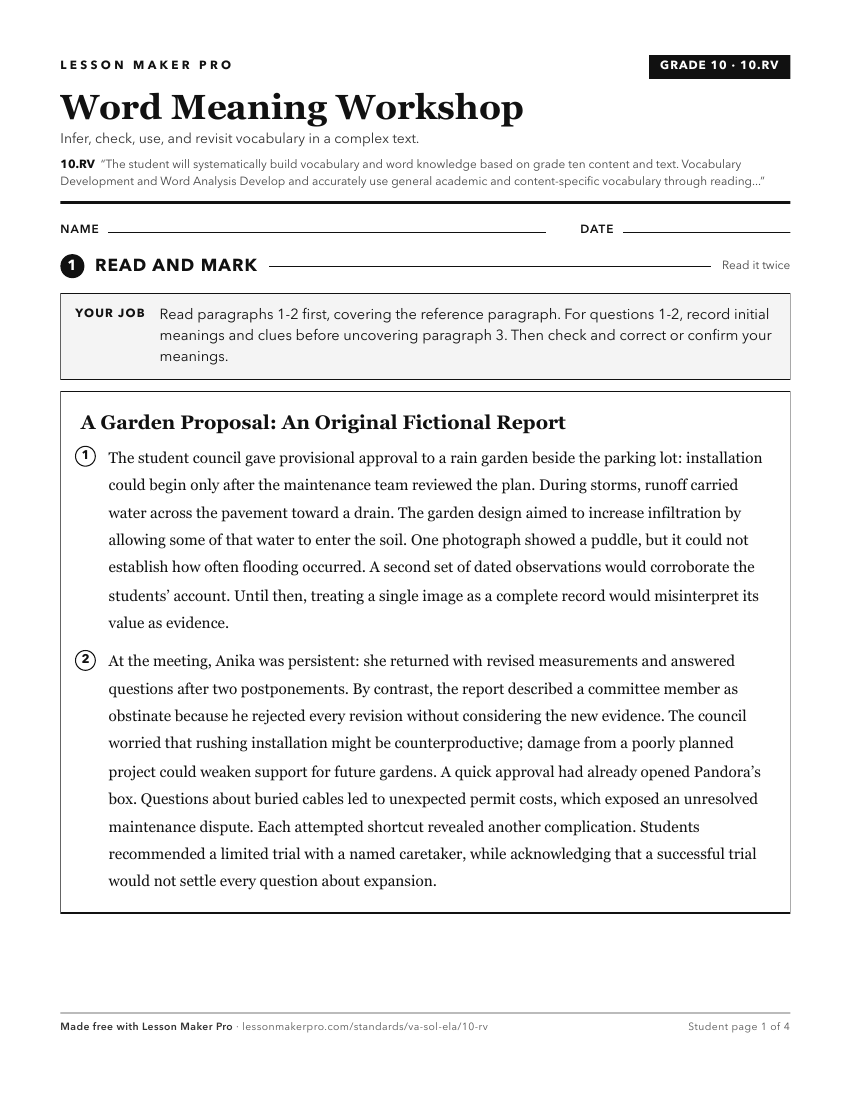
A ready-to-print activity worksheet aligned to 10.RV, with an answer key for the teacher on its own page. No account needed.
PDF, US Letter, prints cleanly in black and white.
Download the worksheetKeep exploring
Related Standards
- 9.RV
The student will systematically build vocabulary and word knowledge based on grade nine content and texts.
- 8.RV
The student will systematically build vocabulary and word knowledge based on grade eight content and texts.
- 11.RV
The student will systematically build vocabulary and word knowledge based on grade eleven content and texts.
- 12.RV
The student will systematically build vocabulary and word knowledge based on grade twelve content and texts.
Turn this cluster into a lesson
Grade, subject, topic, and the complete cluster are prefilled. Create one free, no account needed.
Also for this cluster:Make a WorksheetMake a QuizMake a Sub Lesson