Texas TEKS 8.18.A
The Standard
- 8.18
- Government. The student understands the impact of landmark Supreme Court cases. The student is expected to:
identify the origin of judicial review
Texas Essential Knowledge and Skills for Social Studies
Teacher's field guide
What This Standard Means
What Students Need to Do
- Students connect judicial review to the 1803 Supreme Court case Marbury v. Madison. They explain how Chief Justice John Marshall claimed the Court's power to declare laws unconstitutional.
What Mastery Looks Like
- Students name Marbury v. Madison and describe the dispute over Marbury's commission. They explain that the Court rejected part of the Judiciary Act of 1789 because it conflicted with the Constitution.
Common Misconceptions
- Students may think the Constitution directly gives the Supreme Court the power of judicial review. They may also think Marbury received his commission or that judicial review means hearing appeals.
How to Assess It
- Ask students to complete this exit ticket: Name the case that established judicial review, then explain what the Supreme Court did in that case.
Lesson moves
Ways to Teach It
Give pairs event cards from Marbury v. Madison to sequence, then have them label the moment judicial review was established.
Ask students to write: Why did Marshall deny Marbury's request yet strengthen the Supreme Court?
Play a sorting game using laws, court decisions, and constitutional clauses to decide which laws a court could strike down.
Show a news headline about a law challenged in court, then trace the court's authority back to Marbury v. Madison.
Free download
Printable 8.18.A Worksheet
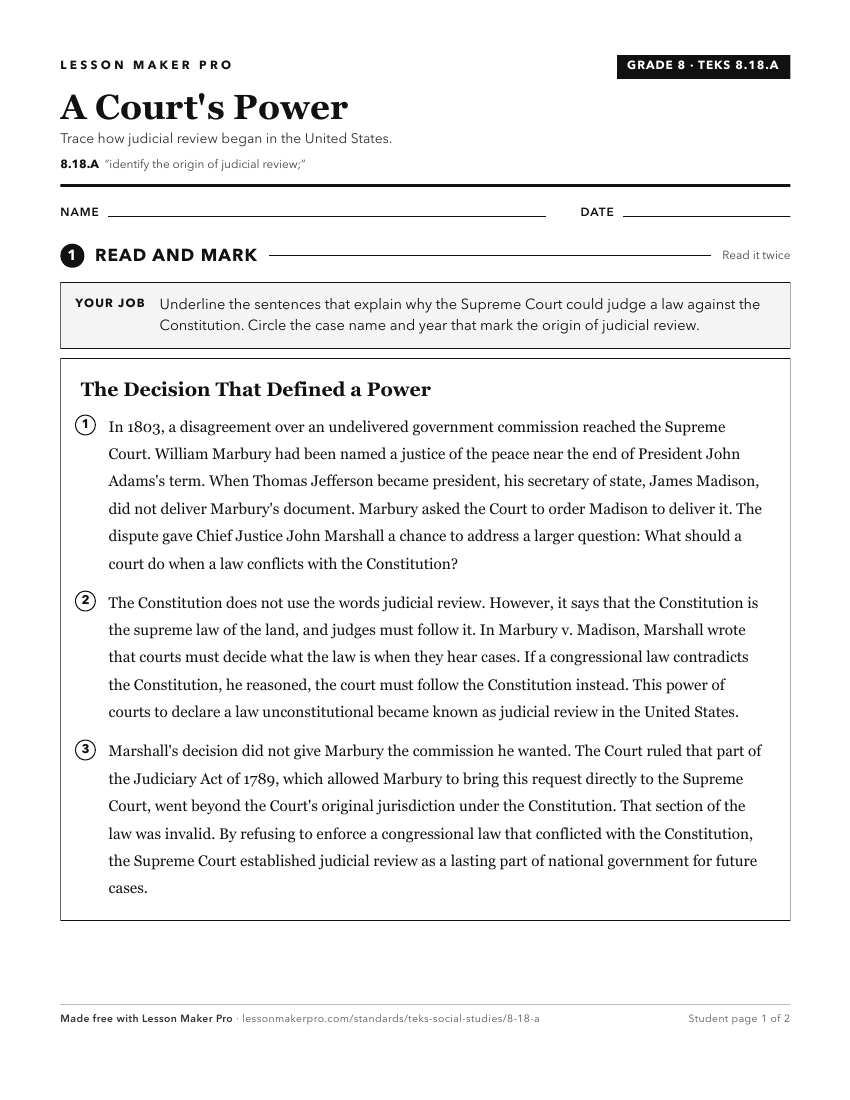
A ready-to-print activity worksheet aligned to 8.18.A, with an answer key for the teacher on its own page. No account needed.
PDF, US Letter, prints cleanly in black and white.
Download the worksheetKeep exploring
Related Standards
- 4.19.F
identify the central claim in a primary or secondary source
- 3.14.E
identify the central claim in a primary or secondary source
- 8.15.A
identify the influence of ideas from historic documents, including the Magna Carta, the English Bill of Rights, the Mayflower Compact, and the Federalist Papers...
- 5.15.B
identify the reasons for and describe the system of checks and balances outlined in the U.S. Constitution
Turn this exact standard into a lesson
Grade, subject, topic, and the complete standard are prefilled. Create one free, no account needed.
Also for this standard:Make a WorksheetMake a QuizMake a Sub Lesson