Texas TEKS 8.1.A
The Standard
- 8.1
- History. The student understands traditional historical points of reference in U.S. history through 1877. The student is expected to:
identify the major eras in U.S. history through 1877, including colonization, revolution, creation and ratification of the Constitution, early republic, the Age of Jackson, westward expansion, reform movements, sectionalism, Civil War, and Reconstruction, and describe their causes and effects
Texas Essential Knowledge and Skills for Social Studies
Teacher's field guide
What This Standard Means
What Students Need to Do
- Students place key periods from colonial settlement through Reconstruction in chronological order. They explain what caused each period to develop and what political, economic, or social changes followed.
What Mastery Looks Like
- Students correctly match major events, people, and developments to their historical periods. They use specific evidence to explain at least one cause and one effect for each period.
Common Misconceptions
- Students often treat periods as isolated units instead of connected developments. They may confuse the early republic with the Jackson era, or sectionalism with the Civil War. They also list events without explaining cause and effect.
How to Assess It
- Give students five mixed event cards: Jamestown, Constitution, Indian Removal, Seneca Falls Convention, and Fort Sumter. Have them order the cards, name each period, and write one cause or effect for three cards.
Lesson moves
Ways to Teach It
Give groups dated event cards to arrange on a floor timeline, then add yarn arrows showing cause-and-effect links.
Ask students to write which period created the biggest change in the nation and support their choice with two examples.
Play Era Match, where teams pair people, events, and effects with labeled period cards for points.
Have students examine a local historical marker from before 1877, identify its period, and explain the larger event connected to it.
Free download
Printable 8.1.A Worksheet
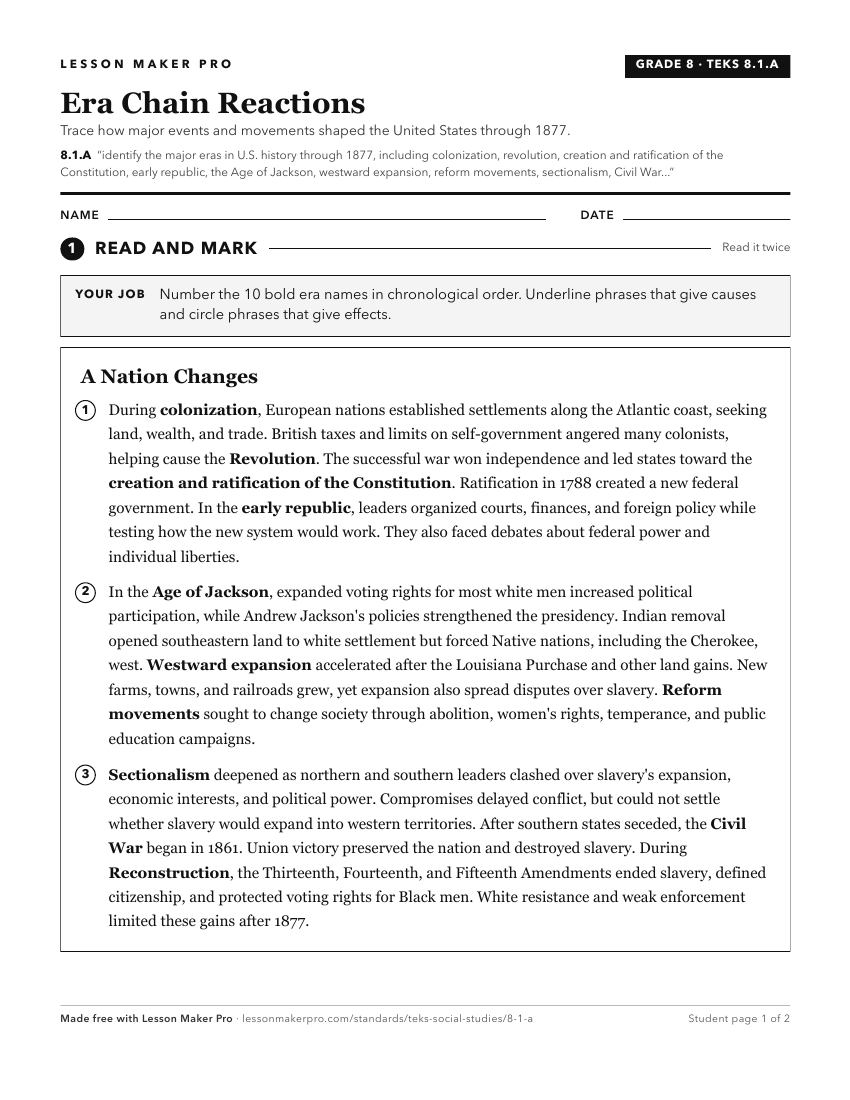
A ready-to-print activity worksheet aligned to 8.1.A, with an answer key for the teacher on its own page. No account needed.
PDF, US Letter, prints cleanly in black and white.
Download the worksheetKeep exploring
Related Standards
- 7.1.A
identify the major eras in Texas history, describe their defining characteristics, and explain the purpose of dividing the past into eras, including Natural Tex...
- 8.1
History. The student understands traditional historical points of reference in U.S. history through 1877. The student is expected to:
- 5.4.E
explain the effects of the Civil War, including Reconstruction and the 13th, 14th, and 15th amendments to the U.S. Constitution
- 8.10.A
locate places and regions directly related to major eras and turning points in the United States during the 17th, 18th, and 19th centuries
Turn this exact standard into a lesson
Grade, subject, topic, and the complete standard are prefilled. Create one free, no account needed.
Also for this standard:Make a WorksheetMake a QuizMake a Sub Lesson