Texas TEKS 7.2
TEKS Knowledge Statement (Expectation Cluster)
History. The student understands how individuals, events, and issues through the Mexican National Era shaped the history of Texas. The student is expected to: compare the cultures of American Indians in Texas prior to European colonization such as Gulf, Plains, Puebloan, and Southeastern; identify important individuals, events, and issues related to European exploration of Texas such as Alonso Álvarez de Pineda, Álvar Núñez Cabeza de Vaca, the search for gold, and the conflicting territorial claims between France and Spain; identify important individuals, events, and issues related to European colonization of Texas, including the establishment of Catholic missions, towns, and ranches, and the contributions of individuals such as Fray Damián Massanet, Antonio Margil de Jesús, and Francisco Hidalgo; identify the individuals, issues, and events related to Mexico becoming an independent nation and its impact on Texas, including Father Miguel Hidalgo, Texas involvement in the fight for independence, José Gutiérrez de Lara, the Battle of Medina, the Mexican federal Constitution of 1824, the merger of Texas and Coahuila as a state, the State Colonization Law of 1825, and slavery; identify the contributions of significant individuals, including Moses Austin, Stephen F. Austin, Erasmo Seguín, Martín De León, and Green DeWitt, during the Mexican settlement of Texas; and contrast Spanish, Mexican, and Anglo purposes for and methods of settlement in Texas.
Texas Essential Knowledge and Skills for Social Studies
Cluster contents
Student Expectations in This Statement
7.2 is a TEKS knowledge and skills statement. These are the student expectations under it.
- 7.2.A
compare the cultures of American Indians in Texas prior to European colonization such as Gulf, Plains, Puebloan, and Southeastern
- 7.2.B
identify important individuals, events, and issues related to European exploration of Texas such as Alonso Álvarez de Pineda, Álvar Núñez Cabeza de Vaca, the se...
- 7.2.C
identify important individuals, events, and issues related to European colonization of Texas, including the establishment of Catholic missions, towns, and ranch...
- 7.2.D
identify the individuals, issues, and events related to Mexico becoming an independent nation and its impact on Texas, including Father Miguel Hidalgo, Texas in...
- 7.2.E
identify the contributions of significant individuals, including Moses Austin, Stephen F. Austin, Erasmo Seguín, Martín De León, and Green DeWitt, during the Me...
- 7.2.F
contrast Spanish, Mexican, and Anglo purposes for and methods of settlement in Texas.
Teacher's field guide
What This Cluster Means
What Students Need to Do
- Students use maps, timelines, and sources to explain how Native groups adapted to different Texas regions. They connect explorers, missionaries, independence leaders, settlers, battles, laws, and slavery to changes in Texas. They also compare Spanish, Mexican, and Anglo settlement goals and methods.
What Mastery Looks Like
- A student can place major people and events in the correct era and explain why each mattered. The student can support cultural and settlement comparisons with specific evidence. The student can explain how Mexican independence and new laws changed government, migration, landholding, and slavery in Texas.
Common Misconceptions
- Students often treat Gulf, Plains, Puebloan, and Southeastern peoples as one culture or match them only by location. They may confuse exploration with colonization or assume Spanish, Mexican, and Anglo settlers had the same goals. Some think Mexican independence immediately made Texas separate from Mexico.
How to Assess It
- Exit ticket: Explain two links in this chain: geography to Native culture, exploration to colonization, Mexican independence to settlement policy, or policy to population change. Use one named person, event, or law.
Lesson moves
Ways to Teach It
Give groups culture, environment, food, housing, and region cards to sort into Gulf, Plains, Puebloan, and Southeastern sets, then defend each match.
Ask students to write: Which change mattered most in Mexican Texas, independence, colonization laws, or slavery, and what evidence supports your choice?
Play a timeline relay where teams place person, event, and policy cards in order and earn points by explaining one connection.
Use a current Texas map to trace mission sites, Spanish place names, Mexican settlements, and Anglo colonies that still shape local communities.
Free download
Printable 7.2 Worksheet
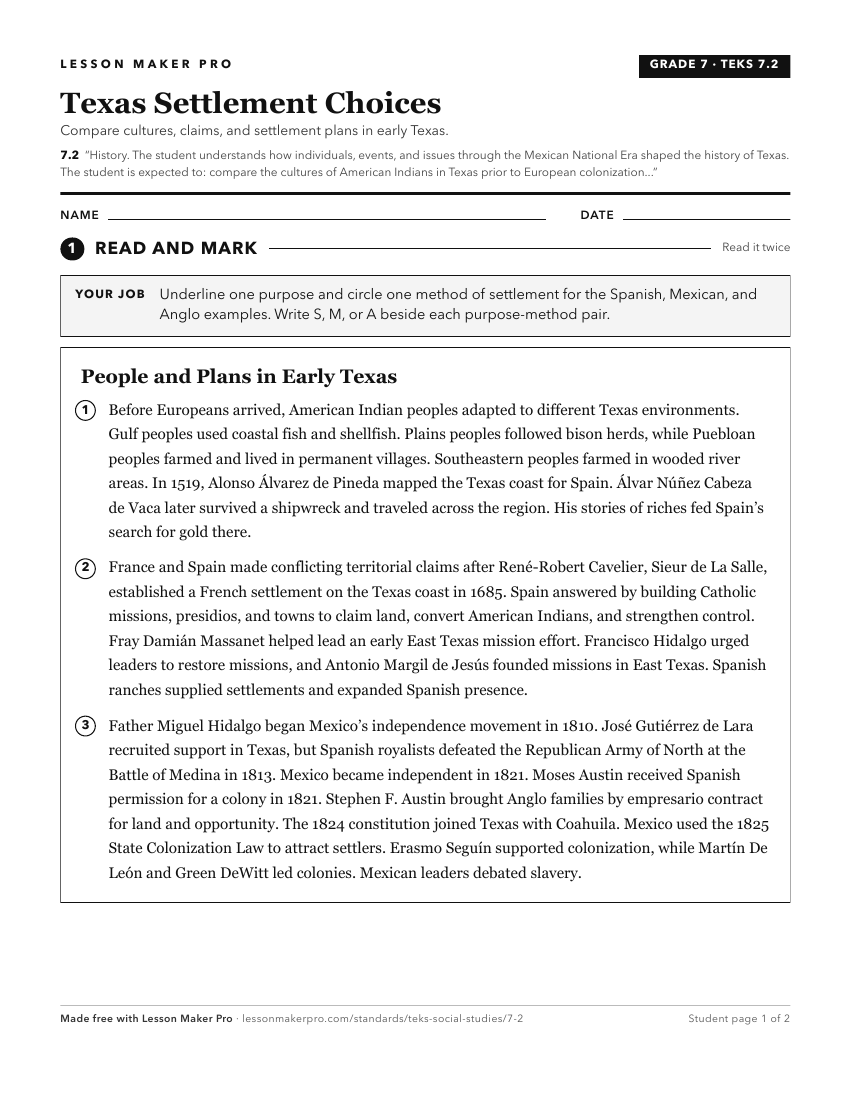
A ready-to-print activity worksheet aligned to 7.2, with an answer key for the teacher on its own page. No account needed.
PDF, US Letter, prints cleanly in black and white.
Download the worksheetKeep exploring
Related Standards
- 7.7
History. The student understands how individuals, events, and issues shaped the history of Texas during the late 19th, 20th, and early 21st centuries. The stude...
- 7.4
History. The student understands how individuals, events, and issues shaped the history of the Republic of Texas and early Texas statehood. The student is expec...
- 7.6
History. The student understands how individuals, events, and issues shaped the history of Texas from Reconstruction through the beginning of the 20th century. ...
- 7.3
History. The student understands how individuals, events, and issues related to the Texas Revolution shaped the history of Texas. The student is expected to:
Turn this cluster into a lesson
Grade, subject, topic, and the complete cluster are prefilled. Create one free, no account needed.
Also for this cluster:Make a WorksheetMake a QuizMake a Sub Lesson