Texas TEKS 6.9.B
The Standard
- 6.9
- The student understands the concepts of limited and unlimited governments
identify reasons for limiting the power of government
Texas Essential Knowledge and Skills for Social Studies
Teacher's field guide
What This Standard Means
What Students Need to Do
- Students explain why citizens place checks on leaders and public institutions. They connect these checks to protecting rights, preventing abuse, and keeping decisions accountable to law.
What Mastery Looks Like
- A student can name several reasons for placing rules on leaders, then explain each with clear cause and effect. Given a scenario, the student can predict what may happen when no safeguard exists.
Common Misconceptions
- Students may think any restriction makes government weak or unable to act. They may confuse checks on leaders with rules for citizens, or assume elections alone prevent abuse.
How to Assess It
- Exit ticket: “A mayor can make laws, arrest people, and spend city money without approval. Give two reasons citizens would want checks on this authority.”
Lesson moves
Ways to Teach It
Give groups leader power cards and safeguard cards, then have them match each power to a safeguard and explain the risk it addresses.
Ask students to write: “What could happen if one leader controlled laws, courts, police, and public money?”
Run a scenario sort where teams label each case protected rights, prevented abuse, ensured accountability, or none.
Read a short city council news report and identify the rules, votes, or public records that keep officials accountable.
Free download
Printable 6.9.B Worksheet
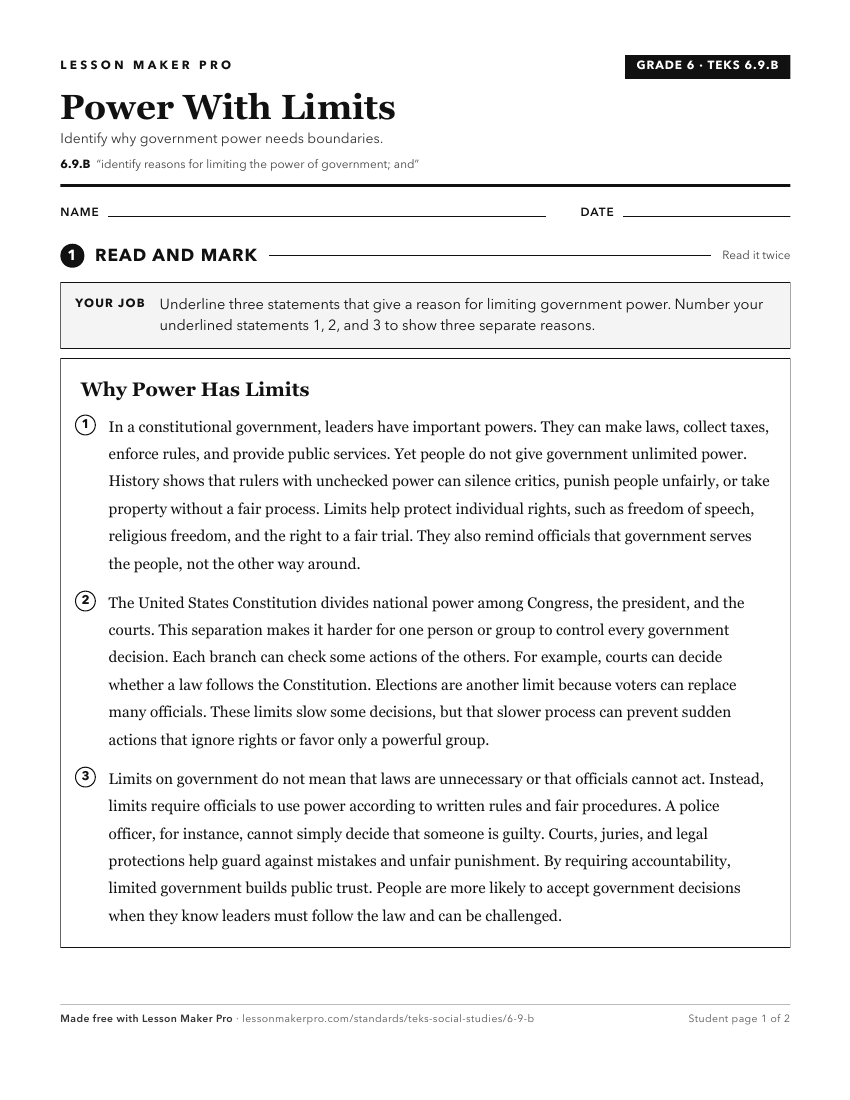
A ready-to-print activity worksheet aligned to 6.9.B, with an answer key for the teacher on its own page. No account needed.
PDF, US Letter, prints cleanly in black and white.
Download the worksheetKeep exploring
Related Standards
- 6.9
The student understands the concepts of limited and unlimited governments
- 5.15.B
identify the reasons for and describe the system of checks and balances outlined in the U.S. Constitution
- 8.15.D
analyze how the U.S. Constitution reflects the principles of limited government, republicanism, checks and balances, federalism, separation of powers, popular s...
- 6.9.A
describe and compare examples of limited and unlimited governments such as constitutional (limited) and totalitarian (unlimited)
Turn this exact standard into a lesson
Grade, subject, topic, and the complete standard are prefilled. Create one free, no account needed.
Also for this standard:Make a WorksheetMake a QuizMake a Sub Lesson