Texas TEKS 8.8.B
The Standard
- 8.8
- The student knows how energy is transferred through waves
explain the use of electromagnetic waves in applications such as radiation therapy, wireless technologies, fiber optics, microwaves, ultraviolet sterilization, astronomical observations, and X-rays.
Texas Essential Knowledge and Skills for Science
Teacher's field guide
What This Standard Means
What Students Need to Do
- Students connect parts of the electromagnetic spectrum to specific tools and procedures. They explain how each wave’s energy, ability to travel, or interaction with matter makes the application work.
What Mastery Looks Like
- Students correctly match wave types with uses such as wireless communication, medical imaging, sterilization, and astronomy. They explain the match using a relevant property, not just a memorized label.
Common Misconceptions
- Students may think electromagnetic waves need matter to travel or that all radiation is equally harmful. They may also confuse microwaves with heat, or assume X-rays and radiation therapy work in the same way.
How to Assess It
- Give students this exit prompt: Choose two applications, name the electromagnetic wave used, and explain why that wave works for each application.
Lesson moves
Ways to Teach It
Shine a flashlight through a stream of water to model how light travels through a fiber optic cable.
Ask students to explain why doctors use X-rays for imaging but higher doses of radiation to destroy cancer cells.
Give pairs wave cards and application cards, then have them race to make matches and defend each choice.
Have students label the electromagnetic waves used in a hospital, home Wi-Fi network, airport scanner, and space telescope.
Free download
Printable 8.8.B Worksheet
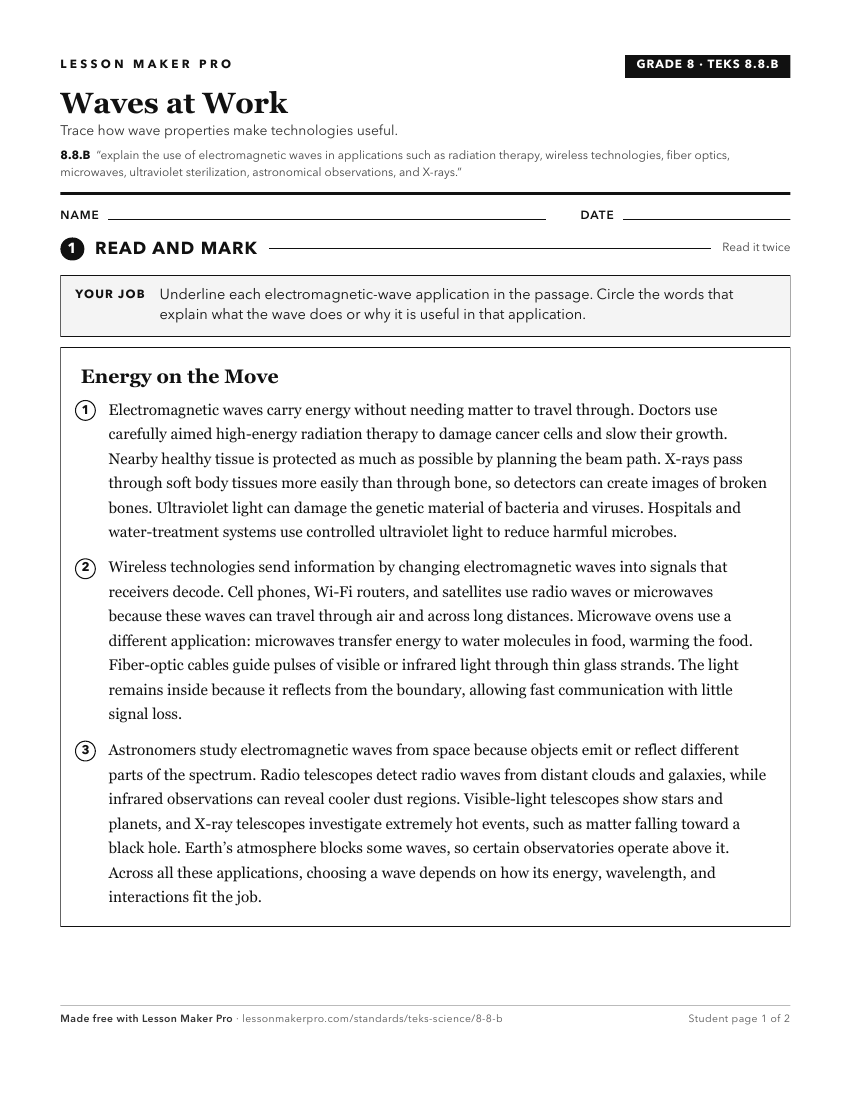
A ready-to-print activity worksheet aligned to 8.8.B, with an answer key for the teacher on its own page. No account needed.
PDF, US Letter, prints cleanly in black and white.
Download the worksheetKeep exploring
Related Standards
- 4.8.A
investigate and identify the transfer of energy by objects in motion, waves in water, and sound
- 3.8.A
identify everyday examples of energy, including light, sound, thermal, and mechanical
- 8.8
The student knows how energy is transferred through waves
- 8.8.A
compare the characteristics of amplitude, frequency, and wavelength in transverse waves, including the electromagnetic spectrum
Turn this exact standard into a lesson
Grade, subject, topic, and the complete standard are prefilled. Create one free, no account needed.
Also for this standard:Make a WorksheetMake a QuizMake a Sub Lesson