Texas TEKS 8.8.A
The Standard
- 8.8
- The student knows how energy is transferred through waves
compare the characteristics of amplitude, frequency, and wavelength in transverse waves, including the electromagnetic spectrum
Texas Essential Knowledge and Skills for Science
Teacher's field guide
What This Standard Means
What Students Need to Do
- Students read and sketch transverse wave models, then compare wave height, crest spacing, and cycles per second. They also compare electromagnetic waves by their relative frequency and wavelength.
What Mastery Looks Like
- Given wave diagrams or data, students can rank amplitude, frequency, and wavelength correctly. They explain that frequency rises as wavelength falls when wave speed stays constant, and apply this pattern across the electromagnetic spectrum.
Common Misconceptions
- Students often measure amplitude from crest to trough instead of from the rest position to a crest. They may confuse frequency with wave speed or think greater amplitude causes greater frequency. Some treat radio waves, visible light, and X-rays as unrelated types of energy.
How to Assess It
- Show three labeled wave sketches and ask students to rank their amplitudes, frequencies, and wavelengths. Then ask which sketch best represents an X-ray compared with a radio wave.
Lesson moves
Ways to Teach It
Pairs shake a rope under constant tension, changing one feature at a time while classmates measure amplitude, frequency, and wavelength.
Ask students to explain why a high-frequency electromagnetic wave has a shorter wavelength than a low-frequency wave traveling at the same speed.
Give teams wave cards to sort by amplitude, frequency, wavelength, and electromagnetic spectrum region, then check another team’s sort.
Compare local radio station frequencies, then have students predict which stations use longer wavelengths and explain their reasoning.
Free download
Printable 8.8.A Worksheet
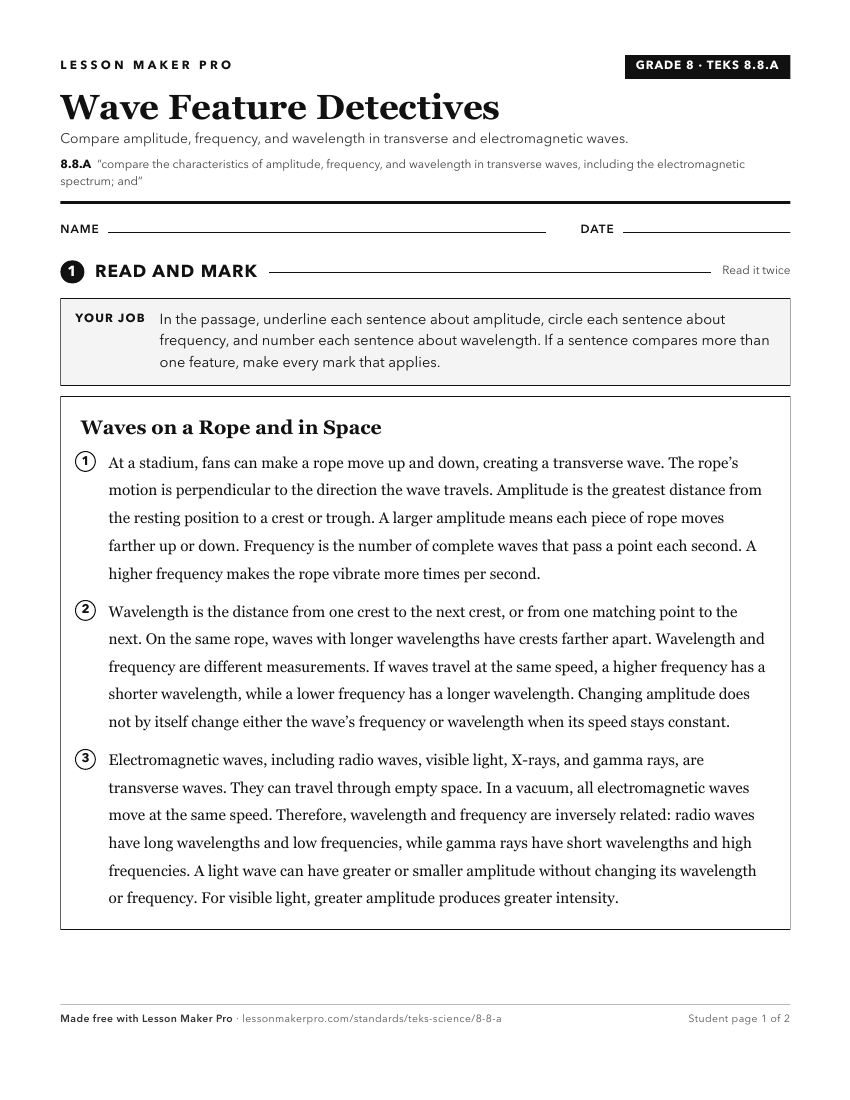
A ready-to-print activity worksheet aligned to 8.8.A, with an answer key for the teacher on its own page. No account needed.
PDF, US Letter, prints cleanly in black and white.
Download the worksheetKeep exploring
Related Standards
- 8.8.B
explain the use of electromagnetic waves in applications such as radiation therapy, wireless technologies, fiber optics, microwaves, ultraviolet sterilization, ...
- 4.8.A
investigate and identify the transfer of energy by objects in motion, waves in water, and sound
- 8.8
The student knows how energy is transferred through waves
- 6.8.C
explain how energy is transferred through transverse and longitudinal waves.
Turn this exact standard into a lesson
Grade, subject, topic, and the complete standard are prefilled. Create one free, no account needed.
Also for this standard:Make a WorksheetMake a QuizMake a Sub Lesson