Texas TEKS 7.7
TEKS Knowledge Statement (Expectation Cluster)
Force, motion, and energy. The student describes the cause-and-effect relationship between force and motion. The student is expected to: calculate average speed using distance and time measurements from investigations; distinguish between speed and velocity in linear motion in terms of distance, displacement, and direction; measure, record, and interpret an object's motion using distance-time graphs; and analyze the effect of balanced and unbalanced forces on the state of motion of an object using Newton's First Law of Motion.
Texas Essential Knowledge and Skills for Science
Cluster contents
Student Expectations in This Statement
7.7 is a TEKS knowledge and skills statement. These are the student expectations under it.
- 7.7.A
calculate average speed using distance and time measurements from investigations
- 7.7.B
distinguish between speed and velocity in linear motion in terms of distance, displacement, and direction
- 7.7.C
measure, record, and interpret an object's motion using distance-time graphs
- 7.7.D
analyze the effect of balanced and unbalanced forces on the state of motion of an object using Newton's First Law of Motion.
Teacher's field guide
What This Cluster Means
What Students Need to Do
- Students measure distance and time, then calculate average speed with correct units. They compare distance with displacement and explain why velocity includes direction. They create and read distance-time graphs, then use net force to predict changes in motion.
What Mastery Looks Like
- A student can calculate average speed in meters per second and use graph slope to compare speeds. They can describe velocity with a direction and identify rest, constant motion, or changing motion from a graph. They explain that balanced forces do not change motion, while unbalanced forces do.
Common Misconceptions
- Students may treat distance and displacement as the same quantity or give velocity without a direction. They may reverse the axes or think a higher point on a distance-time graph always means greater speed. Many think balanced forces stop an object or that a moving object needs a constant forward force.
How to Assess It
- Give an exit ticket with a distance-time graph and a cart moving right under equal opposing forces. Ask students to calculate one interval's speed, describe its velocity, and predict whether the cart's motion changes.
Lesson moves
Ways to Teach It
Roll a toy car over measured distances, time each trial, calculate average speed, and graph distance against time.
Ask students to explain why walking 10 meters east and 10 meters west creates distance but zero displacement.
Play a card match game pairing motion stories, distance-time graphs, speed calculations, and balanced or unbalanced force diagrams.
Use a bus route map and schedule to compare total distance, displacement, average speed, and velocity between two stops.
Free download
Printable 7.7 Worksheet
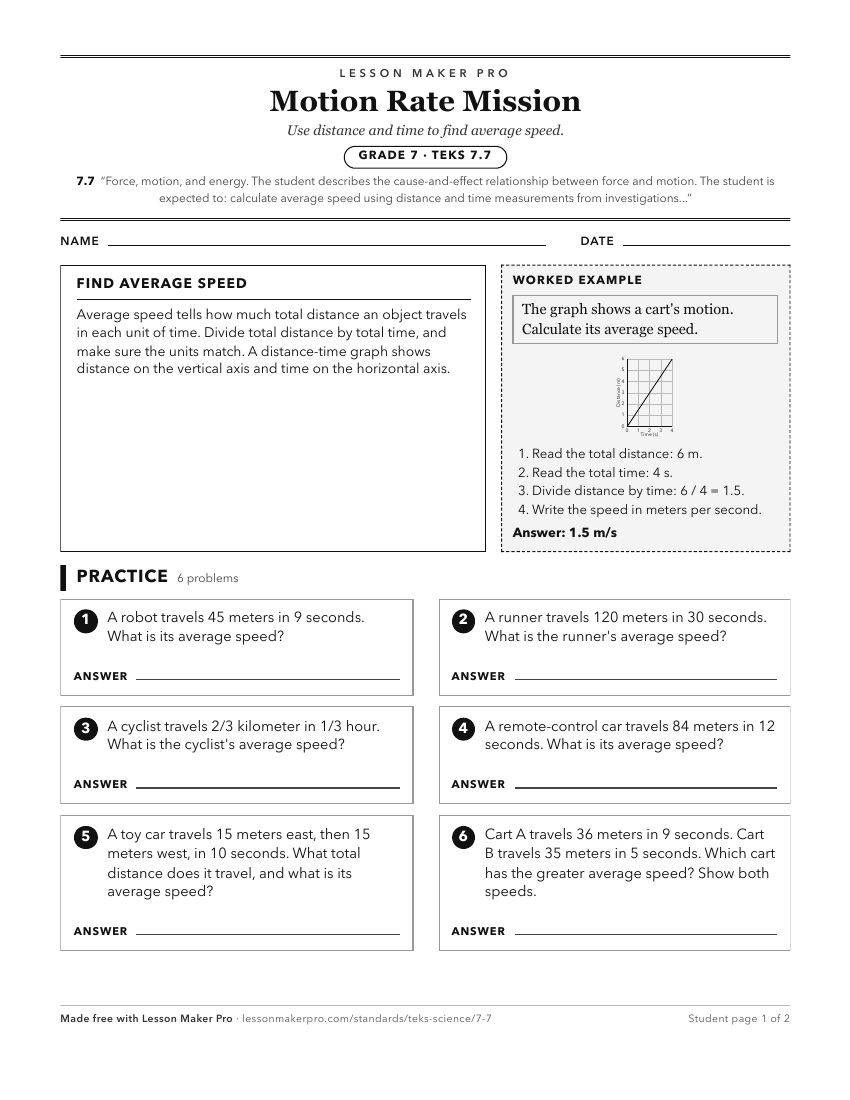
A ready-to-print activity worksheet aligned to 7.7, with an answer key for the teacher on its own page. No account needed.
PDF, US Letter, prints cleanly in black and white.
Download the worksheetKeep exploring
Related Standards
- 1.7
Force, motion, and energy. The student knows that forces cause changes in motion and position in everyday life. The student is expected to:
- 3.7
Force, motion, and energy. The student knows the nature of forces and the patterns of their interactions. The student is expected to:
- 5.7
Force, motion, and energy. The student knows the nature of forces and the patterns of their interactions. The student is expected to:
- 2.7
Force, motion, and energy. The student knows that forces cause changes in motion and position in everyday life. The student is expected to:
Turn this cluster into a lesson
Grade, subject, topic, and the complete cluster are prefilled. Create one free, no account needed.
Also for this cluster:Make a WorksheetMake a QuizMake a Sub Lesson