Texas TEKS 7.7.B
The Standard
- 7.7
- Force, motion, and energy. The student describes the cause-and-effect relationship between force and motion. The student is expected to:
distinguish between speed and velocity in linear motion in terms of distance, displacement, and direction
Texas Essential Knowledge and Skills for Science
Teacher's field guide
What This Standard Means
What Students Need to Do
- Students compare how far an object travels with its net change in position. They explain that speed has magnitude only, while velocity also includes direction.
What Mastery Looks Like
- Students can determine distance, displacement, average speed, and average velocity from a linear motion example. They include direction with velocity and displacement when needed.
Common Misconceptions
- Students often treat distance and displacement as the same value, especially when an object reverses direction. They may omit direction from velocity or incorrectly describe speed as negative.
How to Assess It
- Exit ticket: A runner moves 30 m east, then 10 m west, in 20 s. Find distance, displacement, average speed, and average velocity.
Lesson moves
Ways to Teach It
Mark a 10-meter hallway line; students walk 6 meters east, then 2 meters west, and compare total distance with displacement.
Ask, “Can two students have the same speed but different velocities?” Students write a claim and support it with a directional example.
Play a card sort matching motion stories to distance, displacement, speed, or velocity, then have partners justify each match.
Compare two cars traveling 50 km/h in opposite directions, and have students explain why their speeds match but velocities do not.
Free download
Printable 7.7.B Worksheet
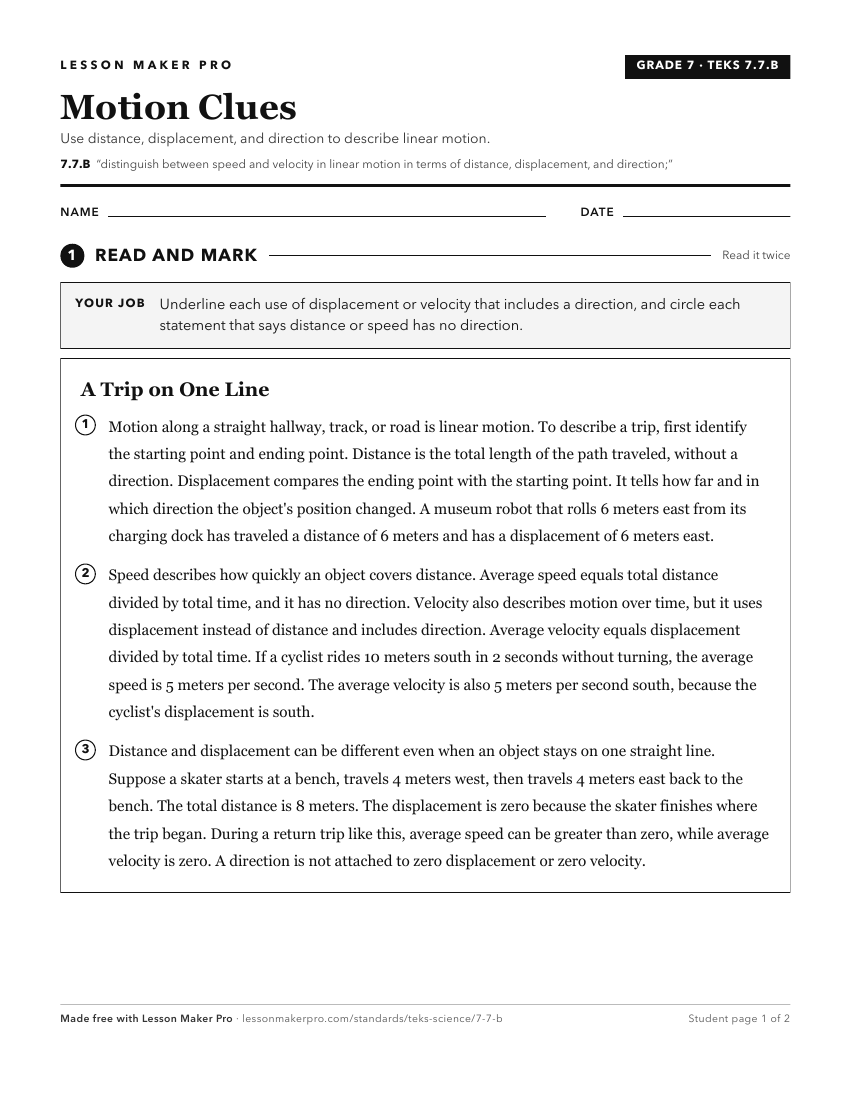
A ready-to-print activity worksheet aligned to 7.7.B, with an answer key for the teacher on its own page. No account needed.
PDF, US Letter, prints cleanly in black and white.
Download the worksheetKeep exploring
Related Standards
- 7.7.A
calculate average speed using distance and time measurements from investigations
- 1.7.A
explain how pushes and pulls can start, stop, or change the speed or direction of an object's motion
- 7.7
Force, motion, and energy. The student describes the cause-and-effect relationship between force and motion. The student is expected to:
- 7.7.C
measure, record, and interpret an object's motion using distance-time graphs
Turn this exact standard into a lesson
Grade, subject, topic, and the complete standard are prefilled. Create one free, no account needed.
Also for this standard:Make a WorksheetMake a QuizMake a Sub Lesson