Texas TEKS 1.7.A
The Standard
- 1.7
- Force, motion, and energy. The student knows that forces cause changes in motion and position in everyday life. The student is expected to:
explain how pushes and pulls can start, stop, or change the speed or direction of an object's motion
Texas Essential Knowledge and Skills for Science
Teacher's field guide
What This Standard Means
What Students Need to Do
- Students observe an object before and after someone applies a push or pull. They identify the force and describe how the object's movement changed.
What Mastery Looks Like
- A student can predict what a particular push or pull will do to a ball, wagon, or toy car. The student names the change and supports the answer with an observation.
Common Misconceptions
- Students may call any contact a push, even when a string or handle is pulled toward them. They may think forces only begin motion, or that changing direction always changes speed.
How to Assess It
- Exit ticket: A wagon is still. Draw and label a push or pull that starts it, then show another force that stops it or makes it turn.
Lesson moves
Ways to Teach It
Set up toy cars, ramps, and blocks, then have pairs use gentle and strong pushes to make cars start, stop, speed up, or turn.
Show a playground photo and ask, “Where do you see a push or pull, and how does it change motion?”
Play Motion Charades: students move an eraser to match cards labeled start, stop, faster, slower, and turn, then name the force used.
Test classroom doors, drawers, and chairs, then record whether each everyday action uses a push, a pull, or both.
Free download
Printable 1.7.A Worksheet
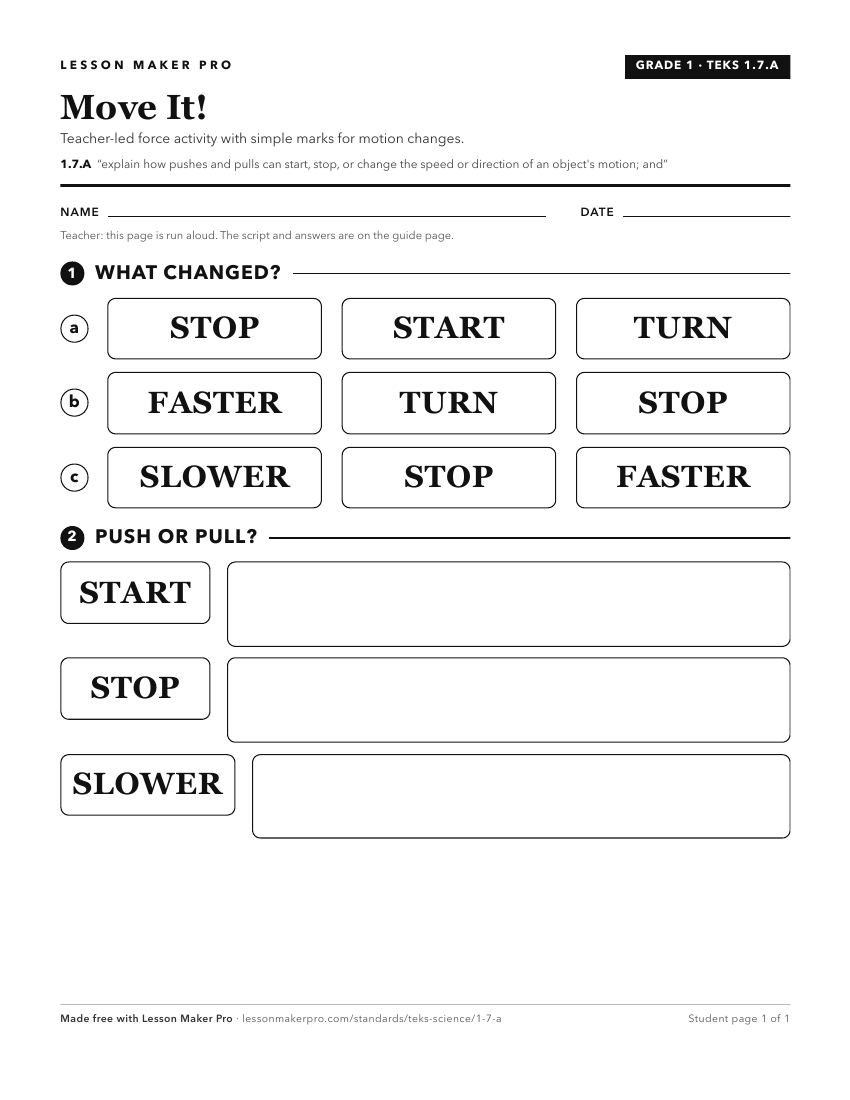
A ready-to-print activity worksheet aligned to 1.7.A, with an answer key for the teacher on its own page. No account needed.
PDF, US Letter, prints cleanly in black and white.
Download the worksheetKeep exploring
Related Standards
- 3.7.A
demonstrate and describe forces acting on an object in contact or at a distance, including magnetism, gravity, and pushes and pulls
- 1.7.B
plan and conduct a descriptive investigation that predicts how pushes and pulls can start, stop, or change the speed or direction of an object's motion.
- 2.7.A
explain how objects push on each other and may change shape when they touch or collide
- 2.7.B
plan and conduct a descriptive investigation to demonstrate how the strength of a push and pull changes an object's motion.
Turn this exact standard into a lesson
Grade, subject, topic, and the complete standard are prefilled. Create one free, no account needed.
Also for this standard:Make a WorksheetMake a QuizMake a Sub Lesson