Texas TEKS 2.7.A
The Standard
- 2.7
- Force, motion, and energy. The student knows that forces cause changes in motion and position in everyday life. The student is expected to:
explain how objects push on each other and may change shape when they touch or collide
Texas Essential Knowledge and Skills for Science
Teacher's field guide
What This Standard Means
What Students Need to Do
- Students explain that when objects make contact, each presses on the other. They observe whether either object changes shape and use visible evidence to support their explanation.
What Mastery Looks Like
- Given a toy car striking a clay block, a student explains that the car presses the clay and the clay presses back. The student identifies the dent as evidence of a shape change.
Common Misconceptions
- Students may think only the moving object pushes. They may assume every collision causes a visible or lasting shape change. They may also confuse a change in position with a change in shape.
How to Assess It
- Give this exit ticket: “A toy car rolls into a soft clay wall and leaves a dent. Draw what happens and explain what each object does.”
Lesson moves
Ways to Teach It
Roll toy cars into blocks of modeling clay, compare the dents, and describe what happened to the car and clay.
Show two balls colliding and ask, “How did each ball act on the other, and what evidence supports your answer?”
Play a card sort using pictures of bumps, dents, bends, and bounces, grouping events by no, temporary, or lasting shape change.
Inspect a bicycle helmet, foam package, and car bumper photos, then explain why each material may bend or compress during impact.
Free download
Printable 2.7.A Worksheet
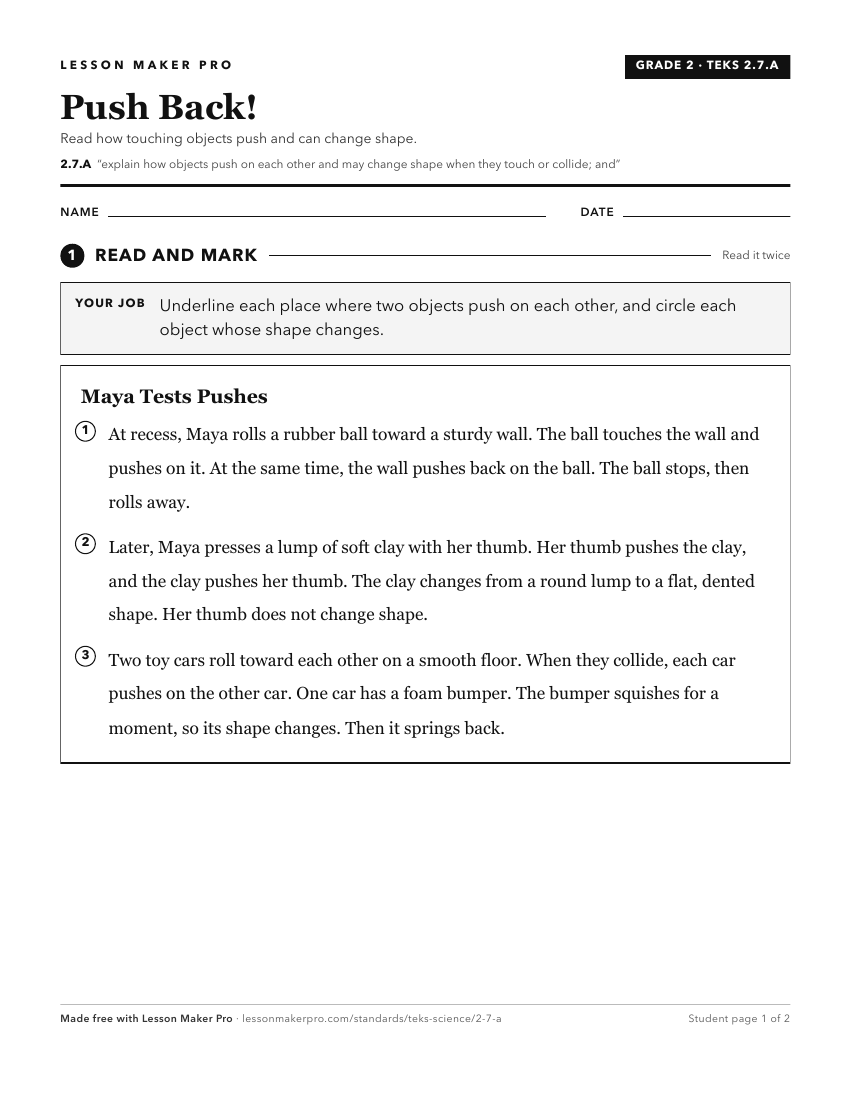
A ready-to-print activity worksheet aligned to 2.7.A, with an answer key for the teacher on its own page. No account needed.
PDF, US Letter, prints cleanly in black and white.
Download the worksheetKeep exploring
Related Standards
- 3.7.A
demonstrate and describe forces acting on an object in contact or at a distance, including magnetism, gravity, and pushes and pulls
- 1.7.A
explain how pushes and pulls can start, stop, or change the speed or direction of an object's motion
- 6.7.A
identify and explain how forces act on objects, including gravity, friction, magnetism, applied forces, and normal forces, using real-world applications
- 5.7.A
investigate and explain how equal and unequal forces acting on an object cause patterns of motion and transfer of energy
Turn this exact standard into a lesson
Grade, subject, topic, and the complete standard are prefilled. Create one free, no account needed.
Also for this standard:Make a WorksheetMake a QuizMake a Sub Lesson