Texas TEKS 7.14.A
The Standard
- 7.14
- Organisms and environments. The student knows how the taxonomic system is used to describe relationships between organisms. The student is expected to:
describe the taxonomic system that categorizes organisms based on similarities and differences shared among groups
Texas Essential Knowledge and Skills for Science
Teacher's field guide
What This Standard Means
What Students Need to Do
- Students explain how scientists place organisms into nested groups by comparing traits. They use domain, kingdom, phylum, class, order, family, genus, and species to show increasing similarity.
What Mastery Looks Like
- Given several organisms, students place each one in the correct groups and justify the placement with shared traits. They read a classification chart and identify which organisms are most closely related.
Common Misconceptions
- Students may reverse the ranks or think each rank is a separate, unrelated group. They may classify organisms by habitat or appearance alone. They may also think groups show which organisms are better or more advanced.
How to Assess It
- Exit ticket: Order the eight taxonomic ranks from broadest to narrowest. Then explain why organisms sharing a genus are more closely related than organisms sharing only a family.
Lesson moves
Ways to Teach It
Give groups organism cards with visible traits, then have students sort them into nested groups and label each split with the trait used.
Ask students to defend or reject this claim: A whale belongs with fish because both live in water.
Run a card relay where teams arrange taxonomic ranks from broadest to narrowest, then match organisms to their listed groups.
Use a local field guide to compare an oak and a pecan, then record the narrowest taxonomic group they share.
Free download
Printable 7.14.A Worksheet
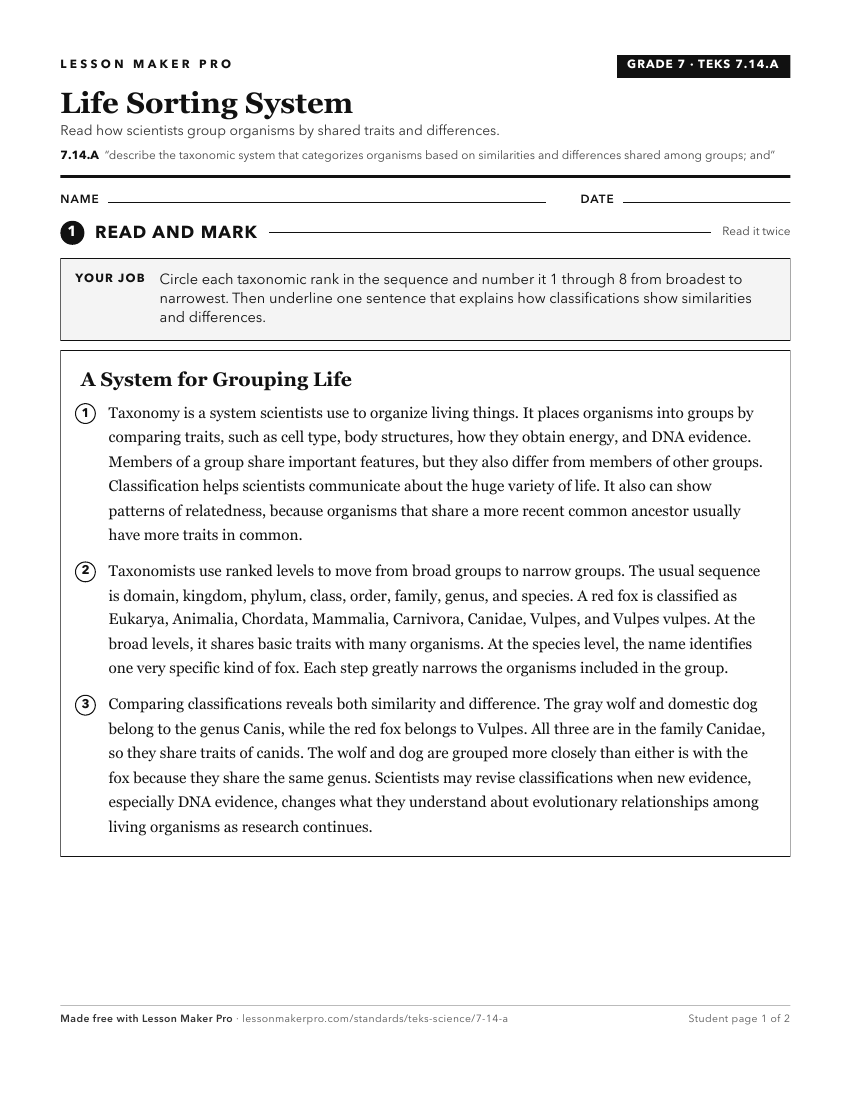
A ready-to-print activity worksheet aligned to 7.14.A, with an answer key for the teacher on its own page. No account needed.
PDF, US Letter, prints cleanly in black and white.
Download the worksheetKeep exploring
Related Standards
- 7.13.B
describe the hierarchical organization of cells, tissues, organs, and organ systems within plants and animals
- K.5.F
describe the relationship between the structure and function of objects, organisms, and systems
- 7.14
Organisms and environments. The student knows how the taxonomic system is used to describe relationships between organisms. The student is expected to:
- 6.13.B
identify and compare the basic characteristics of organisms, including prokaryotic and eukaryotic, unicellular and multicellular, and autotrophic and heterotrop...
Turn this exact standard into a lesson
Grade, subject, topic, and the complete standard are prefilled. Create one free, no account needed.
Also for this standard:Make a WorksheetMake a QuizMake a Sub Lesson