Texas TEKS 7.1.H
The Standard
- 7.1
- Scientific and engineering practices. The student, for at least 40% of instructional time, asks questions, identifies problems, and plans and safely conducts classroom, laboratory, and field investigations to answer questions, explain phenomena, or design solutions using appropriate tools and models. The student is expected to:
distinguish between scientific hypotheses, theories, and laws.
Texas Essential Knowledge and Skills for Science
Teacher's field guide
What This Standard Means
What Students Need to Do
- Students classify scientific statements by their purpose and level of support. They explain that a hypothesis is testable, a theory explains broad evidence, and a law describes a repeated pattern.
What Mastery Looks Like
- Given unfamiliar examples, students label each one and cite clues such as testability, explanatory scope, repeated results, or mathematical form. They also explain why theories do not turn into laws.
Common Misconceptions
- Students often think a hypothesis is just a guess and a theory is an opinion. They may also think a law is a proven theory, rather than a description of a consistent pattern.
How to Assess It
- Exit ticket: Label each statement and give one clue: “Salt raises water’s boiling point,” “Particles explain matter’s properties,” and “Gas pressure rises as volume decreases.”
Lesson moves
Ways to Teach It
Give groups nine statement cards with evidence clues, then have them sort the cards and defend one placement.
Ask students to write: Why does a well-supported theory not become a law, even after many successful tests?
Play a team relay where students label examples, earn a point for accuracy, and earn another point for a valid reason.
Read an aerosol-can heat warning, then connect it to a testable prediction, kinetic molecular theory, and the pressure-temperature gas law.
Free download
Printable 7.1.H Worksheet
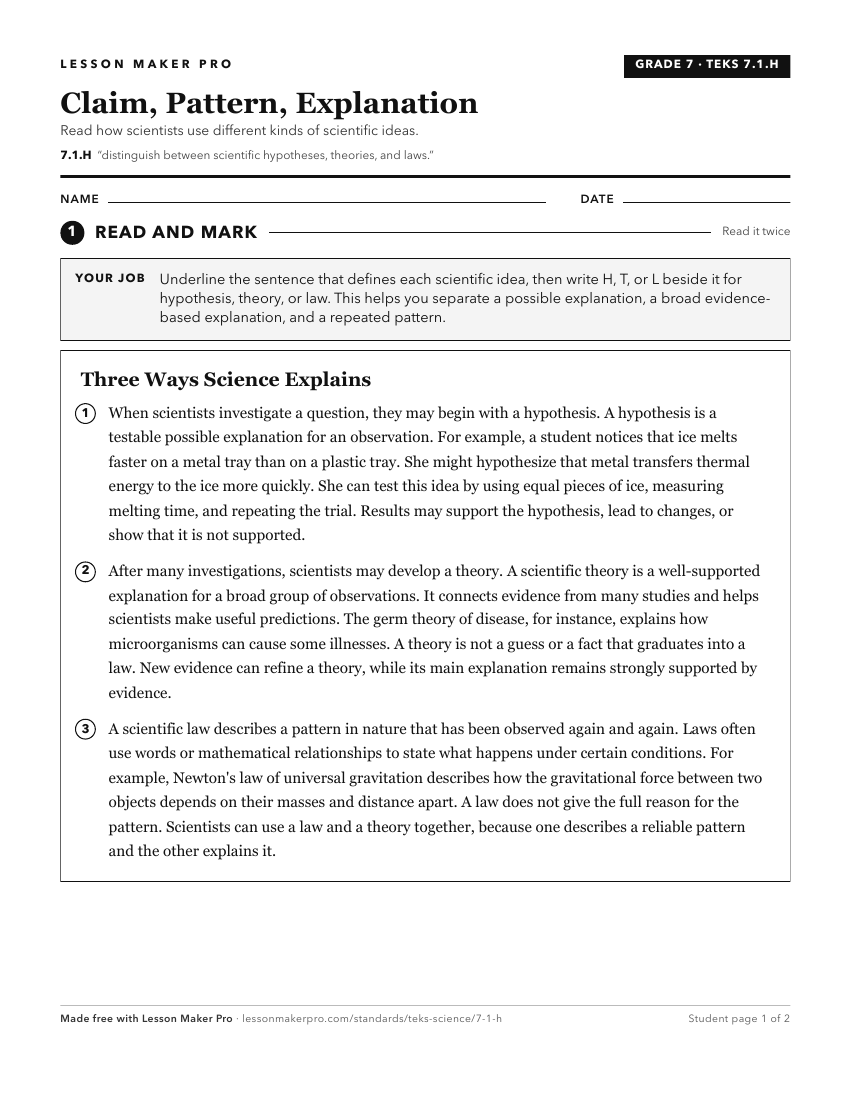
A ready-to-print activity worksheet aligned to 7.1.H, with an answer key for the teacher on its own page. No account needed.
PDF, US Letter, prints cleanly in black and white.
Download the worksheetKeep exploring
Related Standards
Turn this exact standard into a lesson
Grade, subject, topic, and the complete standard are prefilled. Create one free, no account needed.
Also for this standard:Make a WorksheetMake a QuizMake a Sub Lesson