Texas TEKS 6.1.H
The Standard
- 6.1
- Scientific and engineering practices. The student, for at least 40% of instructional time, asks questions, identifies problems, and plans and safely conducts classroom, laboratory, and field investigations to answer questions, explain phenomena, or design solutions using appropriate tools and models. The student is expected to:
distinguish between scientific hypotheses, theories, and laws.
Texas Essential Knowledge and Skills for Science
Teacher's field guide
What This Standard Means
What Students Need to Do
- Students sort scientific claims by their purpose and level of support. They recognize a testable proposed explanation, a broad evidence-based explanation, and a statement describing a consistent pattern.
What Mastery Looks Like
- Given unfamiliar examples, students classify each one and justify the choice using evidence, testing, explanation, or pattern. They explain that theories do not turn into laws.
Common Misconceptions
- Students often think a theory is just a guess or that enough proof turns a theory into a law. They may also think laws explain why patterns occur.
How to Assess It
- Exit ticket: Classify each statement and explain why: “More light will increase bean growth,” plate tectonics, and Newton’s third law.
Lesson moves
Ways to Teach It
Give pairs cards with sample claims, then have them sort the cards into hypothesis, theory, and law groups with written reasons.
Ask students to explain why a well-supported theory does not become a law, using one scientific example.
Play a three-corner game where students move to the matching label after each claim is read and defend their choice.
Examine disease research through a transmission hypothesis, germ theory as an explanation, and gas laws that describe breathing patterns.
Free download
Printable 6.1.H Worksheet
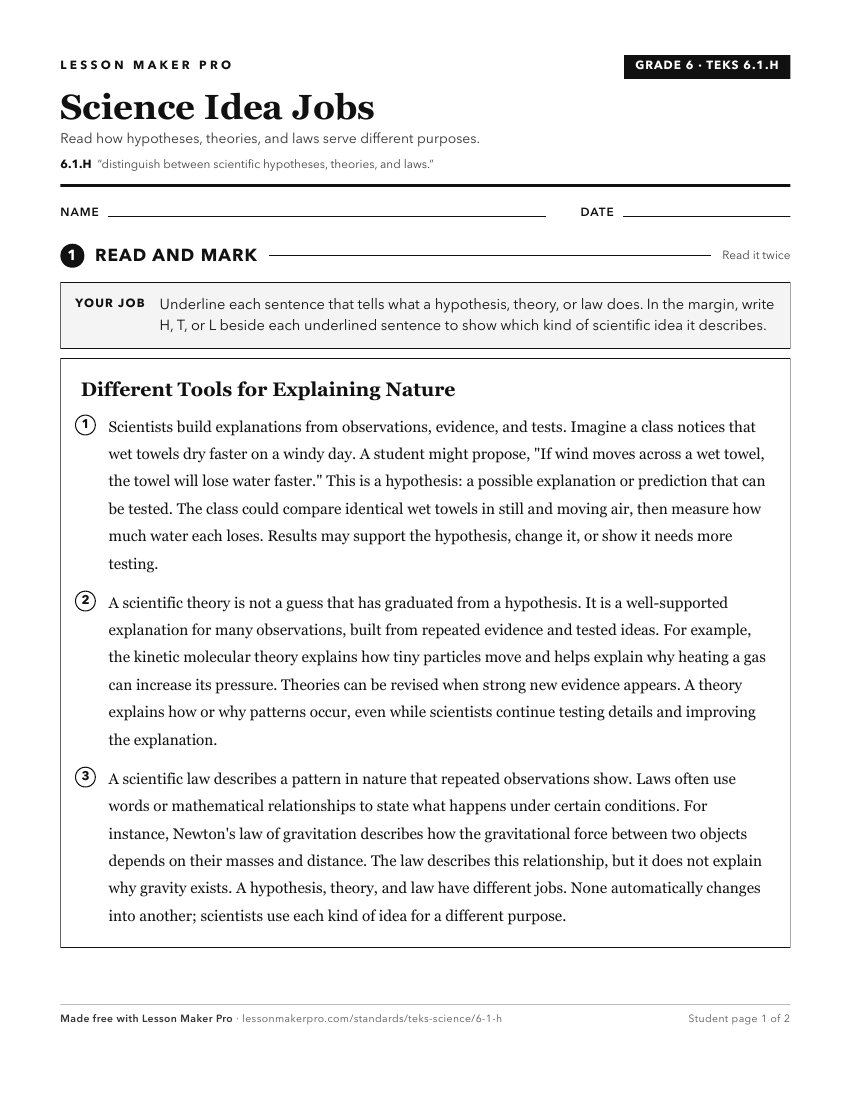
A ready-to-print activity worksheet aligned to 6.1.H, with an answer key for the teacher on its own page. No account needed.
PDF, US Letter, prints cleanly in black and white.
Download the worksheetKeep exploring
Related Standards
Turn this exact standard into a lesson
Grade, subject, topic, and the complete standard are prefilled. Create one free, no account needed.
Also for this standard:Make a WorksheetMake a QuizMake a Sub Lesson