Texas TEKS 7.1.G
The Standard
- 7.1
- Scientific and engineering practices. The student, for at least 40% of instructional time, asks questions, identifies problems, and plans and safely conducts classroom, laboratory, and field investigations to answer questions, explain phenomena, or design solutions using appropriate tools and models. The student is expected to:
develop and use models to represent phenomena, systems, processes, or solutions to engineering problems
Texas Essential Knowledge and Skills for Science
Teacher's field guide
What This Standard Means
What Students Need to Do
- Students create diagrams, physical objects, or simulations that explain how parts of a system interact. They use observations and test results to revise their models.
What Mastery Looks Like
- Students include relevant parts, labels, relationships, and changes over time. They use the model to explain evidence, make a prediction, and identify a limitation.
Common Misconceptions
- Students may treat a model as a decorative copy rather than an explanation. They may omit unseen parts, assume models are exact, or resist revising a model when evidence changes.
How to Assess It
- Ask students to draw a particle model of sugar dissolving in water, then label the changes and predict what happens if more sugar is added.
Lesson moves
Ways to Teach It
Use beads, cups, and craft sticks to build a model showing how particles move when a solid dissolves.
Show two models of the same phenomenon and ask students to write which explains the evidence better and why.
Play Model Match by pairing phenomenon cards with diagram cards, then have students defend or revise each match.
Map lunchtime cafeteria traffic, identify a bottleneck, and model one layout change that could improve movement.
Free download
Printable 7.1.G Worksheet
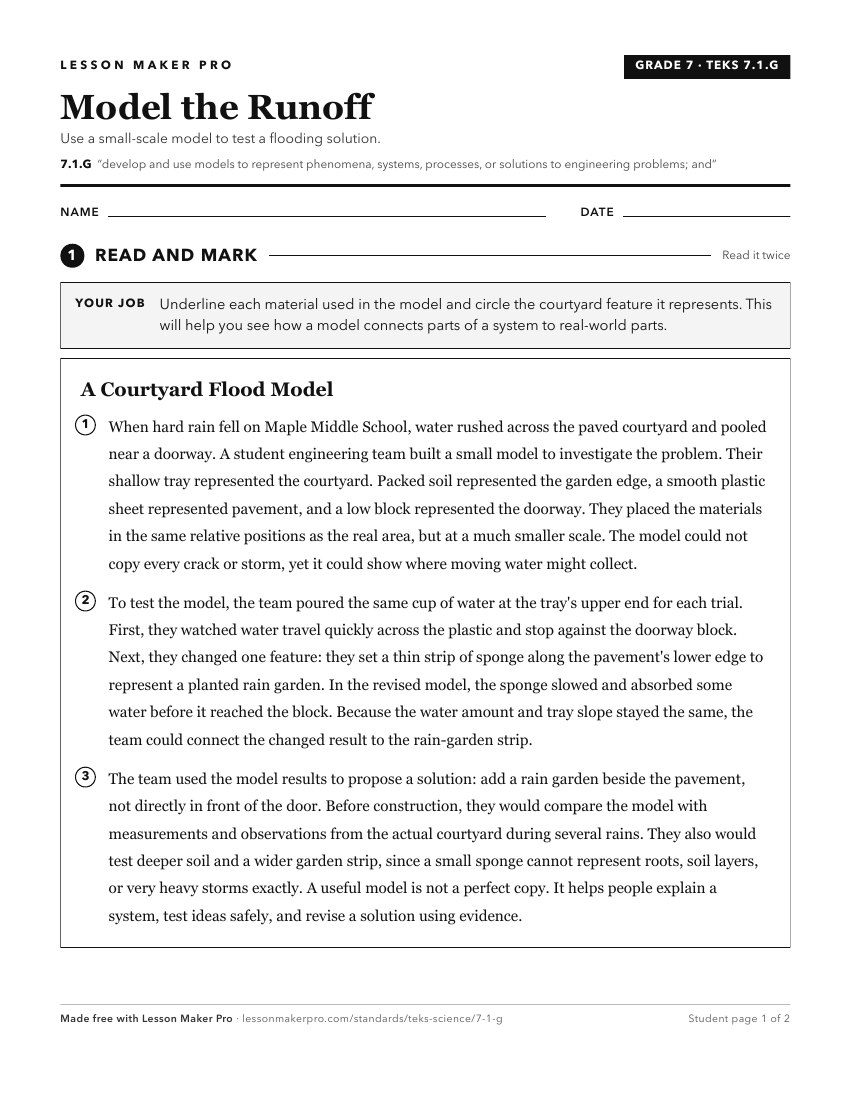
A ready-to-print activity worksheet aligned to 7.1.G, with an answer key for the teacher on its own page. No account needed.
PDF, US Letter, prints cleanly in black and white.
Download the worksheetKeep exploring
Related Standards
- 6.1.G
The 6th Grade version of this standard.
- K.1.G
develop and use models to represent phenomena, objects, and processes or design a prototype for a solution to a problem.
- 5.1.G
develop and use models to represent phenomena, objects, and processes or design a prototype for a solution to a problem.
- 8.1.G
develop and use models to represent phenomena, systems, processes, or solutions to engineering problems
Turn this exact standard into a lesson
Grade, subject, topic, and the complete standard are prefilled. Create one free, no account needed.
Also for this standard:Make a WorksheetMake a QuizMake a Sub Lesson