Texas TEKS 6.2.B
The Standard
- 6.2
- Scientific and engineering practices. The student analyzes and interprets data to derive meaning, identify features and patterns, and discover relationships or correlations to develop evidence-based arguments or evaluate designs. The student is expected to:
analyze data by identifying any significant descriptive statistical features, patterns, sources of error, or limitations
Texas Essential Knowledge and Skills for Science
Teacher's field guide
What This Standard Means
What Students Need to Do
- Students examine tables and graphs for averages, ranges, clusters, outliers, and trends. They explain how measurement errors or limited samples affect a conclusion.
What Mastery Looks Like
- Students support a pattern with specific values from the data. They identify a reasonable source of error or limitation and explain its likely effect.
Common Misconceptions
- Students may treat every outlier as a mistake or claim a pattern from too few results. They may confuse range with average or name “human error” without explaining what happened.
How to Assess It
- Give students plant heights of 8, 9, 9, 10, and 24 centimeters. Ask them to identify one feature, one possible error, and one limitation.
Lesson moves
Ways to Teach It
Groups time ten pendulum swings three times, graph the results, then identify the range, any outlier, and one measurement error.
Show a graph with a small upward trend and ask, “What claim is supported, and what claim goes beyond the data?”
Teams sort data cards into pattern, outlier, source of error, or limitation, then defend one disputed choice.
Students examine seven days of local temperatures and explain why that sample cannot describe the area’s yearly climate.
Free download
Printable 6.2.B Worksheet
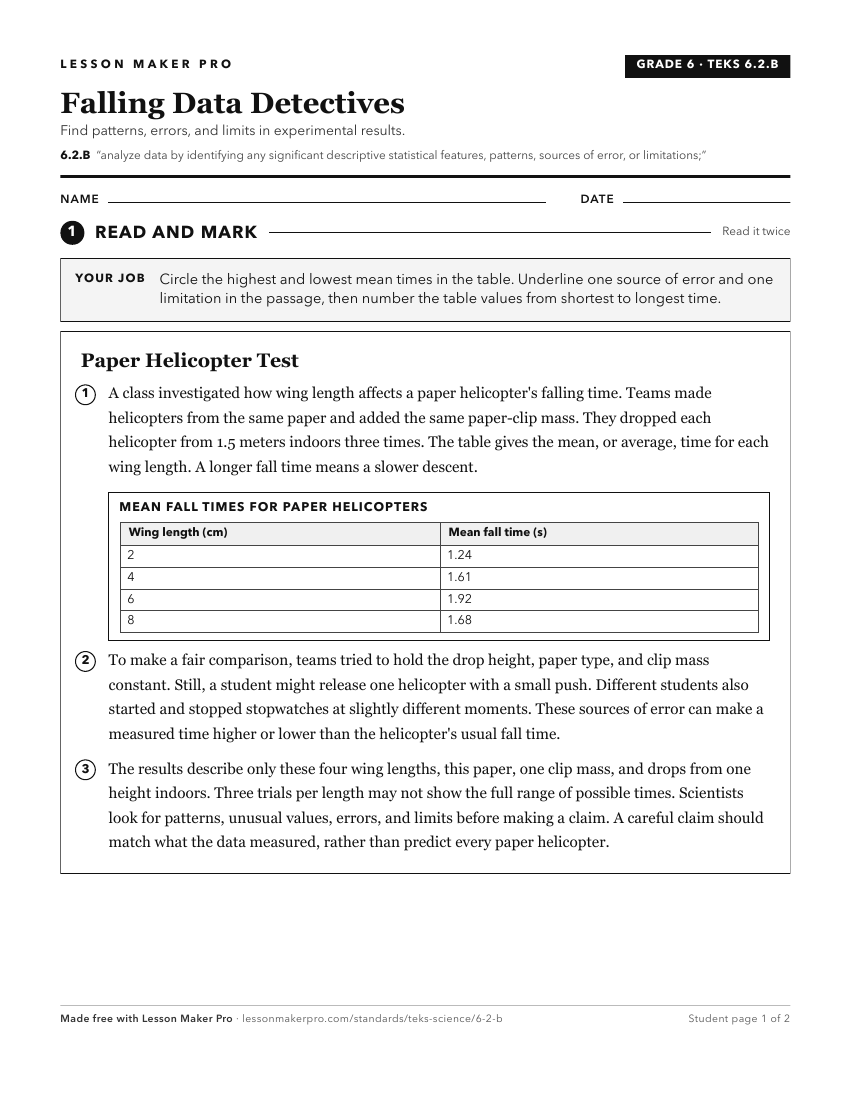
A ready-to-print activity worksheet aligned to 6.2.B, with an answer key for the teacher on its own page. No account needed.
PDF, US Letter, prints cleanly in black and white.
Download the worksheetKeep exploring
Related Standards
- 7.2.B
The 7th Grade version of this standard.
- 8.2.B
analyze data by identifying any significant descriptive statistical features, patterns, sources of error, or limitations
- 4.2.B
analyze data by identifying any significant features, patterns, or sources of error
- 3.2.B
analyze data by identifying any significant features, patterns, or sources of error
Turn this exact standard into a lesson
Grade, subject, topic, and the complete standard are prefilled. Create one free, no account needed.
Also for this standard:Make a WorksheetMake a QuizMake a Sub Lesson