Texas TEKS 5.10.B
The Standard
- 5.10
- Earth and space. The student knows that there are recognizable patterns and processes on Earth. The student is expected to:
model and describe the processes that led to the formation of sedimentary rocks and fossil fuels
Texas Essential Knowledge and Skills for Science
Teacher's field guide
What This Standard Means
What Students Need to Do
- Students build and explain models showing how loose sediment becomes rock through deposition, compaction, and cementation. They also show how buried organism remains change under heat and pressure over millions of years.
What Mastery Looks Like
- Students place each formation process in the correct order and explain what happens at every step. Their models distinguish sedimentary rock formation from fossil fuel formation.
Common Misconceptions
- Students may think sedimentary rocks form when sediment simply dries or that fossil fuels come mainly from dinosaurs. They may also leave out burial time, heat, pressure, compaction, or cementation.
How to Assess It
- Give students six blank boxes and ask them to draw and label two formation sequences, one for sandstone and one for fossil fuels.
Lesson moves
Ways to Teach It
Layer gravel, sand, and clay in a clear cup, press the layers, then add diluted glue to model compaction and cementation.
Write a comparison explaining which steps are shared by sedimentary rock and fossil fuel formation and which steps differ.
Give groups process cards to sequence, then have them defend each placement using words such as deposition, burial, compaction, heat, and pressure.
Trace gasoline or natural gas from everyday use back to buried organisms, then create a timeline showing why these fuels are nonrenewable.
Free download
Printable 5.10.B Worksheet
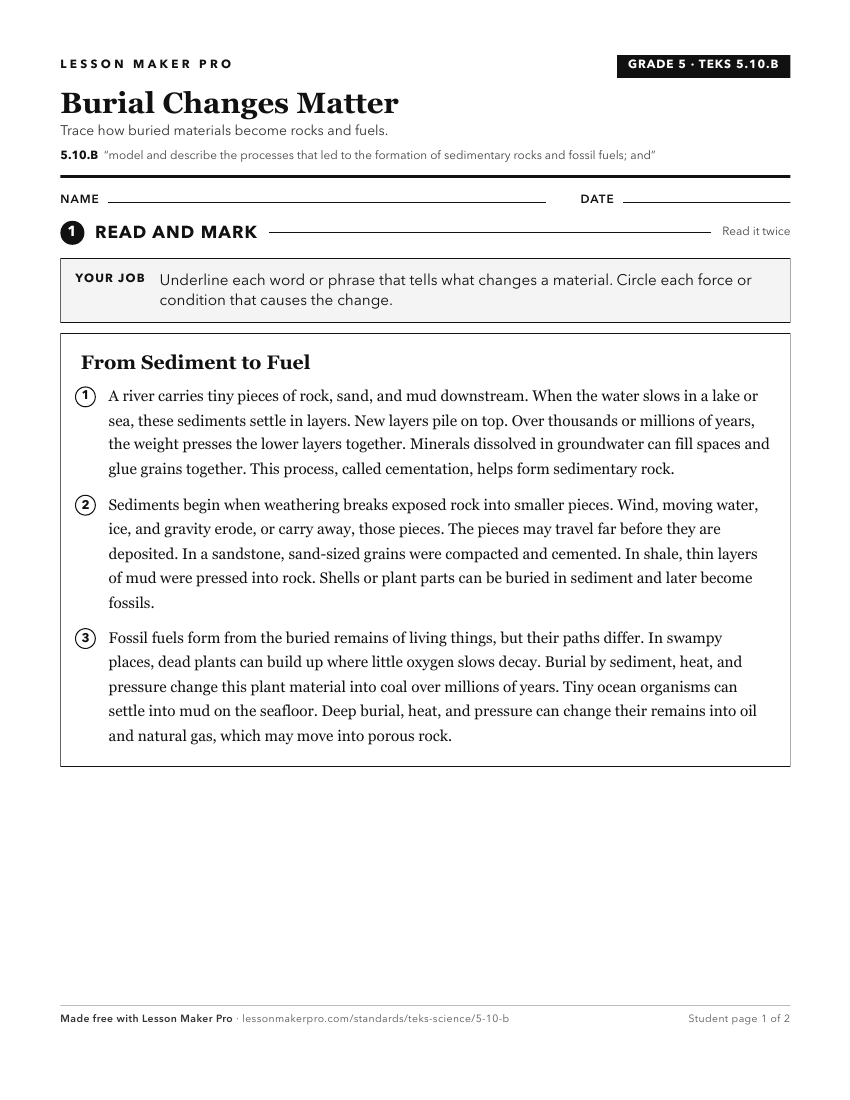
A ready-to-print activity worksheet aligned to 5.10.B, with an answer key for the teacher on its own page. No account needed.
PDF, US Letter, prints cleanly in black and white.
Download the worksheetKeep exploring
Related Standards
- 4.12.C
identify and describe past environments based on fossil evidence, including common Texas fossils.
- 5.10.C
model and identify how changes to Earth's surface by wind, water, or ice result in the formation of landforms, including deltas, canyons, and sand dunes.
- 6.10.C
describe how metamorphic, igneous, and sedimentary rocks form and change through geologic processes in the rock cycle.
- 3.10.B
investigate and explain how soils such as sand and clay are formed by weathering of rock and by decomposition of plant and animal remains
Turn this exact standard into a lesson
Grade, subject, topic, and the complete standard are prefilled. Create one free, no account needed.
Also for this standard:Make a WorksheetMake a QuizMake a Sub Lesson