Texas TEKS 4.9.B
The Standard
- 4.9
- Earth and space. The student recognizes patterns among the Sun, Earth, and Moon system and their effects. The student is expected to:
collect and analyze data to identify sequences and predict patterns of change in the observable appearance of the Moon from Earth.
Texas Essential Knowledge and Skills for Science
Teacher's field guide
What This Standard Means
What Students Need to Do
- Students keep a dated record of the Moon’s visible lit portion. They put observations in order, find the repeating pattern, and predict what the Moon will look like next.
What Mastery Looks Like
- Students correctly sequence Moon images from new Moon through full Moon and back. They use dated observations to predict whether the visible lit portion will grow or shrink.
Common Misconceptions
- Students may think the Moon makes its own light or that Earth’s shadow causes the phases. They may also think clouds change the Moon’s shape or that all phases happen in one night.
How to Assess It
- Give students four dated Moon images with the fifth image missing. Ask them to draw the missing appearance and explain the pattern they used.
Lesson moves
Ways to Teach It
Use a lamp and foam ball to model sunlight, then have students sketch the Moon’s lit portion from eight positions.
Show three dated Moon sketches and ask students to write what changed, what stayed the same, and what should appear next.
Give pairs shuffled Moon phase cards and have them race to arrange the cycle, then defend their sequence using visible changes.
Have students compare a lunar calendar with outdoor Moon observations for one week and note whether each prediction matches.
Free download
Printable 4.9.B Worksheet
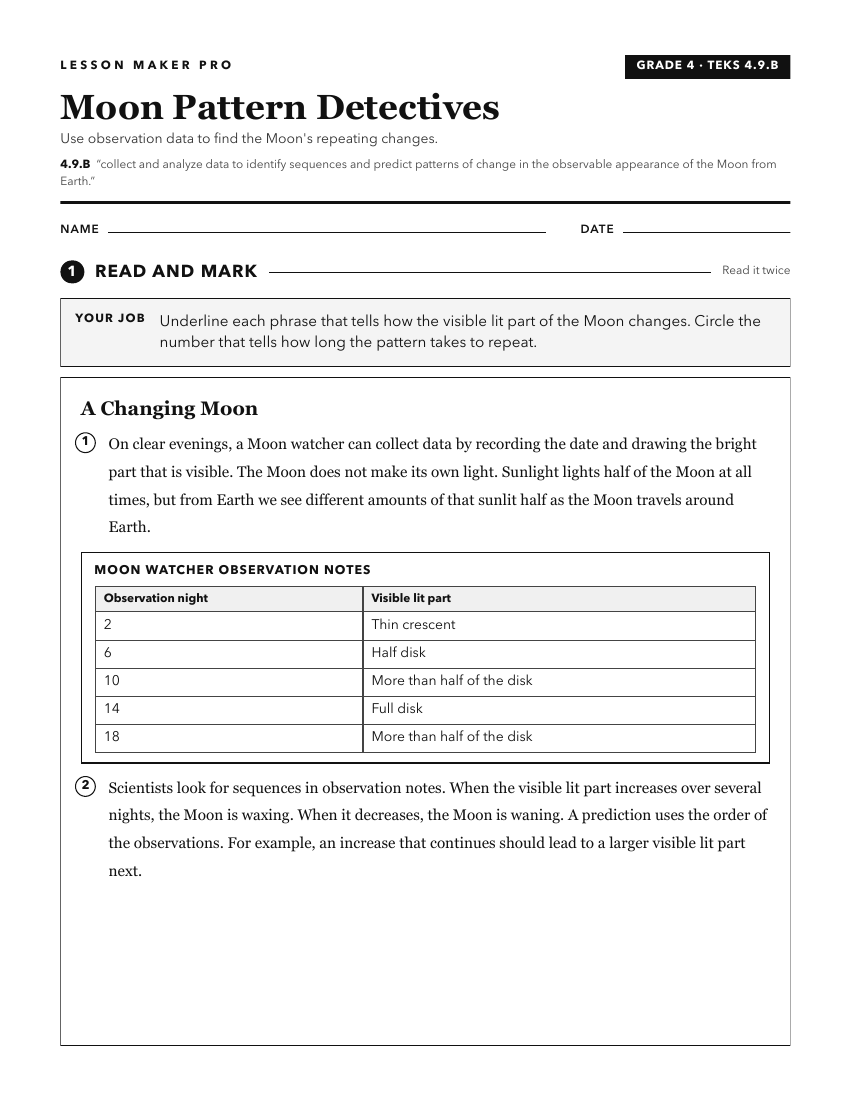
A ready-to-print activity worksheet aligned to 4.9.B, with an answer key for the teacher on its own page. No account needed.
PDF, US Letter, prints cleanly in black and white.
Download the worksheetKeep exploring
Related Standards
- K.9.B
observe, describe, and illustrate the Sun, Moon, stars, and objects in the sky such as clouds.
- 4.9.A
collect and analyze data to identify sequences and predict patterns of change in seasons such as change in temperature and length of daylight
- 3.9.A
construct models and explain the orbits of the Sun, Earth, and Moon in relation to each other
- 4.9
Earth and space. The student recognizes patterns among the Sun, Earth, and Moon system and their effects. The student is expected to:
Turn this exact standard into a lesson
Grade, subject, topic, and the complete standard are prefilled. Create one free, no account needed.
Also for this standard:Make a WorksheetMake a QuizMake a Sub Lesson