Texas TEKS 3.8.B
The Standard
- 3.8
- Force, motion, and energy. The student knows that energy is everywhere and can be observed in cycles, patterns, and systems. The student is expected to:
plan and conduct investigations that demonstrate how the speed of an object is related to its mechanical energy.
Texas Essential Knowledge and Skills for Science
Teacher's field guide
What This Standard Means
What Students Need to Do
- Students plan a fair test using the same object at different speeds. They collect evidence showing that a faster-moving object has more mechanical energy than a slower-moving object.
What Mastery Looks Like
- Students control variables such as object mass, surface, and travel distance. They measure speed, record results, and use collision effects or distance moved as evidence of mechanical energy.
Common Misconceptions
- Students may think heavier objects are always faster or that speed and force mean the same thing. They may also change several variables at once, making their results hard to explain.
How to Assess It
- Exit ticket: Plan a test with two identical toy cars to show how speed affects mechanical energy. Name what you will change, measure, and keep the same.
Lesson moves
Ways to Teach It
Roll identical toy cars down ramps of two heights, time them over one meter, then compare how far each pushes a paper cup.
Ask students to write which of two identical moving balls has more mechanical energy and cite speed evidence for their answer.
Give groups speed and collision-result cards, then have them match each speed to the most likely number of blocks knocked over.
Compare bicycle speeds and stopping distances using a simple data table, then discuss why riders slow down near people and turns.
Free download
Printable 3.8.B Worksheet
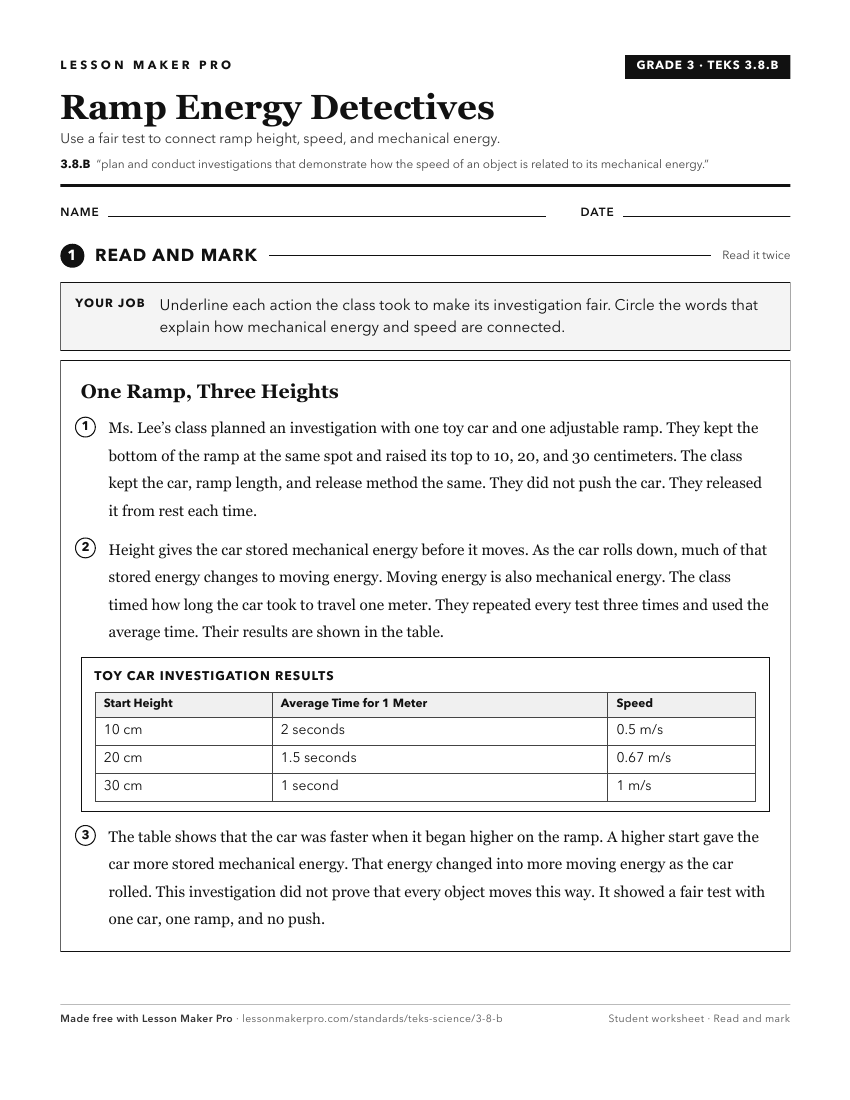
A ready-to-print activity worksheet aligned to 3.8.B, with an answer key for the teacher on its own page. No account needed.
PDF, US Letter, prints cleanly in black and white.
Download the worksheetKeep exploring
Related Standards
- 1.7.B
plan and conduct a descriptive investigation that predicts how pushes and pulls can start, stop, or change the speed or direction of an object's motion.
- 4.8.A
investigate and identify the transfer of energy by objects in motion, waves in water, and sound
- 3.7.B
plan and conduct a descriptive investigation to demonstrate and explain how position and motion can be changed by pushing and pulling objects such as swings, ba...
- 5.7.A
investigate and explain how equal and unequal forces acting on an object cause patterns of motion and transfer of energy
Turn this exact standard into a lesson
Grade, subject, topic, and the complete standard are prefilled. Create one free, no account needed.
Also for this standard:Make a WorksheetMake a QuizMake a Sub Lesson