Texas TEKS 3.5.A
The Standard
- 3.5
- Recurring themes and concepts. The student understands that recurring themes and concepts provide a framework for making connections across disciplines. The student is expected to:
identify and use patterns to explain scientific phenomena or to design solutions
Texas Essential Knowledge and Skills for Science
Teacher's field guide
What This Standard Means
What Students Need to Do
- Students look for repeated shapes, events, or changes in observations and data. They use those repetitions to explain what may happen next or choose a solution to a problem.
What Mastery Looks Like
- A student can point to a specific pattern in a table, picture, or investigation and support it with evidence. The student can use the pattern to make a reasonable prediction or improve a simple design.
Common Misconceptions
- Students may call any similarity a pattern, even when it appears only once. They may describe a pattern without explaining what it shows. They may also assume a pattern proves cause and effect.
How to Assess It
- Give students plant heights recorded every three days: 4, 6, 8, and 10 centimeters. Ask them to name the pattern, predict the next height, and explain their answer.
Lesson moves
Ways to Teach It
Teams measure two ice cubes, one in sun and one in shade, every five minutes, then mark the melting patterns on a chart.
Write: What pattern do you notice in our daily temperature chart, and how does it explain when the day is warmest?
Play Pattern Detective with cards showing weather data, animal tracks, and plant growth, then defend each identified pattern to a partner.
Use hourly playground temperatures from one week to identify the hottest times and propose a shade schedule for recess.
Free download
Printable 3.5.A Worksheet
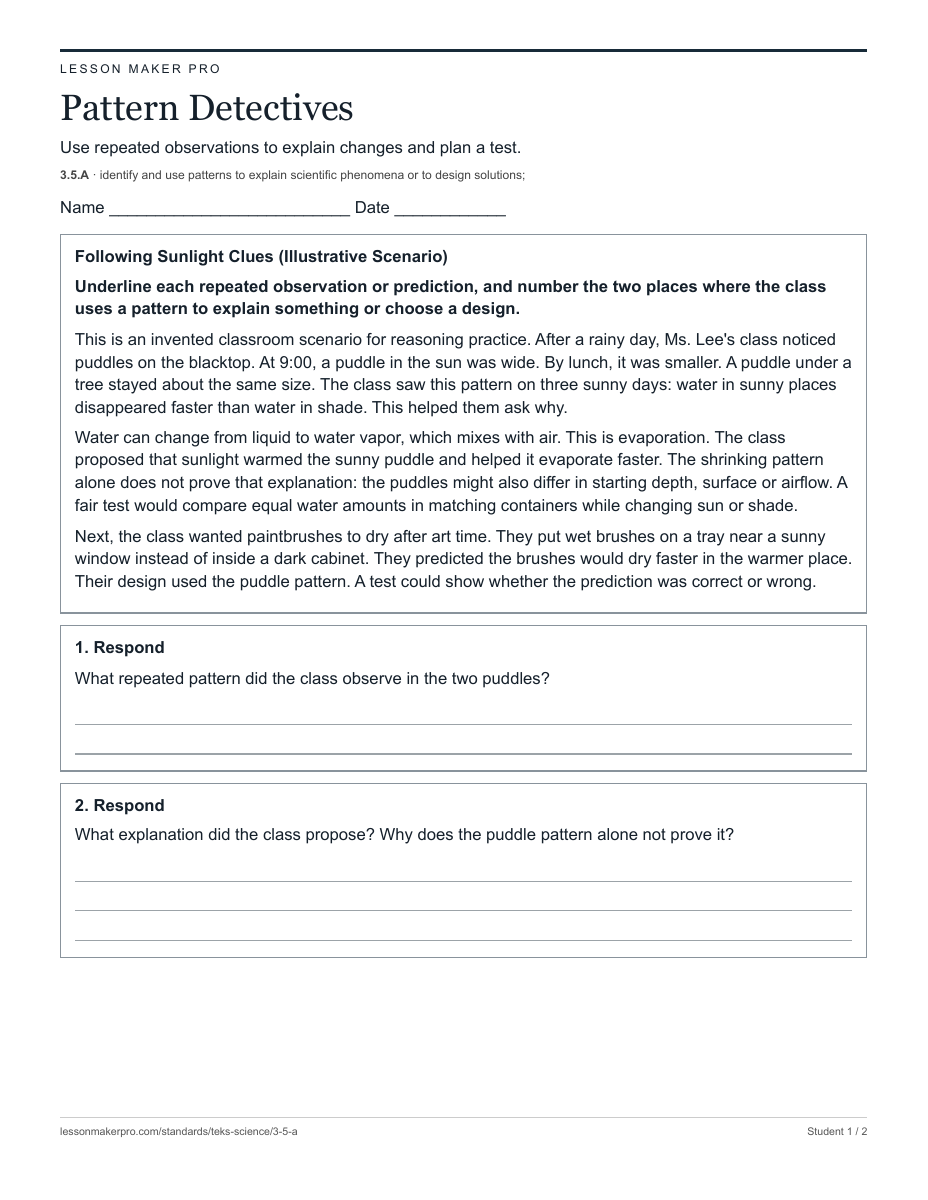
A ready-to-print activity worksheet aligned to 3.5.A, with an answer key for the teacher on its own page. No account needed.
PDF, US Letter, prints cleanly in black and white.
Download the worksheetKeep exploring
Related Standards
Turn this exact standard into a lesson
Grade, subject, topic, and the complete standard are prefilled. Create one free, no account needed.
Also for this standard:Make a WorksheetMake a QuizMake a Sub Lesson