Texas TEKS 1.10.B
The Standard
- 1.10
- Earth and space. The student knows that the natural world includes earth materials that can be observed in systems and processes. The student is expected to:
investigate and describe how water can move rock and soil particles from one place to another
Texas Essential Knowledge and Skills for Science
Teacher's field guide
What This Standard Means
What Students Need to Do
- Students observe water flowing over sand, soil, and small rocks. They describe which particles moved, where they went, and what changed on the surface.
What Mastery Looks Like
- Students can compare the land surface before and after water flows over it. They use observations to explain that flowing water carries loose material to a new location.
Common Misconceptions
- Students may think soil disappears rather than moving elsewhere. They may also think water can move only soil, not sand, gravel, or small rocks.
How to Assess It
- Give students a before-and-after drawing of water poured down a soil slope. Ask them to circle moved particles and draw arrows showing their path.
Lesson moves
Ways to Teach It
Pour water down a tilted tray of sand, soil, and pebbles, then mark where each material collects.
Ask students to write or discuss, "What changed after the water flowed, and what evidence shows that particles moved?"
Play Water Path by having students move particle cards along channels drawn on a tray as water flows.
Examine a photo of a muddy puddle after rain and discuss where the mud came from and where it may settle.
Free download
Printable 1.10.B Worksheet
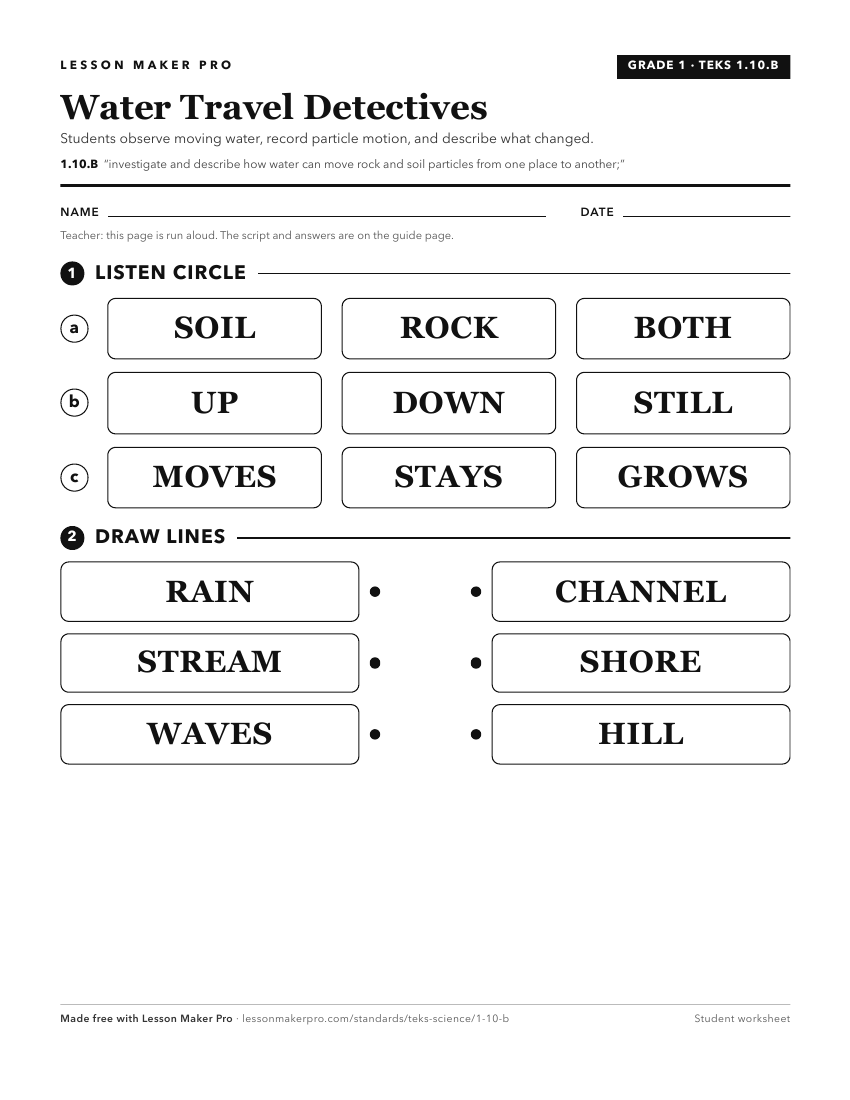
A ready-to-print activity worksheet aligned to 1.10.B, with an answer key for the teacher on its own page. No account needed.
PDF, US Letter, prints cleanly in black and white.
Download the worksheetKeep exploring
Related Standards
- 4.8.A
investigate and identify the transfer of energy by objects in motion, waves in water, and sound
- 2.10.A
investigate and describe how wind and water move soil and rock particles across the Earth's surface such as wind blowing sand into dunes on a beach or a river c...
- 1.11.A
identify and describe how plants, animals, and humans use rocks, soil, and water
- 3.10.B
investigate and explain how soils such as sand and clay are formed by weathering of rock and by decomposition of plant and animal remains
Turn this exact standard into a lesson
Grade, subject, topic, and the complete standard are prefilled. Create one free, no account needed.
Also for this standard:Make a WorksheetMake a QuizMake a Sub Lesson