TEKS Math 8.8
Knowledge and Skills Statement (Standard Cluster)
The student applies mathematical process standards to use one-variable equations or inequalities in problem situations
Texas Essential Knowledge and Skills for Mathematics
Cluster contents
Student Expectations in This Statement
8.8 is a knowledge and skills statement. These are the student expectations under it.
- 8.8.A
write one-variable equations or inequalities with variables on both sides that represent problems using rational number coefficients and constants
- 8.8.B
write a corresponding real-world problem when given a one-variable equation or inequality with variables on both sides of the equal sign using rational number c...
- 8.8.C
model and solve one-variable equations with variables on both sides of the equal sign that represent mathematical and real-world problems using rational number ...
- 8.8.D
use informal arguments to establish facts about the angle sum and exterior angle of triangles, the angles created when parallel lines are cut by a transversal, ...
Teacher's field guide
What This Cluster Means
What Students Need to Do
- Students write equations and inequalities from situations, including variables on both sides and rational numbers. They solve equations and create stories that match given equations or inequalities. They also use angle relationships to explain triangle facts, parallel-line facts, and triangle similarity.
What Mastery Looks Like
- Students translate a situation into an equation or inequality with variables on both sides and explain what each term means. They solve equations accurately and check the solution in context. They justify triangle, transversal, and similarity facts using known angle relationships.
Common Misconceptions
- Students may combine unlike terms or change only one side when solving. They often reverse which plan belongs on each side of an inequality. In geometry, they may trust a diagram instead of naming an angle relationship or giving a reason.
How to Assess It
- Give an exit ticket: “Plan A costs $15 + $2.50m. Plan B costs $6 + $4m. Write and solve an equation for equal cost, then write an inequality showing when Plan A costs less.” Add parallel lines cut by a transversal with one 65° angle, and ask students to find another angle and justify it.
Lesson moves
Ways to Teach It
Run paper stations: rearrange triangle corners, compare exterior angles, trace transversal angles, and overlay triangles with two matching angles.
Write a phone plan story for 12 + 0.08x = 20 + 0.04x, then explain each term and the solution.
Play equation card match: students pair a rational equation with its solution and verify it by substituting into both sides.
Compare two local pricing plans, then write an equation for equal cost and an inequality showing when one plan is cheaper.
Free download
Printable 8.8 Worksheet
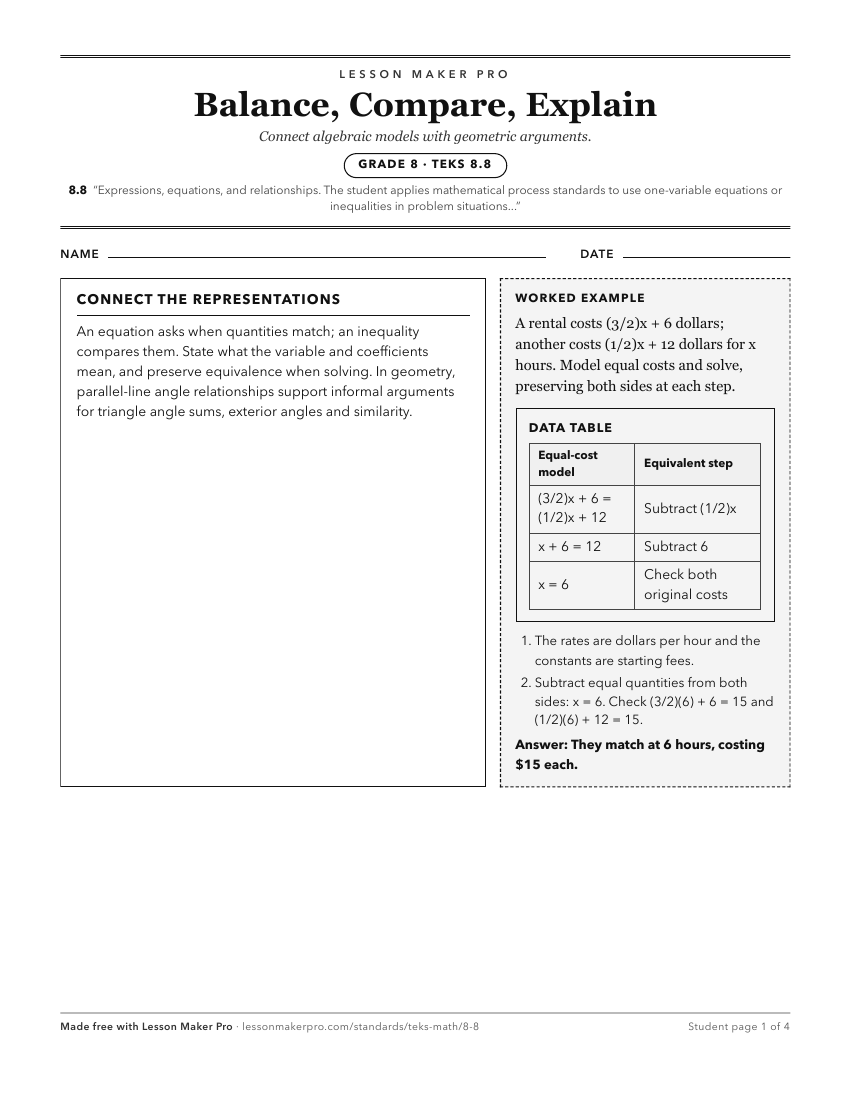
A ready-to-print activity worksheet aligned to 8.8, with an answer key for the teacher on its own page. No account needed.
PDF, US Letter, prints cleanly in black and white.
Download the worksheetKeep exploring
Related Standards
- 7.11
The student applies mathematical process standards to solve one-variable equations and inequalities
- 6.10
The student applies mathematical process standards to use equations and inequalities to solve problems
- 7.10
The student applies mathematical process standards to use one-variable equations and inequalities to represent situations
- 6.9
The student applies mathematical process standards to use equations and inequalities to represent situations
Turn this cluster into a lesson
Grade, subject, topic, and the complete cluster are prefilled. Create one free, no account needed.
Also for this cluster:Make a WorksheetMake a QuizMake a Sub Lesson