TEKS Math 8.8.C
The Standard
model and solve one-variable equations with variables on both sides of the equal sign that represent mathematical and real-world problems using rational number coefficients and constants
Texas Essential Knowledge and Skills for Mathematics
Teacher's field guide
What This Standard Means
What Students Need to Do
- Students write an equation from a situation, with the unknown appearing on both sides. They use inverse operations with fractions, decimals, and negative numbers, then interpret the solution.
What Mastery Looks Like
- A student keeps the equation balanced, combines like terms, and isolates the variable without sign errors. They can identify one solution, no solution, or infinitely many solutions and check the result in context.
Common Misconceptions
- Students often move a term across the equal sign without changing its sign, or perform an operation on only one side. They may distribute incorrectly with negative or fractional coefficients. When variables cancel, they may report zero instead of deciding whether the remaining statement is true or false.
How to Assess It
- Exit ticket: Plan A costs $18 plus $4.50 per visit. Plan B costs $36 plus $3 per visit. Write and solve an equation to find when the costs match.
Lesson moves
Ways to Teach It
Use a balance mat, x-cards, half-x cards, and unit tiles to model 3x + 2 = 1.5x + 8, then remove equal amounts.
Post two worked solutions to 2.5x - 4 = 0.5x + 8. Students identify the first incorrect step and write a correction.
Run a card sort where pairs solve equations, then place each under one solution, no solution, or infinitely many solutions.
Compare two ride-share fares, $3 + $1.20 per mile and $8 + $0.70 per mile, and find where the costs match.
Free download
Printable 8.8.C Worksheet
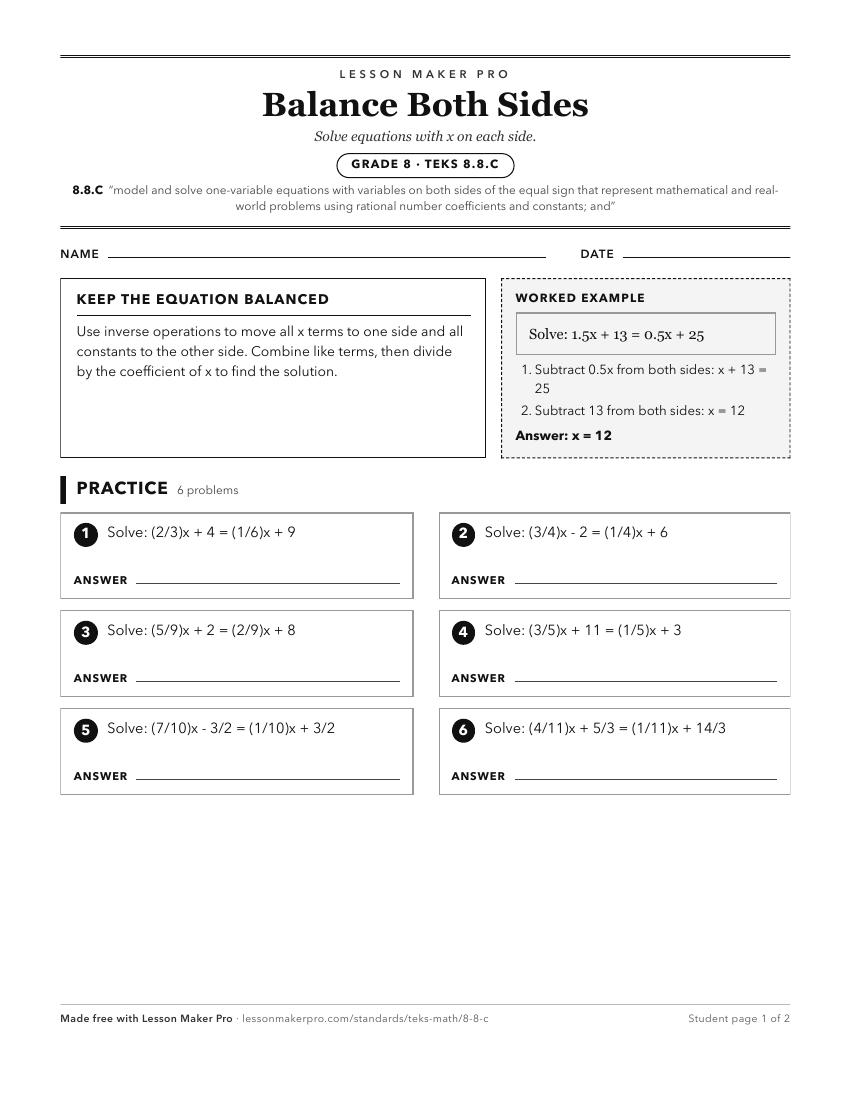
A ready-to-print activity worksheet aligned to 8.8.C, with an answer key for the teacher on its own page. No account needed.
PDF, US Letter, prints cleanly in black and white.
Download the worksheetKeep exploring
Related Standards
- 7.11.A
model and solve one-variable, two-step equations and inequalities
- 6.10.A
model and solve one-variable, one-step equations and inequalities that represent problems, including geometric concepts
- 8.8.B
write a corresponding real-world problem when given a one-variable equation or inequality with variables on both sides of the equal sign using rational number c...
- 8.8.A
write one-variable equations or inequalities with variables on both sides that represent problems using rational number coefficients and constants
Turn this exact standard into a lesson
Grade, subject, topic, and the complete standard are prefilled. Create one free, no account needed.
Also for this standard:Make a WorksheetMake a QuizMake a Sub Lesson