TEKS Math 8.2.B
The Standard
approximate the value of an irrational number, including π and square roots of numbers less than 225, and locate that rational number approximation on a number line
Texas Essential Knowledge and Skills for Mathematics
Teacher's field guide
What This Standard Means
What Students Need to Do
- Students use nearby perfect squares or known decimal values to estimate irrational numbers. They round each estimate to a requested place and place it correctly between labeled values on a number line.
What Mastery Looks Like
- A student can explain why √70 lies between 8 and 9, estimate it as about 8.4, and plot that value accurately. The student treats 3.14 as an approximation of π, not an exact value.
Common Misconceptions
- Students may treat √70 as 35 or assume it sits halfway between √64 and √81. They may write π = 3.14 as an exact equality. They may also ignore the scale when plotting decimal estimates.
How to Assess It
- Exit ticket: Without a calculator, estimate √70 to the nearest tenth, explain your bounds using perfect squares, and mark the estimate on a number line from 8 to 9.
Lesson moves
Ways to Teach It
Use square tiles to build largest squares below 50, 80, and 130, then estimate each root and place cards on a floor number line.
Ask, “Which is closer to √50, 7.0 or 7.1?” Have students defend their answer by squaring both decimals.
Play Estimate and Place: teams draw an irrational-number card, choose a decimal estimate, and earn points for correct order on a shared line.
Measure a circular lid, use 3.14 and 3.1416 to estimate its circumference, then compare both results with a string measurement.
Free download
Printable 8.2.B Worksheet
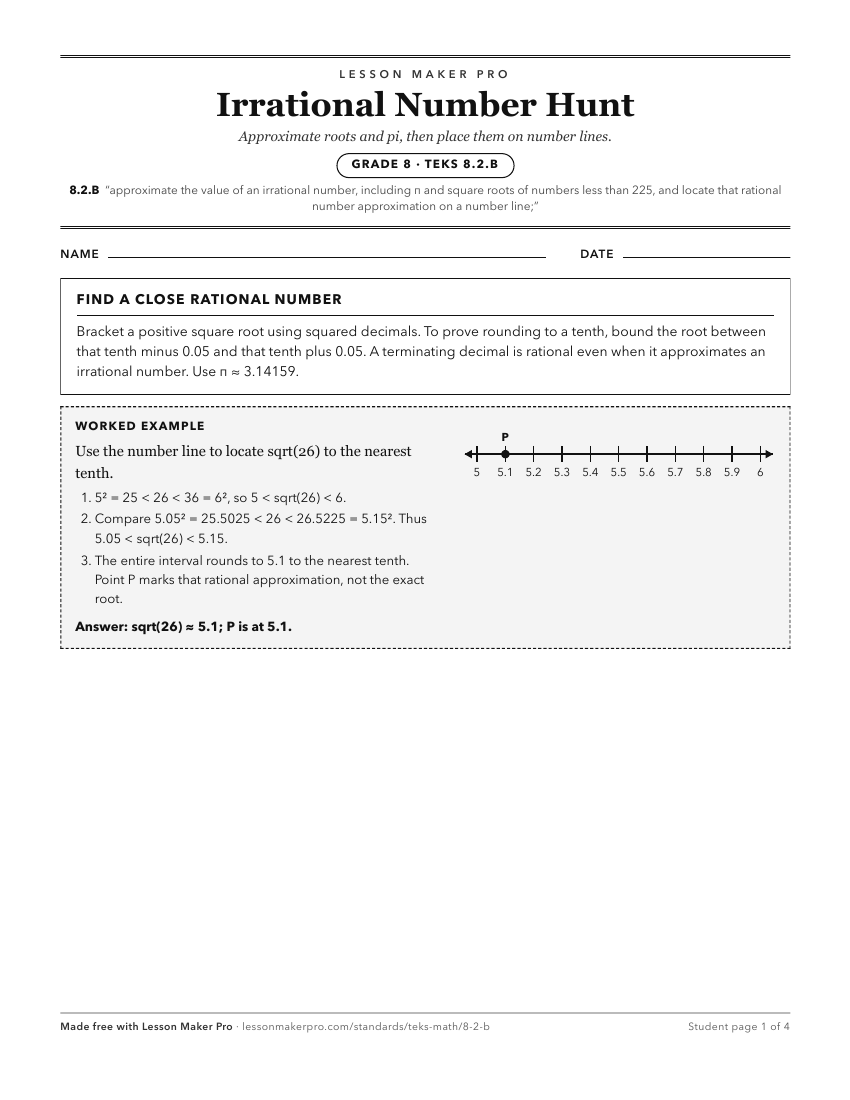
A ready-to-print activity worksheet aligned to 8.2.B, with an answer key for the teacher on its own page. No account needed.
PDF, US Letter, prints cleanly in black and white.
Download the worksheetKeep exploring
Related Standards
- 2.2.E
locate the position of a given whole number on an open number line
- 2.9.C
represent whole numbers as distances from any given location on a number line
- 3.7.A
represent fractions of halves, fourths, and eighths as distances from zero on a number line
- 6.2.C
locate, compare, and order integers and rational numbers using a number line
Turn this exact standard into a lesson
Grade, subject, topic, and the complete standard are prefilled. Create one free, no account needed.
Also for this standard:Make a WorksheetMake a QuizMake a Sub Lesson