TEKS Math 2.2.E
The Standard
locate the position of a given whole number on an open number line
Texas Essential Knowledge and Skills for Mathematics
Teacher's field guide
What This Standard Means
What Students Need to Do
- Students place a whole number in the correct relative position on a line without preset tick marks. They use endpoints, midpoints, and nearby tens as guides.
What Mastery Looks Like
- Students place a number in a reasonable position based on the line's endpoints and other labels. They use benchmarks such as multiples of ten or the midpoint to explain their choice.
Common Misconceptions
- Students may put numbers in order but ignore the space between them. They may place 25 at the midpoint of a 0-to-100 line or count marks instead of intervals.
How to Assess It
- Give students a blank line labeled 0 and 100. Ask them to mark 37 and explain which nearby tens helped them choose the position.
Lesson moves
Ways to Teach It
Stretch masking tape across the floor, label 0 and 100, then have students place numeral cards where they belong.
Ask, "Where would 68 go on a line from 0 to 100, and which benchmark helps you decide?"
Play Closest Wins: name a number, have students mark it on a 0-to-100 line, then compare placements using nearby tens.
Show a 60-minute class timeline and have students mark when minute 25 occurs, using 0, 30, and 60 as anchors.
Free download
Printable 2.2.E Worksheet
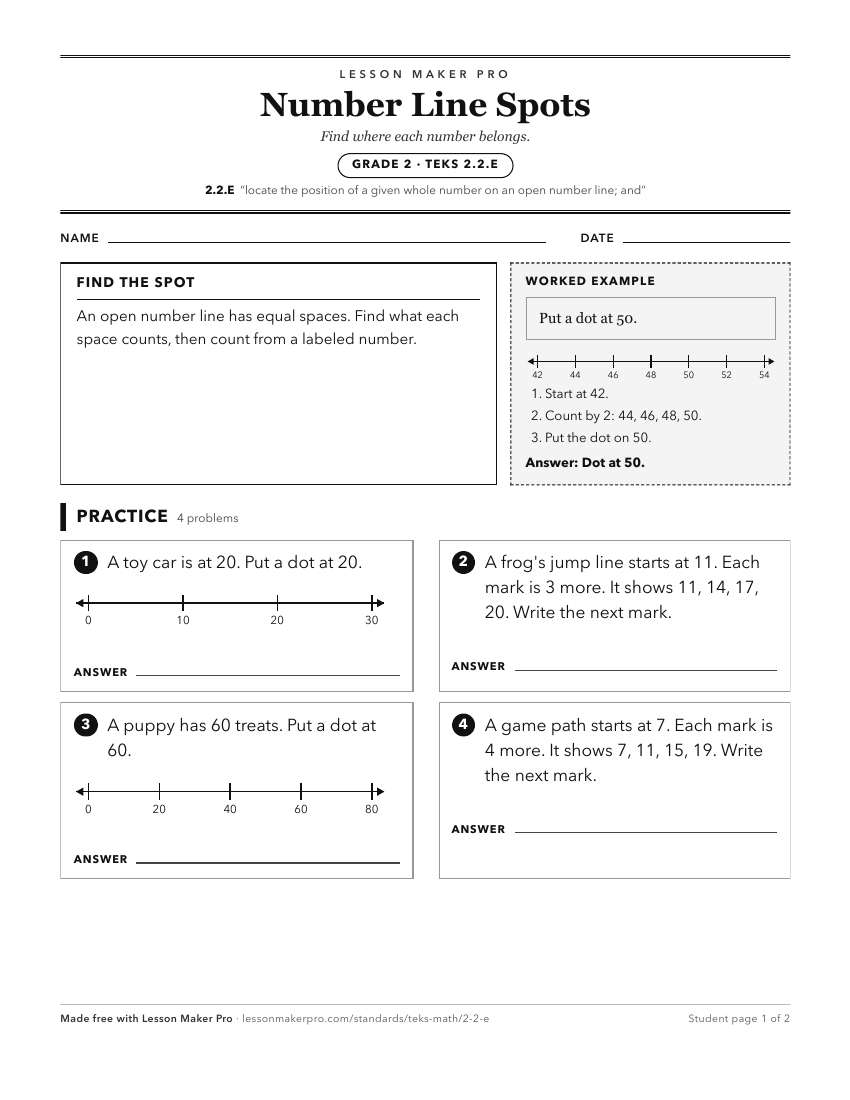
A ready-to-print activity worksheet aligned to 2.2.E, with an answer key for the teacher on its own page. No account needed.
PDF, US Letter, prints cleanly in black and white.
Download the worksheetKeep exploring
Related Standards
- 2.2.F
name the whole number that corresponds to a specific point on a number line
- 2.9.C
represent whole numbers as distances from any given location on a number line
- 6.2.C
locate, compare, and order integers and rational numbers using a number line
- 1.2.F
order whole numbers up to 120 using place value and open number lines
Turn this exact standard into a lesson
Grade, subject, topic, and the complete standard are prefilled. Create one free, no account needed.
Also for this standard:Make a WorksheetMake a QuizMake a Sub Lesson