TEKS Math 6.2.D
The Standard
order a set of rational numbers arising from mathematical and real-world contexts
Texas Essential Knowledge and Skills for Mathematics
Teacher's field guide
What This Standard Means
What Students Need to Do
- Students compare positive and negative integers, fractions, decimals, and mixed numbers. They use number lines, benchmarks, or equivalent forms to arrange values in either direction.
What Mastery Looks Like
- A student accurately orders values when forms are mixed and several values are negative. The student justifies placements by converting forms or locating values on a number line.
Common Misconceptions
- Students often think a negative number with larger digits is greater, so they place -8 above -3. They may compare fraction parts separately or claim 0.4 is greater than 1/2 because 4 is greater than 1.
How to Assess It
- Exit ticket: Order -1.4, -3/2, 0.25, -1, and 2/5 from least to greatest. Explain one comparison using equivalent forms or a number line.
Lesson moves
Ways to Teach It
Give pairs fraction, decimal, and integer cards to place on a taped floor number line, then check positions with benchmarks.
Ask, “Which is greater, -0.6 or -2/3?” Students write a claim using a number line or equivalent form as evidence.
Play Rational Number War with card pairs, awarding each round to the player who identifies the greater value and explains why.
Post five city temperatures, bank balances, or elevations, then have students arrange them from lowest to highest and describe the extremes.
Free download
Printable 6.2.D Worksheet
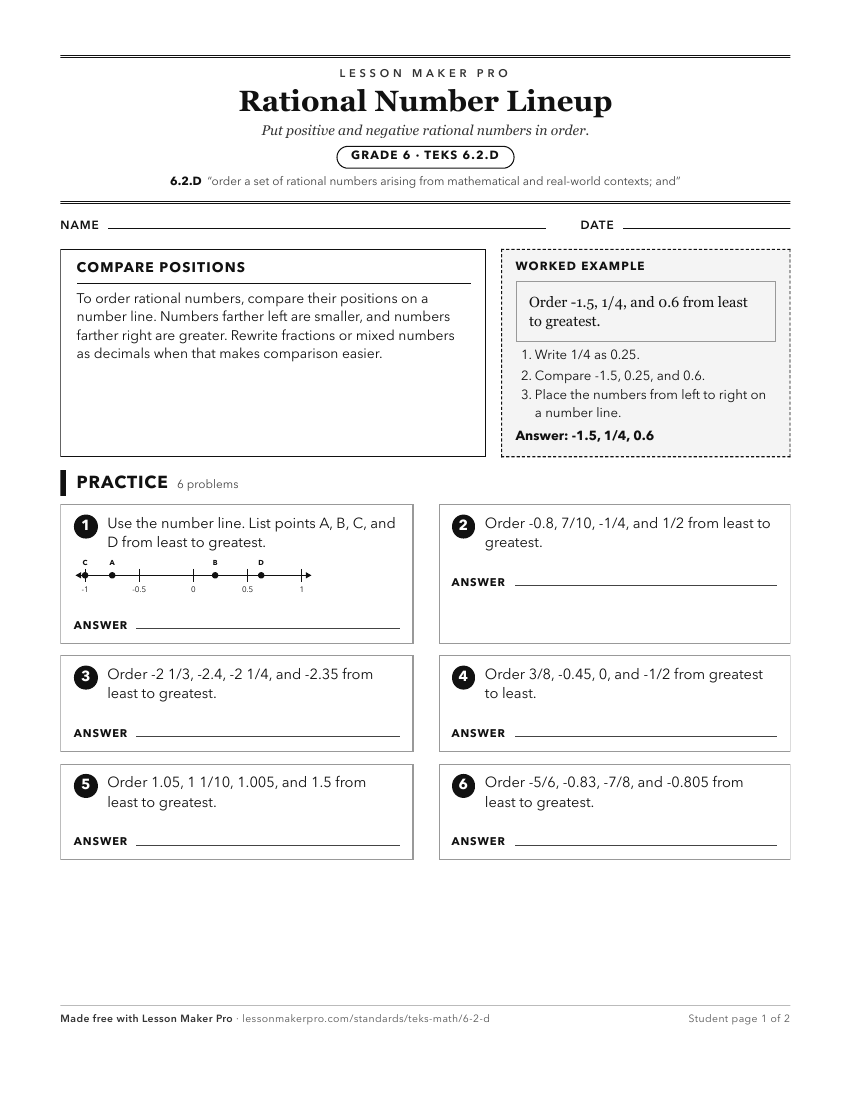
A ready-to-print activity worksheet aligned to 6.2.D, with an answer key for the teacher on its own page. No account needed.
PDF, US Letter, prints cleanly in black and white.
Download the worksheetKeep exploring
Related Standards
- 7.2
The student applies mathematical process standards to represent and use rational numbers in a variety of forms. The student is expected to extend previous know...
- 8.2.D
order a set of real numbers arising from mathematical and real-world contexts
- 6.2
The student applies mathematical process standards to represent and use rational numbers in a variety of forms
- 6.2.C
locate, compare, and order integers and rational numbers using a number line
Turn this exact standard into a lesson
Grade, subject, topic, and the complete standard are prefilled. Create one free, no account needed.
Also for this standard:Make a WorksheetMake a QuizMake a Sub Lesson