TEKS Math 7.2
The Standard
The student applies mathematical process standards to represent and use rational numbers in a variety of forms. The student is expected to extend previous knowledge of sets and subsets using a visual representation to describe relationships between sets of rational numbers
Texas Essential Knowledge and Skills for Mathematics
Teacher's field guide
What This Standard Means
What Students Need to Do
- Students sort rational numbers into natural numbers, whole numbers, and integers. They use nested diagrams to show how these sets overlap and fit inside one another.
What Mastery Looks Like
- Students correctly place natural numbers, whole numbers, and integers within the rational numbers on a nested diagram. They name all sets containing a given number and justify each choice.
Common Misconceptions
- Students often place each number in only one set instead of naming every set it belongs to. They may think negative integers are not rational, or that fractions and terminating decimals belong to separate sets.
How to Assess It
- Give students the numbers -4, 0, 2/3, and 5. Ask them to place each number in a nested set diagram and explain one placement.
Lesson moves
Ways to Teach It
Give groups number cards and nested hoops labeled natural, whole, integer, and rational, then have them place and defend each card.
Ask students to explain why every integer is rational but not every rational number is an integer, using two examples.
Play a sorting relay where teams place fractions, decimals, negatives, and zeros into every set that applies.
Use temperatures, bank balances, recipe amounts, and item counts to identify which rational number sets describe each value.
Free download
Printable 7.2 Worksheet
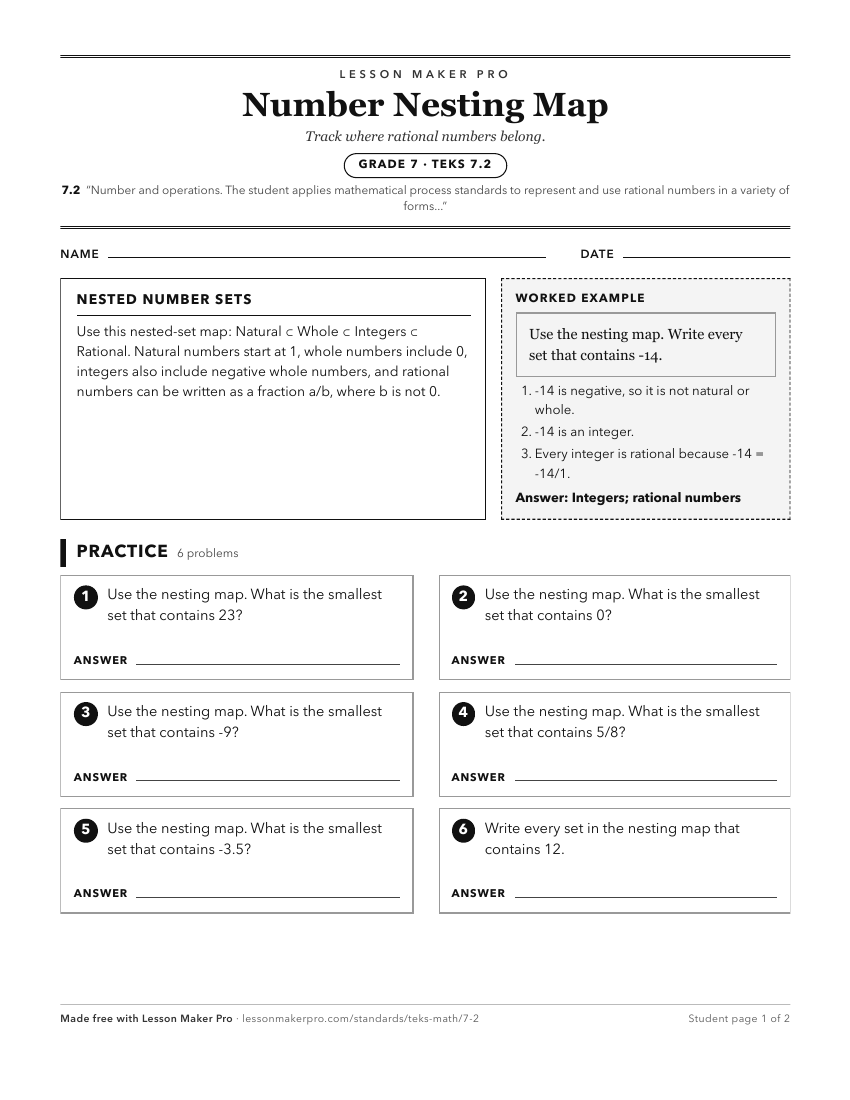
A ready-to-print activity worksheet aligned to 7.2, with an answer key for the teacher on its own page. No account needed.
PDF, US Letter, prints cleanly in black and white.
Download the worksheetKeep exploring
Related Standards
- 5.2
The student applies mathematical process standards to represent, compare, and order positive rational numbers and understand relationships as related to place v...
- 5.3
The student applies mathematical process standards to develop and use strategies and methods for positive rational number computations in order to solve problem...
- 6.2
The student applies mathematical process standards to represent and use rational numbers in a variety of forms
- 8.2
The student applies mathematical process standards to represent and use real numbers in a variety of forms
Turn this exact standard into a lesson
Grade, subject, topic, and the complete standard are prefilled. Create one free, no account needed.
Also for this standard:Make a WorksheetMake a QuizMake a Sub Lesson