TEKS Math 2.7.A
The Standard
determine whether a number up to 40 is even or odd using pairings of objects to represent the number
Texas Essential Knowledge and Skills for Mathematics
Teacher's field guide
What This Standard Means
What Students Need to Do
- Students arrange counted objects into groups of two. They identify a number as even when every object has a partner, or odd when one remains.
What Mastery Looks Like
- Given a numeral or set no greater than 40, students represent the amount accurately and pair all objects. They name it even or odd and explain using whether an object remains.
Common Misconceptions
- Some students judge by how a numeral looks, or think odd means unusual. Others miscount, make groups larger than two, or call a messy arrangement odd.
How to Assess It
- Show a set of 17 dots. Ask students to circle pairs, label the number even or odd, and explain what the leftover shows.
Lesson moves
Ways to Teach It
Give each pair of students 31 counters. Call out numbers, then have them build each set, make pairs, and label it even or odd.
Ask, "How does one leftover object prove a number is odd?" Students draw an example and explain it to a partner.
Play Pairing Race: students draw a number card, count out counters, make pairs, and place the card on an even or odd mat.
Ask students to pack 26 crayons into bags of two, then repeat with 27 and record whether any crayon remains.
Free download
Printable 2.7.A Worksheet
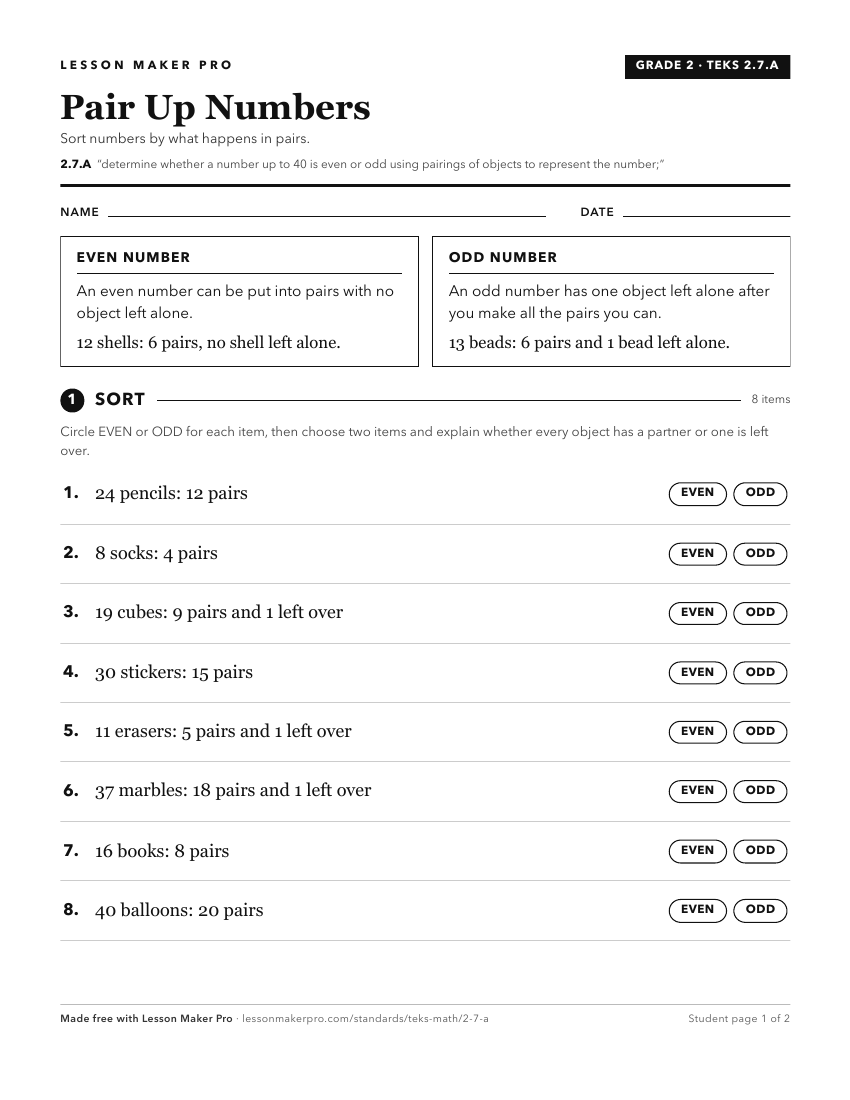
A ready-to-print activity worksheet aligned to 2.7.A, with an answer key for the teacher on its own page. No account needed.
PDF, US Letter, prints cleanly in black and white.
Download the worksheetKeep exploring
Related Standards
- 1.4.C
use relationships to count by twos, fives, and tens to determine the value of a collection of pennies, nickels, and/or dimes
- 1.5.C
use relationships to determine the number that is 10 more and 10 less than a given number up to 120
- 3.4.I
determine if a number is even or odd using divisibility rules
- 1.5.B
skip count by twos, fives, and tens to determine the total number of objects up to 120 in a set
Turn this exact standard into a lesson
Grade, subject, topic, and the complete standard are prefilled. Create one free, no account needed.
Also for this standard:Make a WorksheetMake a QuizMake a Sub Lesson