TEKS Math 1.4.C
The Standard
use relationships to count by twos, fives, and tens to determine the value of a collection of pennies, nickels, and/or dimes
Texas Essential Knowledge and Skills for Mathematics
Teacher's field guide
What This Standard Means
What Students Need to Do
- Students find the value of groups of pennies, nickels, and dimes. They use coin values and skip counting to total the collection efficiently.
What Mastery Looks Like
- Students name each coin and state its value. They group like coins, count by tens, fives, or twos when useful, then give the total in cents.
Common Misconceptions
- Students may think the largest coin is worth the most or count every coin as one cent. They may also lose track when changing from counting dimes to nickels or pennies.
How to Assess It
- Show 3 dimes, 2 nickels, and 4 pennies. Ask students to write the total value and show their counting sequence.
Lesson moves
Ways to Teach It
Give pairs bags of pennies, nickels, and dimes to sort, count, and label with the total value.
Ask, “Why is one dime worth more than one nickel even though the nickel is larger?”
Play Coin Count Match by pairing picture cards of coin collections with cards showing totals in cents.
Set up a classroom store where students choose coins to pay exact prices under 50 cents.
Free download
Printable 1.4.C Worksheet
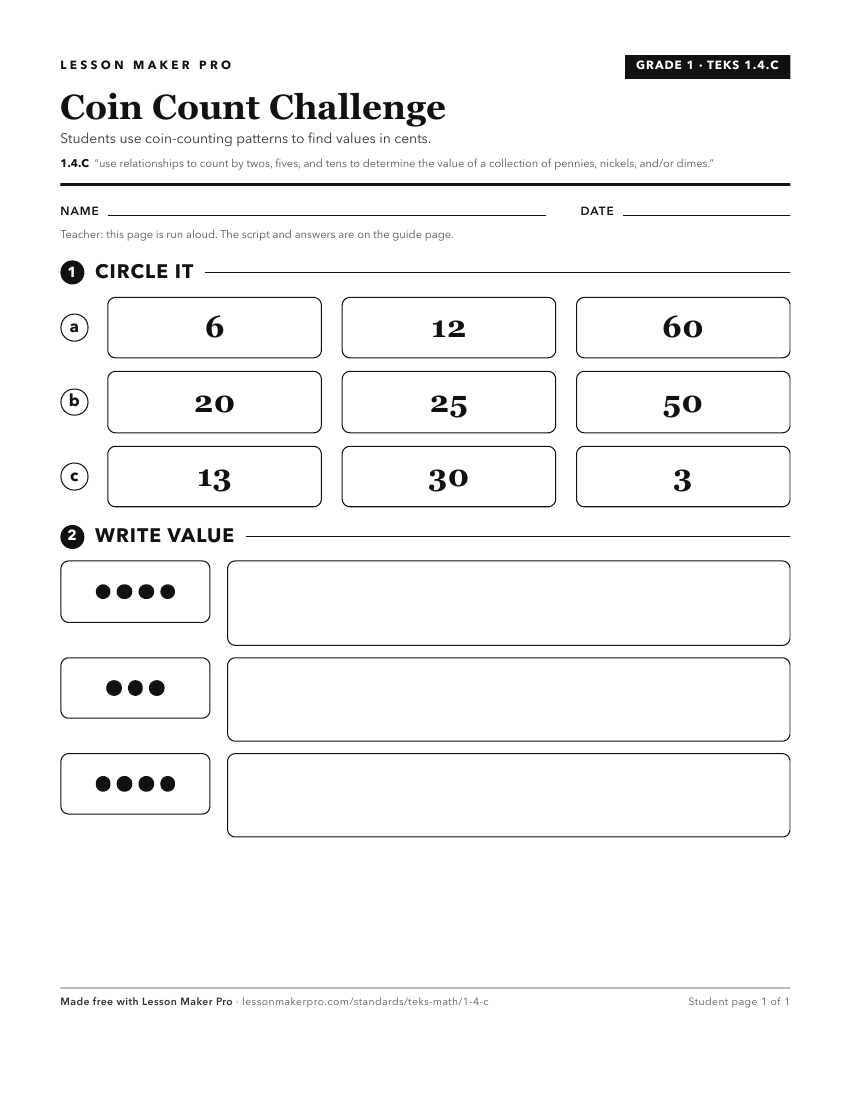
A ready-to-print activity worksheet aligned to 1.4.C, with an answer key for the teacher on its own page. No account needed.
PDF, US Letter, prints cleanly in black and white.
Download the worksheetKeep exploring
Related Standards
- 1.4.A
identify U.S. coins, including pennies, nickels, dimes, and quarters, by value and describe the relationships among them
- K.4
The student applies mathematical process standards to identify coins in order to recognize the need for monetary transactions. The student is expected to identi...
- 1.5.B
skip count by twos, fives, and tens to determine the total number of objects up to 120 in a set
- 3.4.C
determine the value of a collection of coins and bills
Turn this exact standard into a lesson
Grade, subject, topic, and the complete standard are prefilled. Create one free, no account needed.
Also for this standard:Make a WorksheetMake a QuizMake a Sub Lesson