TEKS Math 3.4.I
The Standard
determine if a number is even or odd using divisibility rules
Texas Essential Knowledge and Skills for Mathematics
Teacher's field guide
What This Standard Means
What Students Need to Do
- Students classify whole numbers as even or odd. They use the ones digit to decide and explain the result using pairs.
What Mastery Looks Like
- Students correctly classify one-digit and multi-digit numbers as even or odd. They explain that numbers ending in 0, 2, 4, 6, or 8 can be arranged in pairs.
Common Misconceptions
- Students may check every digit instead of only the ones digit. They may think 0 is odd, or that a large number cannot be even.
How to Assess It
- Exit ticket: Label 246, 371, and 905 as even or odd. Circle each ones digit and explain one answer.
Lesson moves
Ways to Teach It
Give students counters and number cards, then have them build pairs to test whether each number has a counter left over.
Ask students to explain why 438 and 738 must both be even without counting or making groups.
Play a card sort where teams place number cards under even or odd headings and justify any challenged placement.
Use classroom objects, such as 27 pencils or 32 books, and ask whether everyone could receive items in pairs with none left over.
Free download
Printable 3.4.I Worksheet
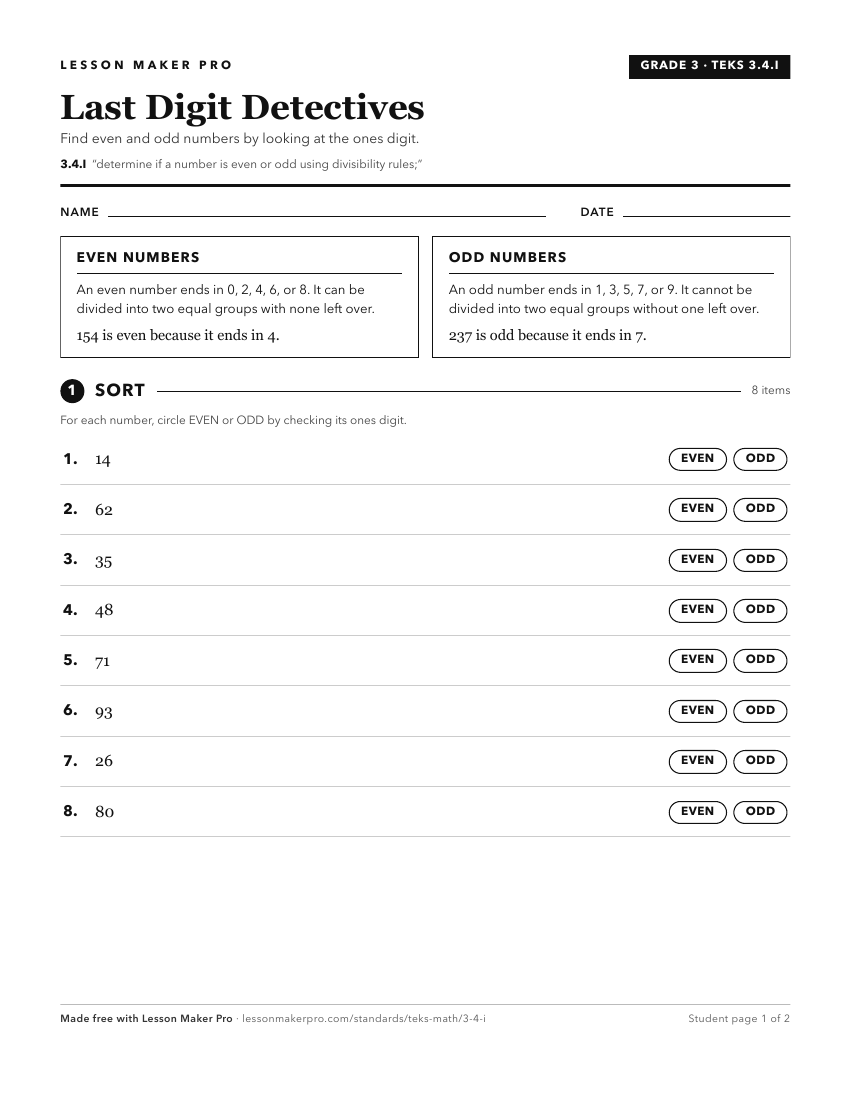
A ready-to-print activity worksheet aligned to 3.4.I, with an answer key for the teacher on its own page. No account needed.
PDF, US Letter, prints cleanly in black and white.
Download the worksheetKeep exploring
Related Standards
- 2.7.A
determine whether a number up to 40 is even or odd using pairings of objects to represent the number
- 4.4.F
use strategies and algorithms, including the standard algorithm, to divide up to a four-digit dividend by a one-digit divisor
- 3.4.J
determine a quotient using the relationship between multiplication and division
- 5.3.G
solve for quotients of decimals to the hundredths, up to four-digit dividends and two-digit whole number divisors, using strategies and algorithms, including th...
Turn this exact standard into a lesson
Grade, subject, topic, and the complete standard are prefilled. Create one free, no account needed.
Also for this standard:Make a WorksheetMake a QuizMake a Sub Lesson