TEKS Math 2.2.B
The Standard
use standard, word, and expanded forms to represent numbers up to 1,200
Texas Essential Knowledge and Skills for Mathematics
Teacher's field guide
What This Standard Means
What Students Need to Do
- Students read and write numbers through 1,200 in standard, word, and expanded forms. They show how each digit's place determines its value.
What Mastery Looks Like
- Students can represent any number through 1,200 in standard, word, and expanded form. They can move accurately between all three forms and use zero as a placeholder when needed.
Common Misconceptions
- Students may write 642 as 60042 or expand it as 6 + 4 + 2. They may also confuse number words such as fourteen and forty or omit zero placeholders in numbers like 1,005.
How to Assess It
- Give students the number 1,072. Ask them to write it in word form and expanded form, then explain what the zero means.
Lesson moves
Ways to Teach It
Give pairs base-ten blocks to build a number, then record its standard, word, and expanded forms on a place-value mat.
Display 1,105 and ask students to write how they know the value of each digit, including the zero.
Play a matching game with cards showing standard, word, and expanded forms for the same numbers.
Use a store receipt total, such as 1,148 cents, and have students represent the amount in all three forms.
Free download
Printable 2.2.B Worksheet
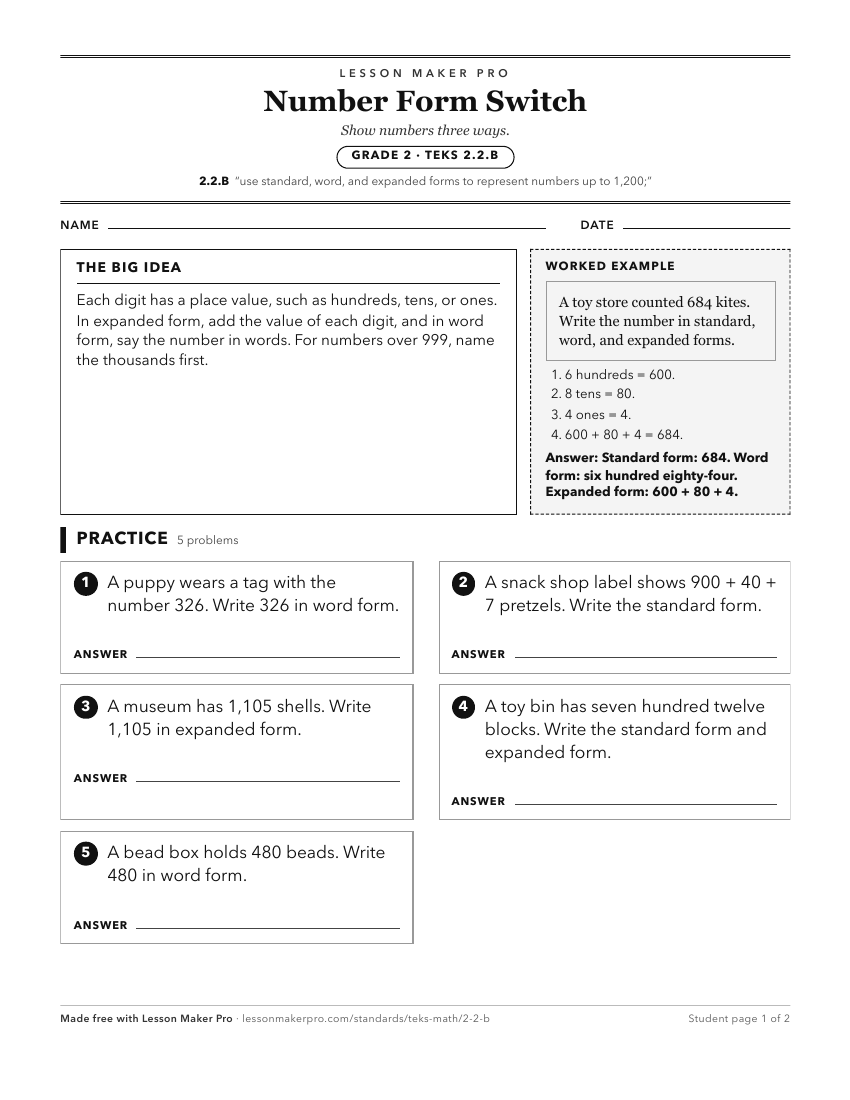
A ready-to-print activity worksheet aligned to 2.2.B, with an answer key for the teacher on its own page. No account needed.
PDF, US Letter, prints cleanly in black and white.
Download the worksheetKeep exploring
Related Standards
- 1.2.C
use objects, pictures, and expanded and standard forms to represent numbers up to 120
- K.2.H
use comparative language to describe two numbers up to 20 presented as written numerals
- 2.7.B
use an understanding of place value to determine the number that is 10 or 100 more or less than a given number up to 1,200
- 2.2.D
use place value to compare and order whole numbers up to 1,200 using comparative language, numbers, and symbols (>, <, or =)
Turn this exact standard into a lesson
Grade, subject, topic, and the complete standard are prefilled. Create one free, no account needed.
Also for this standard:Make a WorksheetMake a QuizMake a Sub Lesson