TEKS ELAR K.10.D.i
The Standard
complete sentences
Texas Essential Knowledge and Skills for English Language Arts and Reading · The student uses the writing process recursively to compose multiple texts that are legible and uses appropriate conventions.
Teacher's field guide
What This Standard Means
What Students Need to Do
- Students reread a draft with an adult and check that each sentence tells a whole idea. They add missing words so the reader knows who or what is involved and what happened.
What Mastery Looks Like
- Given a short draft and a teacher prompt, a student can spot a word group that feels unfinished. The student can revise it into a full thought and read it aloud to confirm it makes sense.
Common Misconceptions
- Students may think any line of words is a sentence, especially if it starts with a capital or ends with a period. They may write fragments such as “The red dog” or leave out the subject, as in “Ran to me.”
How to Assess It
- Give students “The little cat.” Ask, “Is this a whole thought? Add words to tell what the cat did, then read your new sentence aloud.”
Lesson moves
Ways to Teach It
Give pairs word cards for “The frog,” “jumps,” and “into the pond”; have them build, read, and illustrate the finished sentence.
Show “My friend” and ask, “What does your friend do?” Record answers, then have students write one finished idea.
Play Sentence or Not: read word groups aloud, and students hold up a green card for finished ideas or red for unfinished ones.
Examine classroom signs and lunch notes, then revise one unfinished message so another person knows what happened or what to do.
Free download
Printable K.10.D.i Worksheet
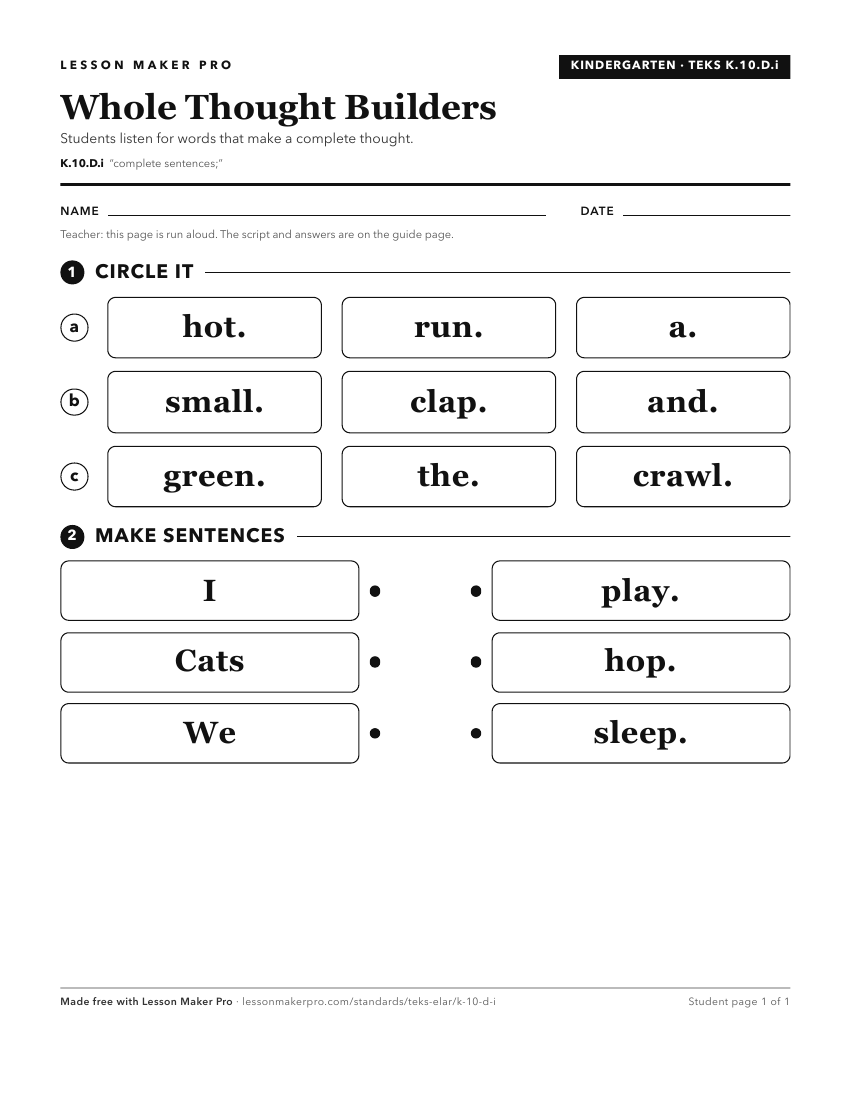
A ready-to-print activity worksheet aligned to K.10.D.i, with an answer key for the teacher on its own page. No account needed.
PDF, US Letter, prints cleanly in black and white.
Download the worksheetKeep exploring
Related Standards
- 6.10.D.i
complete complex sentences with subject-verb agreement and avoidance of splices, run-ons, and fragments;
- 8.10.D.i
complete complex sentences with subject-verb agreement and avoidance of splices, run-ons, and fragments;
- 2.11.D.i
complete sentences with subject-verb agreement;
- 1.11.D.i
complete sentences with subject-verb agreement;
Turn this exact standard into a lesson
Grade, subject, topic, and the complete standard are prefilled. Create one free, no account needed.
Also for this standard:Make a WorksheetMake a QuizMake a Sub Lesson