TEKS ELAR 8.9
Knowledge and Skills Statement (Standard Cluster)
The student uses critical inquiry to analyze the authors' choices and how they influence and communicate meaning within a variety of texts. The student analyzes and applies author's craft purposefully in order to develop his or her own products and performances.
Texas Essential Knowledge and Skills for English Language Arts and Reading
Cluster contents
Student Expectations in This Statement
8.9 is a knowledge and skills statement. These are the student expectations under it.
- 8.9.A
explain the author's purpose and message within a text
- 8.9.B
analyze how the use of text structure contributes to the author's purpose
- 8.9.C
analyze the author's use of print and graphic features to achieve specific purposes
- 8.9.D
describe how the author's use of figurative language such as extended metaphor achieves specific purposes
- 8.9.E
identify and analyze the use of literary devices, including multiple points of view and irony
- 8.9.F
analyze how the author's use of language contributes to the mood, voice, and tone
- 8.9.G
explain the purpose of rhetorical devices such as analogy and juxtaposition and of logical fallacies such as bandwagon appeals and circular reasoning.
Teacher's field guide
What This Cluster Means
What Students Need to Do
- Students determine what an author wants readers to think, feel, or do. They explain how structure, visuals, word choice, figurative language, viewpoint, irony, and arguments shape meaning. They use similar choices intentionally in their own writing or presentations.
What Mastery Looks Like
- Students state a clear purpose and message, then support their explanation with precise evidence. They explain how structure, language, visuals, or literary devices shape meaning. They also use selected craft moves deliberately in their own work.
Common Misconceptions
- Students may confuse the topic with the author’s message or purpose. They may name a device without explaining its effect. They also confuse mood with tone and treat analogies or popular claims as proof.
How to Assess It
- Give students a short editorial with an image and one rhetorical device. Ask: “What is the author trying to communicate, and how do two specific choices help achieve that purpose?”
Lesson moves
Ways to Teach It
Cut apart a short article by section, have groups rebuild it, then explain how the final order supports the author’s purpose.
Compare two passages on the same issue and write which author creates the stronger tone, citing two language choices.
Play a card sort matching examples of irony, analogy, juxtaposition, bandwagon appeals, and circular reasoning with their effects.
Analyze a product advertisement’s image, slogan, and claims, then revise it to target a different audience or purpose.
Free download
Printable 8.9 Worksheet
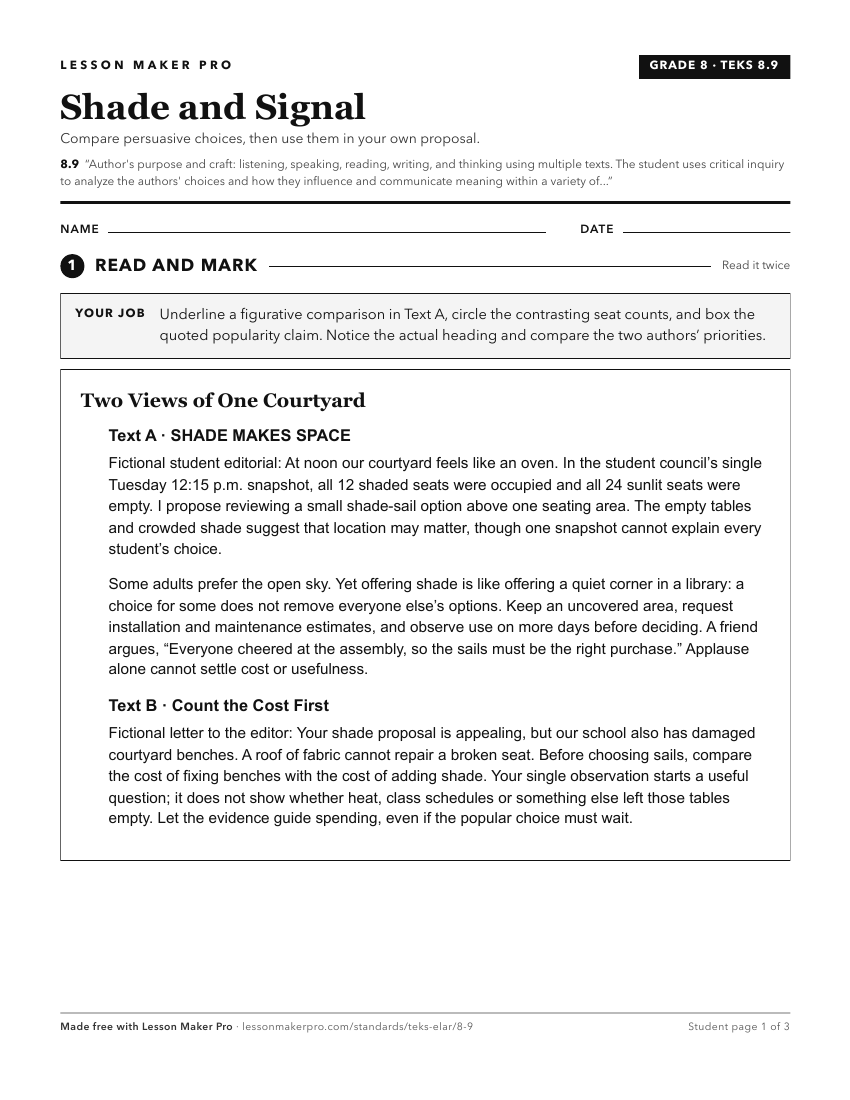
A ready-to-print activity worksheet aligned to 8.9, with an answer key for the teacher on its own page. No account needed.
PDF, US Letter, prints cleanly in black and white.
Download the worksheetKeep exploring
Related Standards
Turn this cluster into a lesson
Grade, subject, topic, and the complete cluster are prefilled. Create one free, no account needed.
Also for this cluster:Make a WorksheetMake a QuizMake a Sub Lesson