TEKS ELAR 3.10
Knowledge and Skills Statement (Standard Cluster)
The student uses critical inquiry to analyze the authors' choices and how they influence and communicate meaning within a variety of texts. The student analyzes and applies author's craft purposefully in order to develop his or her own products and performances.
Texas Essential Knowledge and Skills for English Language Arts and Reading
Cluster contents
Student Expectations in This Statement
3.10 is a knowledge and skills statement. These are the student expectations under it.
- 3.10.A
explain the author's purpose and message within a text
- 3.10.B
explain how the use of text structure contributes to the author's purpose
- 3.10.C
explain the author's use of print and graphic features to achieve specific purposes
- 3.10.D
describe how the author's use of imagery, literal and figurative language such as simile, and sound devices such as onomatopoeia achieves specific purposes
- 3.10.E
identify the use of literary devices, including first- or third-person point of view
- 3.10.F
discuss how the author's use of language contributes to voice
- 3.10.G
identify and explain the use of hyperbole.
Teacher's field guide
What This Cluster Means
What Students Need to Do
- Students explain why an author wrote a text and what message the author communicates. They show how structure, graphics, point of view, imagery, figurative language, sound words, hyperbole, and voice support that purpose. They use some of these choices in their own writing.
What Mastery Looks Like
- Students state the author’s purpose and message using evidence from the text. They identify craft choices and explain how each choice affects meaning, voice, or reader response. They can use a chosen craft move in their own writing.
Common Misconceptions
- Students may name a purpose, such as inform, but not explain the message. They often spot a simile, graphic, or sound word without explaining its effect. They may confuse the narrator with the author or treat every exaggeration as hyperbole.
How to Assess It
- Give students a short passage with a heading, illustration, simile, and clear narrator. Ask them to state the purpose and message, then explain how two craft choices support the purpose.
Lesson moves
Ways to Teach It
Give pairs sentence strips showing craft choices and purpose cards, then have them match each choice to its likely effect.
Ask students to write: Which author choice most shaped the message, and what would change if the author removed it?
Play Craft Detective bingo using examples of simile, onomatopoeia, hyperbole, point of view, imagery, text structure, and graphic features.
Compare a cereal box with a short news article, then list how each uses words, print, and images to influence readers.
Free download
Printable 3.10 Worksheet
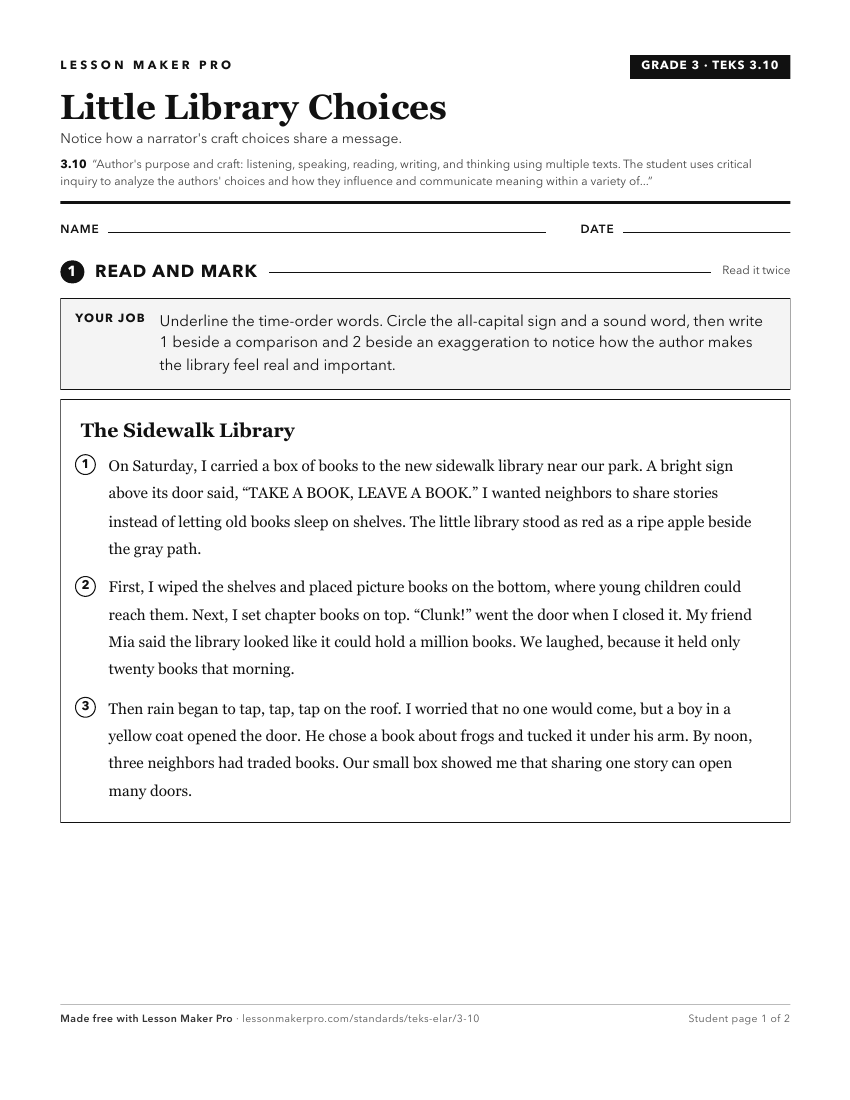
A ready-to-print activity worksheet aligned to 3.10, with an answer key for the teacher on its own page. No account needed.
PDF, US Letter, prints cleanly in black and white.
Download the worksheetKeep exploring
Related Standards
Turn this cluster into a lesson
Grade, subject, topic, and the complete cluster are prefilled. Create one free, no account needed.
Also for this cluster:Make a WorksheetMake a QuizMake a Sub Lesson