TEKS ELAR 3.10.C
The Standard
explain the author's use of print and graphic features to achieve specific purposes
Texas Essential Knowledge and Skills for English Language Arts and Reading
Teacher's field guide
What This Standard Means
What Students Need to Do
- Students identify print and graphic features in a text. They explain how each feature helps the author organize information, show details, or guide the reader.
What Mastery Looks Like
- Students correctly identify features such as headings, bold words, captions, diagrams, and photographs. They explain a specific purpose, such as locating information, clarifying an idea, or showing details.
Common Misconceptions
- Students may name a feature without explaining what it helps the reader do. They may confuse a caption with a heading or assume pictures are only decorative.
How to Assess It
- Give students a short page with a bold heading, diagram, and caption. Ask them to choose one feature and write how it helps the reader.
Lesson moves
Ways to Teach It
Give pairs a magazine page and sticky notes to label each print or graphic feature and state its purpose.
Ask, "How would this page be harder to understand without the diagram or heading?" Students discuss, then write one response.
Play Feature Match by having students pair cards showing text features with cards naming purposes such as organize, explain, locate, or compare.
Compare a weather website and printed forecast, then identify how icons, maps, headings, and bold numbers help readers find information.
Free download
Printable 3.10.C Worksheet
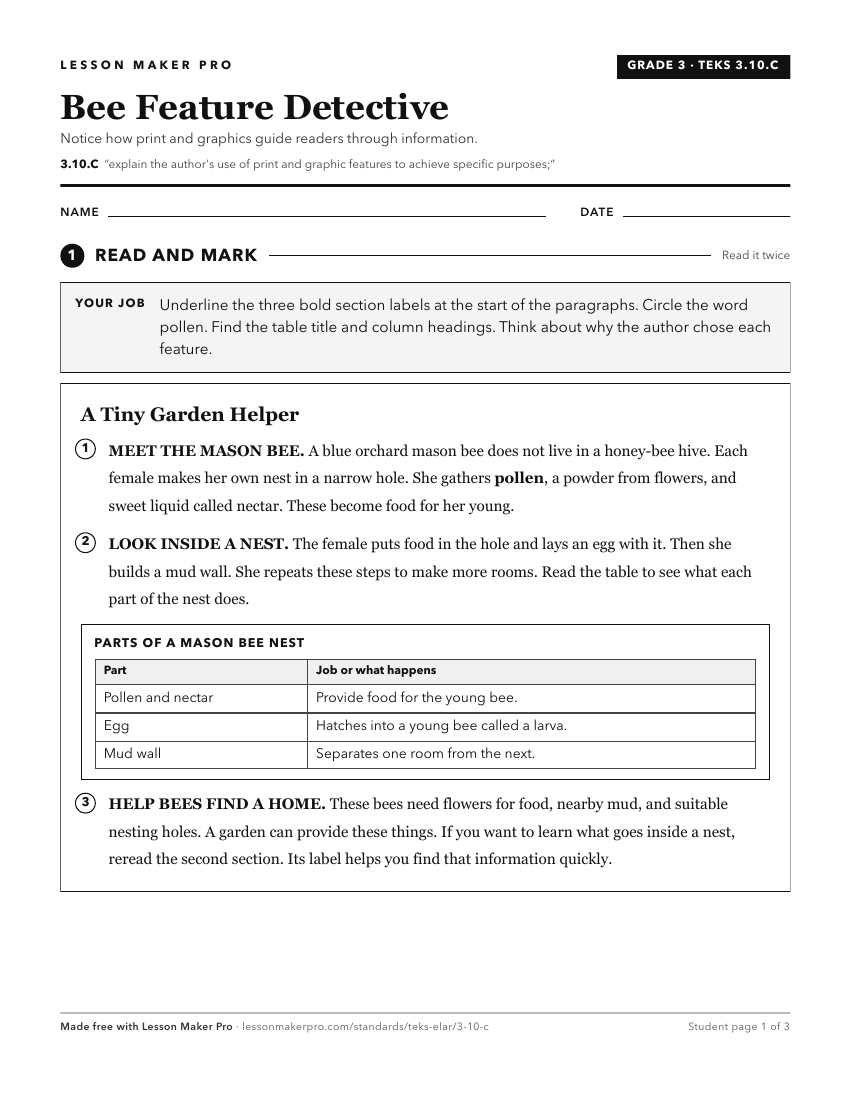
A ready-to-print activity worksheet aligned to 3.10.C, with an answer key for the teacher on its own page. No account needed.
PDF, US Letter, prints cleanly in black and white.
Download the worksheetKeep exploring
Related Standards
- 6.9.C
analyze the author's use of print and graphic features to achieve specific purposes;
- 2.10.C
discuss the author's use of print and graphic features to achieve specific purposes;
- 5.10.C
analyze the author's use of print and graphic features to achieve specific purposes;
- 4.10.C
analyze the author's use of print and graphic features to achieve specific purposes;
Turn this exact standard into a lesson
Grade, subject, topic, and the complete standard are prefilled. Create one free, no account needed.
Also for this standard:Make a WorksheetMake a QuizMake a Sub Lesson