TEKS ELAR 5.10.C
The Standard
analyze the author's use of print and graphic features to achieve specific purposes
Texas Essential Knowledge and Skills for English Language Arts and Reading
Teacher's field guide
What This Standard Means
What Students Need to Do
- Students examine print and graphic features in a text. They explain what each feature helps the author do and how it affects the reader's understanding.
What Mastery Looks Like
- Students identify features such as headings, bold print, captions, diagrams, maps, and charts. They use page evidence to explain how each feature organizes, emphasizes, clarifies, or adds information.
Common Misconceptions
- Students may name a feature without explaining its purpose. They may say every picture is decorative or confuse what a feature shows with why the author included it.
How to Assess It
- Give students a nonfiction page with a heading, bold word, and diagram. Ask them to choose one feature and explain how it helps the author communicate information.
Lesson moves
Ways to Teach It
Give pairs a cut-up article to rebuild, then have them explain where each heading, caption, photo, and diagram belongs.
Ask students to write: Which feature helps you understand the page most, and what would be harder without it?
Play Feature Match by pairing cards showing headings, maps, charts, and bold words with cards naming their likely purposes.
Examine a weather website and discuss how maps, icons, color, headings, and charts help readers make plans.
Free download
Printable 5.10.C Worksheet
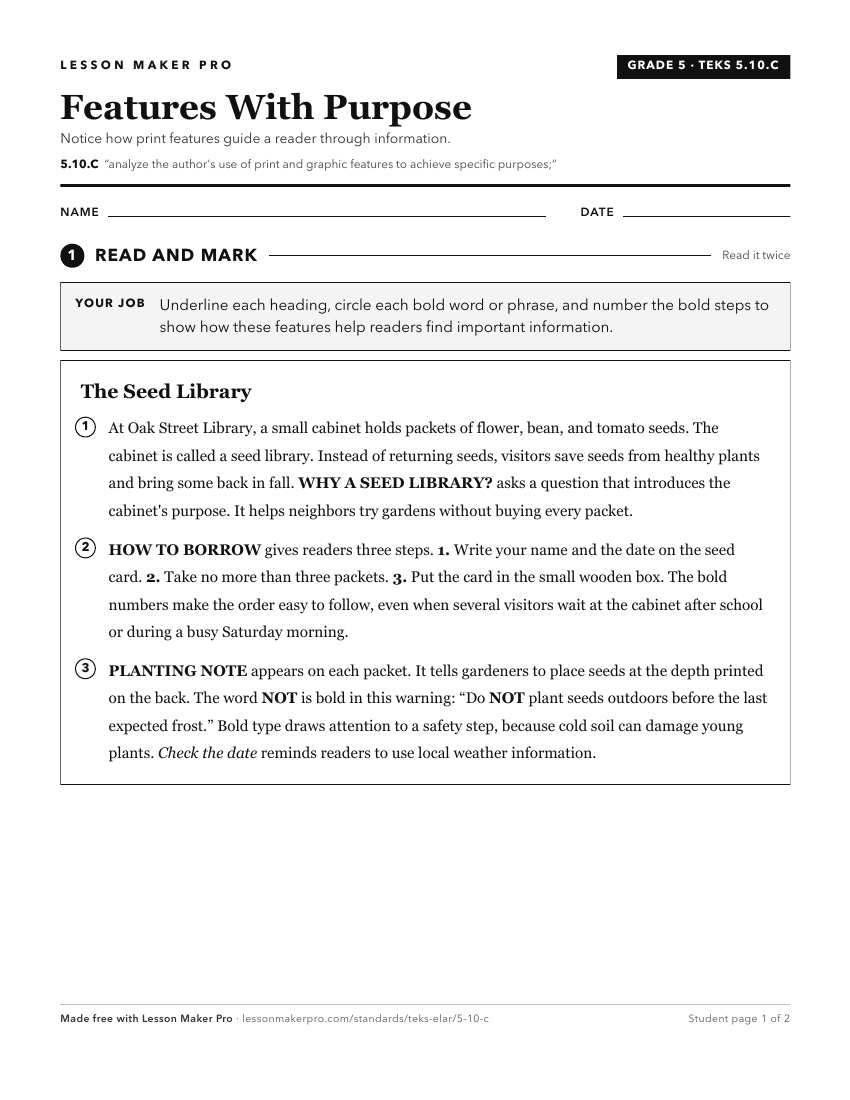
A ready-to-print activity worksheet aligned to 5.10.C, with an answer key for the teacher on its own page. No account needed.
PDF, US Letter, prints cleanly in black and white.
Download the worksheetKeep exploring
Related Standards
Turn this exact standard into a lesson
Grade, subject, topic, and the complete standard are prefilled. Create one free, no account needed.
Also for this standard:Make a WorksheetMake a QuizMake a Sub Lesson